
Unveiling How Many Batteries In Golf Cart: A Guide
A golf cart usually has 4, 6, or 8 batteries. The exact number depends on the cart’s total power, also called its voltage. Most golf carts run on 36 volts or 48 volts, but some stronger carts use 72 volts. Each battery in the cart has its own voltage, like 6 volts, 8 volts, or 12 volts. These smaller batteries link together to make the cart’s total voltage. Knowing how many batteries are in your golf cart, and what kind, is key to keeping it running well. This guide will help you understand all about golf cart batteries.
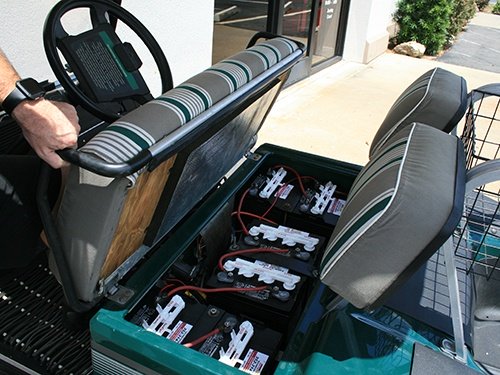
Image Source: jsgolfcarts.com
Deciphering Golf Cart Battery Systems
Golf carts need a lot of power. They use special deep-cycle batteries. These batteries give out power over a long time, unlike car batteries that give a quick burst to start an engine. The golf cart battery voltage is the main thing that decides how many batteries your cart needs.
Grasping Golf Cart Battery Types
Before we talk about numbers, let’s look at the main types of batteries golf carts use. Each type works a bit differently.
Lead-Acid Batteries
Most golf carts still use lead-acid batteries. They are often cheaper upfront. There are three main kinds:
- Flooded Lead-Acid (FLA): These are the most common. They have liquid inside (electrolyte). You need to add distilled water to them often. They are strong and last a long time if you care for them right.
- Sealed Lead-Acid (SLA): These batteries are sealed. You don’t need to add water. They come in two types:
- Absorbed Glass Mat (AGM): In AGM batteries, the electrolyte is held in fiberglass mats. They don’t spill and handle bumps well. They charge faster than FLA and need less care.
- Gel Cell: Gel batteries have the electrolyte mixed into a thick gel. They also don’t spill. They are very good for slow use over time. But they can cost more and charge slower than AGM.
Lithium-ion Batteries
Lithium-ion batteries are newer for golf carts. They are becoming more popular.
* Pros:
* Lighter weight: This can make your cart go faster and use less power.
* Longer golf cart battery life: They can last 2 to 3 times longer than lead-acid batteries.
* No maintenance: You don’t need to add water.
* Charge faster: They can fully charge in a few hours.
* More power: They give steady power, even when low on charge.
* Cons:
* Higher upfront cost: They cost a lot more to buy at first.
Choosing the right golf cart battery types matters for your cart’s power and how much care it needs.
How Many Batteries For Your Cart’s Voltage
The total golf cart battery voltage of your cart tells you how many batteries it will have. This is usually 36V, 48V, or 72V.
36-Volt Golf Cart Battery Quantity
A 36-volt golf cart uses batteries that add up to 36 volts. There are a few ways to get this total:
- Six 6-volt batteries: This is the most common setup for 36V carts. You will see six batteries, each giving 6 volts.
- Three 12-volt batteries: Some 36V carts use three 12-volt batteries. This is less common but still works.
So, for a 36-volt cart, you will likely have 6 batteries.
48-Volt Golf Cart Battery Setup
A 48-volt golf cart is more powerful than a 36-volt one. It uses batteries that add up to 48 volts. Here are the common ways:
- Six 8-volt batteries: This is the most common setup for 48V carts. You will find six batteries, each giving 8 volts.
- Four 12-volt batteries: Another common way is to use four 12-volt batteries. This also adds up to 48 volts.
- Eight 6-volt batteries: Less often, you might see eight 6-volt batteries in a 48V cart.
So, for a 48-volt cart, you will usually have 4 or 6 batteries.
72-Volt Golf Cart Battery Systems
Some high-performance golf carts, or those made for tough jobs, use 72 volts. These carts need more batteries to reach that voltage:
- Six 12-volt batteries: This is the most common for 72V carts. Six batteries, each 12 volts, add up to 72 volts.
- Nine 8-volt batteries: Sometimes, nine 8-volt batteries are used.
- Twelve 6-volt batteries: You might also see twelve 6-volt batteries.
Here’s a quick look at common setups:
| Cart Voltage | Individual Battery Voltage | Number of Batteries |
|---|---|---|
| 36V | 6 volts | 6 |
| 36V | 12 volts | 3 |
| 48V | 8 volts | 6 |
| 48V | 12 volts | 4 |
| 48V | 6 volts | 8 |
| 72V | 12 volts | 6 |
| 72V | 8 volts | 9 |
| 72V | 6 volts | 12 |
This table helps you quickly see the golf cart battery quantity based on your cart’s total voltage.
Specific Battery Voltages and Their Counts
Let’s look closer at each common battery voltage.
6 Volt Golf Cart Battery Count
6-volt batteries are very popular in golf carts. They are known for being tough and long-lasting.
* If your cart is 36 volts, you will use six 6-volt batteries.
* If your cart is 48 volts, you will use eight 6-volt batteries. (Less common for 48V, but possible).
* If your cart is 72 volts, you will use twelve 6-volt batteries.
These batteries are big and heavy. They need regular water checks if they are flooded lead-acid type.
8 Volt Golf Cart Battery Arrangement
8-volt batteries are often found in 48-volt golf carts.
* If your cart is 48 volts, you will use six 8-volt batteries. This is a very common setup for 48V carts.
* If your cart is 72 volts, you will use nine 8-volt batteries.
8-volt batteries are a good middle ground. They give more power than 6-volt ones but are not as big as 12-volt ones.
12 Volt Golf Cart Battery Configuration
12-volt batteries are what you might find in a car. In golf carts, they are used to make up higher voltages with fewer batteries.
* If your cart is 36 volts, you will use three 12-volt batteries.
* If your cart is 48 volts, you will use four 12-volt batteries. This is another very common setup for 48V carts.
* If your cart is 72 volts, you will use six 12-volt batteries.
While 12-volt batteries mean fewer batteries to check, they sometimes have less capacity for deep discharge compared to 6-volt or 8-volt deep-cycle batteries built for golf carts. This can mean shorter run times.
Golf Cart Battery Series Parallel Connections
Almost all golf cart batteries are wired in series. This means the positive (+) terminal of one battery connects to the negative (-) terminal of the next battery. Wiring batteries in series adds up their voltages. For example:
* Six 6-volt batteries in series: 6V + 6V + 6V + 6V + 6V + 6V = 36V.
* Six 8-volt batteries in series: 8V + 8V + 8V + 8V + 8V + 8V = 48V.
* Four 12-volt batteries in series: 12V + 12V + 12V + 12V = 48V.
Parallel wiring connects positive to positive and negative to negative. This increases the total power (amp-hours) but keeps the voltage the same. This is very rare in golf carts. Golf carts need higher voltage to run, so series wiring is key.
When you replace batteries or check connections, make sure they are wired in series correctly. Wrong wiring can damage your cart or batteries.
Replacing Golf Cart Batteries
When it’s time for replacing golf cart batteries, it’s a job you can do yourself. But you need to be careful. Batteries are heavy and hold a lot of power.
Signs You Need New Batteries
- Your cart goes slower or doesn’t go as far.
- The charger runs for a very long time, or not at all.
- Batteries look swollen or have cracks.
- Battery fluid (for flooded types) is low often, even after filling.
- Your batteries are old (5-7 years for lead-acid, 8-10+ for lithium).
What You Need
- New batteries (make sure they are the same voltage and type as your old ones).
- Wrench for battery terminals (usually 1/2 or 9/16 inch).
- Battery terminal puller (optional, but helpful).
- Wire brush for cleaning terminals.
- Baking soda and water mix for cleaning acid.
- Battery terminal protector spray.
- Safety gear: Rubber gloves, safety glasses, old clothes.
Steps to Replace Batteries
- Safety First: Turn off the cart’s main power switch. Take the key out. Put on your safety glasses and gloves.
- Take Pictures: Before you unhook anything, take clear photos of how the cables are connected. This is very important for putting the new ones back in right. Labeling cables also helps.
- Disconnect Cables: Start with the main negative (-) cable from the entire battery pack (usually goes to the cart frame or motor). Then, remove the negative (-) cable from each battery. After that, remove all positive (+) cables. Keep track of which cable goes where.
- Remove Old Batteries: They are heavy! Lift them carefully. Ask for help if needed.
- Clean the Battery Tray: Use the baking soda and water mix to clean up any acid, rust, or dirt. Rinse with clean water. Dry the tray completely.
- Place New Batteries: Put the new batteries in the tray in the same way the old ones were. Make sure they are stable.
- Connect New Cables:
- First, connect the cables that link the batteries together (series connections). Connect positive (+) of one battery to negative (-) of the next. Use your photos!
- Make sure connections are tight.
- After all linking cables are on, connect the main positive (+) cable to the battery pack.
- Finally, connect the main negative (-) cable to the battery pack.
- Clean and Protect: Clean all new terminals with a wire brush. Spray battery terminal protector on them.
- Check and Charge: Double-check all connections. Make sure no tools are left on the batteries. Plug in your charger and let the batteries get a full charge before using the cart.
Warning: Always connect negative cables first and disconnect positive cables last when connecting to the cart’s main system. But when connecting batteries in a series, connect negative to positive between batteries. The very last cable you connect is the main negative one that goes to the cart. If unsure, call a professional.
Extending Golf Cart Battery Life
The golf cart battery life can vary a lot. Lead-acid batteries usually last 3-7 years. Lithium-ion batteries can last 8-10+ years. How you care for them makes a huge difference.
Charging Habits
- Charge after every use: Even if you only drove a short distance, charge the batteries. Deep discharge (letting them run almost completely dead) hurts them.
- Don’t overcharge: Most modern chargers stop when full. But cheap ones might not. Overcharging can dry out flooded batteries or harm sealed ones.
- Don’t undercharge: Always let the charger finish its cycle.
- Charge in a cool, dry place: Extreme heat or cold can harm charging.
Water Levels (for Flooded Lead-Acid Batteries)
- Check water often: Every 1-2 months, lift the caps and look at the water level. It should be just above the plates inside.
- Add distilled water: If low, add only distilled water. Never tap water. Add water after charging, unless the plates are exposed before charging (then add just enough to cover them, then charge, then fill properly).
- Don’t overfill: Leave a little space for the electrolyte to expand.
Cleaning and Maintenance
- Keep terminals clean: Battery terminals can get corroded (white or blue stuff). This stops power flow. Clean them with a wire brush and a mix of baking soda and water. Rinse and dry.
- Keep batteries tight: Make sure the hold-down straps are snug. Loose batteries can bounce and get damaged.
- Inspect cables: Check for frayed or damaged cables. Replace them if needed.
Storage
- Fully charge before storing: If storing your cart for winter or a long time, fully charge the batteries.
- Use a smart charger: A “smart” or “maintainer” charger can keep batteries topped off during storage without overcharging.
- Check charge monthly: Even with a smart charger, check the battery charge every month or so.
- Disconnect batteries: For very long storage, disconnect the main negative cable. This stops any small power drain.
Following these tips will help you get the most out of your golf cart batteries. A little care goes a long way in saving money on replacements.
Final Thoughts
Knowing how many batteries are in your golf cart is important. It helps you understand your cart’s power and how to care for it. Whether you have a 36V or 48V system, the number and type of batteries change. Remember, the goal is always to have the right golf cart battery voltage for your system. Caring for your batteries, checking them often, and replacing them safely when needed will keep your golf cart running smoothly for years. Taking care of your batteries means more time enjoying your cart and less time worrying about power.
Frequently Asked Questions (FAQ)
Q1: How can I tell if my golf cart is 36V or 48V?
A1: The easiest way is to look at the batteries. Count how many batteries there are and check the voltage printed on each one (e.g., 6V, 8V, 12V). Multiply the number of batteries by the individual battery voltage. For example, six 6V batteries mean a 36V system (6×6=36). Six 8V batteries mean a 48V system (6×8=48).
Q2: Can I mix different battery voltages in my golf cart?
A2: No, never. All batteries in your golf cart must be the same voltage and type. Mixing them can damage your batteries, charger, or even the golf cart itself.
Q3: Can I use car batteries in my golf cart?
A3: No. Car batteries are “starting” batteries. They give a lot of power quickly to start an engine. Golf carts need “deep-cycle” batteries. These batteries give power slowly over a long time. Using car batteries will shorten their life and not power your cart well.
Q4: How often should I add water to my flooded lead-acid golf cart batteries?
A4: You should check the water levels every 1-2 months, or more often if you use your cart a lot or live in a hot climate. Only add distilled water.
Q5: My golf cart batteries are not charging. What could be wrong?
A5: First, check if the charger is plugged in and working. Then, check all battery cable connections. Make sure they are tight and clean. A bad connection can stop charging. If all looks good, it might be a bad battery, a bad charger, or a problem with the cart’s charging system. You might need a professional to check it.
Q6: What is the best way to clean battery corrosion?
A6: Mix baking soda and water to make a paste. Spread it on the corroded areas. It will fizz. Let it sit, then scrub with a wire brush. Rinse with clean water and dry completely. Wear gloves and safety glasses.
Q7: Is it worth upgrading to lithium-ion golf cart batteries?
A7: It depends on your budget and how you use your cart. Lithium-ion batteries cost more at first. But they last longer, are lighter, need no water, and charge faster. If you use your cart often and plan to keep it for many years, the extra cost might be worth it over time.