
A golf scramble is a popular and fun team golf format where players work together to shoot the lowest score. It’s often used in golf tournaments because it’s inclusive and speeds up play. How does a golf scramble work? Simply put, each player on the team hits a shot, the team chooses the best shot among them, and then all players hit their next shot from that spot. This continues until the ball is in the hole.
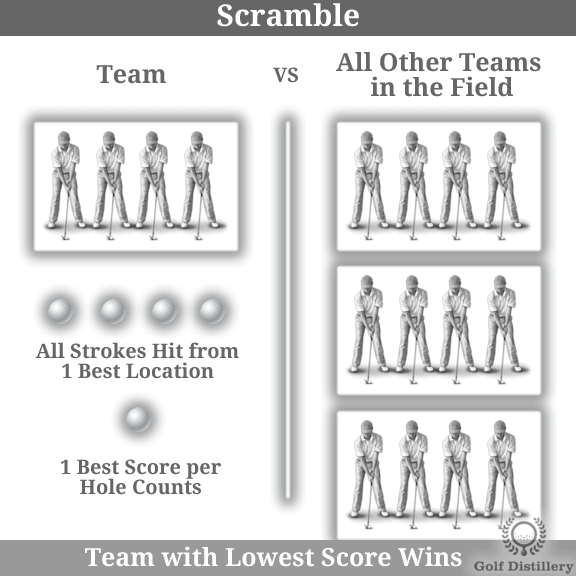
Image Source: www.golfdistillery.com
Fathoming the Golf Scramble Concept
The golf scramble is one of the most common golf tournament formats. It is a team golf format. Instead of playing your own ball the whole time like in stroke play, you play as a unit. It’s a great way to get friends together. It is also perfect for golfers of all skill levels. Even new players can help the team. This format makes the game less stressful. It often leads to lower scores than if players played alone.
Grasping Golf Scramble Rules
The basic golf scramble rules are easy to learn. Teams are usually made of two, three, or four players. A foursome scramble is the most common. Here is how a typical hole works:
- Every player on the team hits their own ball from the tee.
- After everyone hits, the team looks at all the shots.
- They decide which shot is the “best ball” or best shot.
- This best ball is the spot where everyone on the team will hit their next shot from.
- All other balls are picked up.
- Each player goes to the spot of the best ball.
- They drop their own ball near that spot (often within one club length, but rules can vary slightly). No closer to the hole.
- Every player then hits their shot from this new spot.
- The team repeats this process. They choose the best second shot. Then everyone hits their third shot from that new spot.
- This keeps going for every shot on the hole. This includes chips around the green and putts on the green.
- The hole is finished when one player on the team makes the putt.
The team counts the number of shots they took together to get the ball in the hole. This is the team’s score for that hole.
Key Rules to Remember
- Everyone Hits: All players on the team must hit a shot from the tee box. And from every chosen spot after that.
- Choosing the Best: The team must agree on which shot is the best. Once decided, that’s where everyone plays from.
- Playing from the Spot: Players usually drop their ball. It is typically dropped within a short distance of the chosen spot. The exact distance can be specified by the tournament rules. A common rule is one club length. This distance is often measured from the side of the ball. The ball cannot be dropped or placed closer to the hole.
- On the Green: When the best shot is on the green, players place their balls. They put them at the spot of the best ball. They don’t drop on the green. The balls are placed.
- Marking the Spot: The location of the best ball must be marked. Use a tee or ball marker before anyone else hits their shot. This shows everyone where to play from.
Interpreting Gameplay: A Hole in a Scramble
Let’s walk through how to play a scramble on a par 4 hole. Assume you are in a foursome scramble. Your team has Player A, B, C, and D.
On the Tee Box:
- Player A hits their drive. It goes 200 yards but is in the rough.
- Player B hits their drive. It goes 210 yards and is in the fairway.
- Player C hits their drive. It goes 230 yards and is in the fairway, but a little off center.
- Player D hits their drive. It goes 220 yards and is in the middle of the fairway.
- Team Decision: The team looks at the four balls. The shot by Player C went the farthest and is in the fairway. This looks like the best spot.
- Action: The team agrees Player C’s drive is the best. They mark the spot where Player C’s ball came to rest. Players A, B, and D pick up their balls.
For the Second Shot:
- Players A, B, C, and D go to the spot of Player C’s drive.
- They each drop their own ball near the marker. For example, within one club length. But not closer to the hole.
- Player A hits their second shot. It lands on the green, but far from the pin.
- Player B hits their second shot. It lands in the bunker near the green.
- Player C hits their second shot. It lands on the green, closer to the pin than A’s shot.
- Player D hits their second shot. It lands just off the back of the green.
- Team Decision: Player C’s shot is on the green and closest. This is the best second shot.
- Action: The team agrees Player C’s second shot is the best. They mark the spot on the green where Player C’s ball is. Players A, B, and D pick up their balls (A’s from the green, B’s from the bunker, D’s from off the green).
For the Third Shot (Putting):
- Players A, B, C, and D go to the spot of Player C’s second shot on the green.
- They place their own ball at the marked spot.
- Player A putts first. The ball stops 3 feet past the hole.
- Player B putts next. The ball stops 2 feet short of the hole.
- Player C putts. The ball misses the hole and stops 1 foot past.
- Player D putts. The ball goes in the hole!
- Team Decision: Player D made the putt! This is the best “shot” for this turn.
- Action: The team has finished the hole. They made it in 3 shots (1 tee shot, 1 second shot, 1 putt).
Scoring: The team writes down a score of 3 for this hole.
This process shows how the team works together. They always choose the best result from each set of shots. This makes the game much easier and faster. Everyone gets to hit good shots during the round.
Deciphering Golf Scramble Scoring
Golf scramble scoring is simple. The team keeps one score for the whole group. On each hole, the score is the total number of shots the team needed to get the ball into the hole. This count starts with the tee shot (which is shot number 1). It ends when any player on the team successfully makes the final putt.
Think of it like the team is one player. That “player” always gets to hit from the best spot. The score is just the total strokes for this “team player”.
Teams write down their team score on a scorecard, just like in regular golf. At the end of the round (usually 18 holes), the team adds up their scores for all holes. This is their gross score. If golf scramble handicaps are used, the team handicap is subtracted from this gross score. This gives the team’s net score. The team with the lowest net score wins the tournament.
Scorecard Example (Partial)
Here is a simple example of a scramble scorecard for a foursome:
| Hole | Par | Team Score (Gross) |
|---|---|---|
| 1 | 4 | 3 |
| 2 | 5 | 4 |
| 3 | 3 | 2 |
| 4 | 4 | 3 |
| … | … | … |
| Total | Calculated Later |
This shows the team needed 3 shots on Hole 1, 4 on Hole 2, and 2 on Hole 3. The total score is the sum of these hole scores.
Exploring Types of Golf Scrambles
While the basic scramble is the most common, there are a few types of golf scrambles. They add small twists to the rules. This makes the game a bit different or helps balance skill levels more.
- Standard Scramble (Captain’s Choice): This is what we have described so far. Any player’s shot can be chosen as the best on any turn. Often played with a foursome scramble.
- Texas Scramble: This is a very popular variation, especially in larger tournaments. The main Texas scramble rules add one rule: Each player’s tee shot must be used at least a certain number of times during the round. For a foursome playing 18 holes, the rule is often that each player’s drive must be used at least four times. This forces teams to sometimes choose a less-than-perfect drive to meet the requirement. It ensures all players contribute drives. Teams must keep track of which player’s drive they used on each hole.
- Florida Scramble (Step Aside Scramble): This variation is faster-paced but requires coordination. After the team chooses the best shot, the player who hit that shot does not hit the next shot. For example, if Player C’s drive was chosen, only Players A, B, and D hit the second shot. If Player A’s second shot is chosen, only Players B, C, and D hit the third shot. This means the team always has one less player hitting each turn after the first shot.
- Shamble: This format is a mix of a scramble and individual stroke play. The team plays a scramble off the tee: everyone hits, they pick the best drive. But from the spot of the best drive, each player then plays their own ball for the rest of the hole. The team records the best individual score among the teammates on that hole. For example, if Player A gets a par, Player B gets a bogey, Player C gets a birdie, and Player D gets a par after hitting from the best drive, the team score is Player C’s birdie. Shamble is often played with handicaps applied to individual scores. It is less of a pure team format than a scramble.
These variations offer different challenges and fun. The standard scramble is the easiest for beginners. Texas Scramble adds a layer of strategy. Florida Scramble speeds things up later in the hole. Shamble tests individual skill more after the tee shot.
Interpreting Golf Scramble Handicaps
Golf scramble handicaps are used to make the game fair for teams with different skill levels. Just like individual handicaps, team handicaps help lower-skill teams compete with higher-skill teams. Without handicaps, a team of great players would almost always win.
Calculating a team handicap is not standard across all tournaments. There are different formulas. The goal is to create a single handicap number for the whole team. This number is usually lower than any individual’s handicap. This is because the team gets to pick the best shot every time. This makes their potential score much lower than what any one player could do alone.
Common Handicap Formulas
Here are some common ways team handicaps are figured out for a foursome scramble:
-
Percentage of Combined Handicaps: Add up the handicaps of all four players. Then take a percentage of that total. This percentage might be around 10% or 20%.
- Example: Player A (5), B (10), C (18), D (25). Total = 58. Team Handicap = 10% of 58 = 5.8 (rounds to 6).
-
Percentage Based on Order: This method uses a larger percentage of the lowest handicap and smaller percentages of higher handicaps. A common formula is taking:
- 20% of the lowest handicap player
- 15% of the second lowest handicap player
- 10% of the third lowest handicap player
- 5% of the highest handicap player
- Add these results together.
- Example: Using the same players (A=5, B=10, C=18, D=25).
- 20% of 5 = 1.0
- 15% of 10 = 1.5
- 10% of 18 = 1.8
- 5% of 25 = 1.25
- Total = 1.0 + 1.5 + 1.8 + 1.25 = 5.55 (rounds to 6).
-
Larger Percentages: Some tournaments use larger percentages, like:
- 40% of A player (lowest handicap)
- 30% of B player
- 20% of C player
- 10% of D player
- Add these together.
- Example: Using the same players (A=5, B=10, C=18, D=25).
- 40% of 5 = 2.0
- 30% of 10 = 3.0
- 20% of 18 = 3.6
- 10% of 25 = 2.5
- Total = 2.0 + 3.0 + 3.6 + 2.5 = 11.1 (rounds to 11).
The specific formula is set by the tournament organizers. Teams need to know their individual handicaps beforehand. These handicaps might be official ones (like from the USGA) or unofficial ones based on past scores.
Applying the Team Handicap
Once the team handicap is calculated, it is used at the end of the round.
- The team finishes all 18 holes.
- They add up their gross score (total shots taken).
- They subtract their team handicap from the gross score.
- This gives them their net score.
Example: A team shoots a gross score of 65. Their calculated team handicap is 8.
Their net score is 65 – 8 = 57.
The team with the lowest net score wins the handicapped division. This system allows a team of higher handicappers to compete fairly against a team of lower handicappers. Even if the lower handicappers shoot a lower gross score, the higher handicappers’ larger handicap allowance can make their net score better.
Contrasting Best Ball vs Scramble
People sometimes confuse best ball vs scramble formats. Both are team golf formats, but they are quite different in how you play each hole.
Here is a simple comparison:
| Feature | Golf Scramble | Best Ball |
|---|---|---|
| How you play | Everyone hits, pick best shot, everyone plays next from there. | Everyone plays their own ball from tee to green. |
| Team Score | Team takes ONE score for the hole (total strokes for the group playing from best spots). | Team takes the LOWEST individual score on the hole. |
| Pace of Play | Generally faster. Less searching for lost balls. Less putts needed per hole. | Can be slower, as players finish out their own holes. |
| Contribution | Everyone contributes to every shot (theoretically, by providing options). | Only the player with the best score on a hole truly “counts” their score for that hole. Other players’ scores on that hole are thrown out. |
| Good For | All skill levels, especially beginners. Social, less pressure. | Players comfortable playing their own ball. Can be more competitive individually. |
| Example | Team hits 4 drives, picks the best. Then all hit second from there. | Player A gets a 4, B gets a 5, C gets a 6, D gets a 4. Team score is 4 (best of A, B, D). |
In a scramble, the team is truly playing as one unit on every single shot after the first. In best ball, the team shares a score based on individual play, but each player completes the hole on their own. A scramble feels more like a single, very good player moving down the hole because you always play from the optimal spot. Best ball feels more like a relay race where the best performance on that leg (the hole) wins for the team.
Diving into Golf Tournament Formats
Scramble and Best Ball are just two examples of golf tournament formats. The world of golf offers many ways to compete. The format chosen depends on the goals: fun, fairness, competition level, and participant skill.
Other common formats include:
- Stroke Play: The most standard format. Each player plays their own ball from tee to hole. They add up their total strokes for the round. The player with the lowest total wins. This is used in most professional tournaments (like the Masters or the US Open).
- Match Play: Players or teams compete hole by hole. The player/team who takes fewer strokes on a hole wins that hole. The match is won by the player/team who wins more holes than the other. For example, winning by “3 & 2” means being 3 holes ahead with 2 holes left to play. The Ryder Cup uses match play.
- Stableford: A scoring system where points are awarded based on the score relative to par. For example, a double bogey might be 0 points, bogey 1 point, par 2 points, birdie 3 points, eagle 4 points. The player with the highest point total wins. This format encourages aggressive play and limits the damage of a really bad hole (you just get 0 points, not a huge stroke number added to your total).
- Alternate Shot (Foursomes): A two-player team format. Players take turns hitting the same ball. One player hits the tee shot. The other hits the second shot, and so on. They also alternate hitting tee shots on each hole. This format requires great teamwork.
Understanding these different golf tournament formats helps you know what to expect when you sign up for an event. The scramble remains popular because of its inclusivity and fun nature, especially for charity events or casual gatherings.
Advantages and Disadvantages of the Scramble
Why do people love the scramble format?
- It’s Fun and Social: You spend more time with your teammates. You celebrate good shots together. You strategize together.
- Less Pressure: One bad shot does not ruin the hole or the round for you. The team can likely recover.
- Great for Beginners: New golfers can play with experienced golfers. They can hit some shots without the pressure of scoring on every hole. Their good shots are celebrated and used.
- Faster Play: Choosing the best ball often leads to fewer strokes per hole. Fewer balls are lost. This helps the round move along faster than typical stroke play.
- You Hit More Good Shots: Since you are always hitting from the best position, you are more likely to hit greens or make putts.
Are there any downsides?
- Less Individual Practice: You don’t play your own ball from start to finish. This means you don’t get to practice recovering from bad shots as much.
- Doesn’t Test Your Full Game: You rely on your teammates for different parts of the game. It doesn’t show how well you can score playing entirely on your own.
- Can Cause Issues (Rarely): Sometimes choosing the “best” shot can lead to disagreements, but this is uncommon in friendly games.
For most players looking for a fun round with friends, the benefits far outweigh the drawbacks.
Pointers for Playing a Better Scramble
Playing in a scramble is different from playing alone. Here are some tips to help your team play well:
- Drive Strategy: Decide who hits when off the tee. Often, the player who is feeling confident or hits it longest goes last. They know what the team already has in play. If others hit good drives, they can swing harder. If others hit poor drives, they need to ensure they get one in the fairway.
- Use Everyone’s Skills: Does one player chip well? Let them chip first to give the team a look. Is another player a great putter? Have them putt last after others have shown the line.
- Putting Order: On the green, let someone who is good at reading greens putt first. This gives the team a look at the line and speed. The best putter might putt last to try and make it after seeing the others.
- Talk Through Shots: Discuss the lie, distance, wind, and club choice as a team. Share ideas.
- Be Supportive: Encourage your teammates! Celebrate good shots. Don’t dwell on bad ones. It’s a team game.
Playing smart as a team can shave strokes off your score and make the round even more enjoyable.
Frequently Asked Questions about Golf Scrambles
Here are some common questions people ask about golf scrambles:
h4 What does “scramble” mean in golf?
It means a team format where everyone hits a shot, you choose the best one, and everyone plays from that spot until the ball is in the hole.
h4 Can a two-person team play a scramble?
Yes, two-person scrambles are common. The rules are the same, just with two players instead of more.
h4 What is the difference between a foursome and a scramble?
A foursome refers to a group of four players. A scramble is a format of play. A scramble is often played by a foursome. But a foursome could also play other formats like stroke play or best ball.
h4 Do you use your own ball in a scramble?
Yes, each player hits their own ball for each stroke. But after everyone hits, you pick up the balls that were not the best shot and everyone hits their next shot using their own ball again, but from the location of the chosen best shot.
h4 If the best shot is in the bunker, do all players hit from the bunker?
Yes. If the best shot landed in the bunker, then all players on the team must hit their next shot from the bunker. If the best shot was in the rough, everyone hits from the rough. If it was out of bounds, the team must take a penalty and hit from where the previous shot was taken, following the rules for hitting out of bounds.
h4 Do all players have to putt in a scramble?
Yes. Once the team’s best shot is on the green, all players place their own ball at that spot and must take a putt. This continues until one player makes the putt.
h4 How do you score a Texas Scramble?
Scoring is the same as a standard scramble (total team strokes per hole). The difference is the rule that each player’s tee shot must be used a minimum number of times during the round (e.g., 4 times for an 18-hole foursome). The team must track which player’s drive was used on each hole.
h4 Why are scramble handicaps usually lower than individual handicaps?
Because the team always plays from the best shot, they have a much higher chance of making low scores. The team handicap reflects this advantage, so it’s lower to make the competition fair compared to individual play handicaps.
h4 Is a scramble sanctioned by official golf bodies?
Scrambles are not a USGA or R&A sanctioned format for establishing an official handicap. They are considered a casual or tournament-specific format. Rules can vary slightly between events.
In Summary
The golf scramble is a fantastic way to play golf. It focuses on teamwork, fun, and faster play. By understanding the simple golf scramble rules, golf scramble scoring, and how golf scramble handicaps work, you can jump into this popular team golf format. Whether it’s a standard foursome scramble or a variation like the Texas scramble rules, playing a scramble is sure to be an enjoyable day on the course for golfers of all levels. It is a great alternative among golf tournament formats when the goal is camaraderie and less pressure.