
Ever felt a little nervous when working near electrical outlets or wires? Electricity is powerful and can be dangerous if you aren’t careful. Knowing if a circuit is live before you touch it is super important for staying safe.
Choosing the right tool to check for electricity can be confusing. There are so many different voltage tester pens out there! Some are simple, some have extra features, and it’s hard to know which one is best for what you need to do. You don’t want to buy one that doesn’t work right or one that’s too complicated.
This post will clear things up for you. We will look at what makes a good voltage tester pen and help you understand the different types available. By the end, you will know exactly what to look for to pick the perfect one for your home projects or simple checks.
Let’s dive in and find the best voltage tester pen to keep you safe around electricity!
Top Voltage Tester Pen Recommendations

- NON-CONTACT DETECTION of AC voltage in cables, cords, circuit breakers, lighting fixtures, switches, non-tamper-resistant outlets, and wires
- CLEAR INDICATION: Bright LED illuminates green to indicate tester is operational and flashes red and emits a beeping alert when voltage is detected
- BROAD APPLICATION with a 50 to 1000V AC power detection range
- CONSERVE BATTERIES with auto power-off function
- LIGHTWEIGHT AND DURABLE compact design with a convenient clip fits securely in pocket; 6.6-Foot (2 m) drop protection


- Be aware of voltage easily - the tip glows red and a beeper sounds when voltage is detected
- Continuous self-test so you always know it’s working
- Voltage detection range for wide application use - 90 V to 1000 V AC or 200 V to 1000 V AC
- Audible/Silent mode for added convenience

- NON-CONTACT VOLTAGE DETECTION: Detects 12-1000V AC in cables, cords, circuit breakers, lighting fixtures, switches, outlets, and wires
- LCD INDICATES SIGNAL STRENGTH: Bar graph display indicates signal strength with more bars lighting up as voltage increases or as detector moves closer to the source
- AUDIBLE ALERT: The audible alert indicator increases/decreases rate corresponding to bar graph
- 3-COLOR LED TIP: Blue indicates low signal strength, red indicates high signal strength, and green indicates that no voltage is detected
- SLIM POCKET CLIP: Ensures the tester stays securely in place, providing quick and convenient access when needed

- VERSATILE VOLTAGE DETECTION: This Voltage Tester offers non-contact detection of low voltage in security, entertainment, communications, environmental control, and irrigation systems
- CLEAR INDICATION: Bright LED illuminates green to indicate tester is operational and flashes red and emits a beeping alert when voltage is detected
- BRIGHT FLASHLIGHT: Equipped with a bright flashlight, this tester illuminates the work area, allowing for enhanced visibility. The flashlight can also be used independently of the voltage detection function
- DUAL-RANGE DETECTION: Select voltage range of 12-1000V, or 70-1000V for targeted voltage detection
- LIGHTWEIGHT AND COMPACT: With its lightweight and compact design, this tester is easy to carry and features a pocket clip for convenient storage and quick access

- 【Non-contact Voltage Tester】 Ranging 12-1000V AC, You can easily distinguish the live and null wire through different level of alarm sound and LED indicator. ( Note Please:Not Suitable for Christmas Light Testing)
- 【Safe and Convenient】 The Voltage Pen Tester Detectes Voltage in a Non-Contact Way, So Do Not Worry about There Could be any Possibility of being Shocked by the Electricity
- 【High Efficiency】 As Long As Voltage is Detected, the Led in the Tester Pen will Shine
- 【Multifunction, Easy to Use】 It Also Acts as an Emergency Flashlight which can Illuminate the Working Area, You can Use the Non Contact Voltage Detector in Circuit Breakers, Lighting Fixtures, Switches, Outlets, Wires and Anywhere You Need it
- 【CE CAT III600V RoHS Certificate】 A Professional Tester, It is Perfectly Suitable also for DIY'ers, Hobbyists and Home Owners, It Helps You Make the First and the Most Important Safety Check
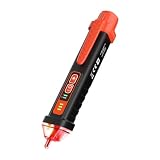
- Non-Contact AC Voltage Detector Pen: Check AC voltage without touching conductors. Supports high sensitivity 12-1000V and low sensitivity 48-1000V for wires, switches, socket holes, and basic AC electrical checks.
- Dual Sensitivity AC Checks: Select high or low sensitivity before detection. High sensitivity is for about 12-1000V AC, while low sensitivity is for about 48-1000V AC. Avoid switching sensitivity during detection.
- Live/Neutral Wire Identification: Compare the signal strength near two wires or between socket holes. A stronger signal indicates the live wire; a weaker or no signal indicates the neutral wire in this comparison method. No alarm alone does not confirm the absence of voltage.
- Audible and Visual Alarm: When AC voltage is detected, the electric tester pen beeps and lights 1-3 signal indicators by signal strength. Faster beeps and more lights indicate a stronger or closer AC voltage source.
- CAT Rated Safety for AC Checks: CAT III 1000V/CAT IV 600V rated with ABS housing, low-battery alert, LED flashlight, auto shutoff, and pocket clip. For AC voltage checks only; test on a known live source before use.

- SMART BUY: A complete, high-performance kit that offers convenience and value
- COMPLETE OUTLET TESTER TOOL KIT: Includes GFCI Tester (Cat. No. RT210) and Non-Contact Voltage Tester Pen (Cat. No. NCVT1P)
- DETECT COMMON WIRING PROBLEMS: Quickly identifies wiring issues in standard and GFCI receptacles
- GFCI OUTLET COMPATIBLE: Confirms the proper operation of ground fault protective devices in GFCI outlets
- VOLTAGE TESTER PEN: Non-contact detection of voltage in cables, circuit breakers, lighting fixtures, switches, and more

- Voltbeat technology and continuous self test so you always know it is working
- Upon detection, tip glows
- Non-contact voltage detection from 90 to 1000 V ac
- Battery Check' ensures battery is in good condition
- Suitable for a wide range of residential, commercial and industrial needs
The Essential Buying Guide for Your Voltage Tester Pen
A voltage tester pen is a handy tool. It helps you check if electricity is flowing in a wire or outlet. This guide will help you pick the best one for your needs. Safety is important when dealing with electricity. A good tester keeps you safe.
Key Features to Look For
When you shop, certain features make a voltage tester pen much better. These features help you work fast and safely.
1. Voltage Range and Sensitivity
- AC Voltage Range: Check the range it tests. Most standard home circuits are 120V or 240V. A good pen tests from about 90V up to 1000V.
- Non-Contact vs. Contact Testing: Non-contact testers (NCV) are very safe. They beep or light up just by being near a live wire. Contact testers require touching the wire directly. The best pens offer both options.
2. Safety Ratings (CAT Ratings)
Safety ratings tell you how tough the tester is. Look for CAT ratings like CAT II or CAT III. Higher numbers mean the tester can handle bigger electrical surges safely. Always pick a rating that matches where you plan to use it.
3. Display and Alerts
- Visual Indicators: A bright LED light is a must. Red usually means voltage is present.
- Audible Alerts: A loud beep helps when you cannot look directly at the pen.
- Backlit Screen (If Digital): If your pen has a screen, a backlight helps you see readings in dark areas like attics or basements.
Important Materials and Build Quality
The materials used in the pen affect how long it lasts and how safe it feels.
Durable Casing
The outer body should be made of strong, tough plastic. This plastic protects the sensitive electronics inside. A rubberized grip makes the pen easier to hold, especially if your hands are sweaty or oily. Good quality plastic prevents cracks if you drop the tool.
Probe Tip Material
The tip that touches the circuit should be made of hardened steel or a similar durable metal. This tip must resist corrosion so it always makes good contact when needed.
Factors That Improve or Reduce Quality
Not all voltage testers perform the same way. Pay attention to these details.
Quality Boosters
- Automatic Power Off (Auto-Off): This feature saves battery life. If you forget to turn it off, the pen shuts down by itself after a few minutes.
- Low Battery Indicator: This warns you before the battery dies. A dead battery means you cannot trust your reading.
- Built-in Flashlight: Many modern pens include a small light. This is super helpful for working in poorly lit breaker boxes.
Quality Reducers
- Cheap Components: If the pen feels very light or rattles, it probably uses low-quality internal parts. These can fail unexpectedly.
- Poor Calibration: Testers that are not properly calibrated might give false readings. Buying from a trusted brand usually avoids this problem.
User Experience and Common Use Cases
How easy is the pen to use? A good design makes your job faster.
Ease of Use
Simple operation is key. You should be able to turn it on easily and switch between test modes with minimal effort. A pen that fits comfortably in your pocket or tool belt is always better.
Where You Will Use It
- Home DIY Projects: Checking outlets before replacing them.
- Automotive Work: Testing fuses or low-voltage wiring in cars (ensure the range covers lower voltages).
- Troubleshooting Appliances: Finding out if power is reaching a specific part of a machine.
A voltage tester pen is a crucial safety item. Choose wisely based on features and build quality. This tool will serve you well for years.
10 Frequently Asked Questions (FAQ) About Voltage Tester Pens
Q: What is the main difference between a non-contact tester and a multimeter?
A: A non-contact tester only tells you if voltage is present. A multimeter measures the exact voltage, current, or resistance. Testers are quicker for safety checks; multimeters are better for detailed diagnosis.
Q: Do I need to change the battery often?
A: It depends on usage and if the auto-off feature works. If you use it daily, you might change it every few months. If it has a low battery indicator, you will know exactly when to swap it out.
Q: Can a voltage tester pen check for DC voltage (like in a car battery)?
A: Most basic voltage tester pens only check for AC (Alternating Current) voltage found in wall outlets. You need a multimeter or a specialized DC tester for car batteries.
Q: How close do I need to hold the pen to the wire to get a reading?
A: For non-contact testing, you usually hold the tip within half an inch (about 1-2 cm) of the conductor. The closer you are, the stronger the signal.
Q: What does a CAT rating mean?
A: CAT stands for Category rating. It shows the maximum transient voltage surge the tester can safely handle. Higher numbers (like CAT III) are safer for industrial or main panel work.
Q: If the tester doesn’t light up, does that guarantee there is no electricity?
A: It means the tester did not detect live voltage. However, if the pen’s battery is dead or the tester is broken, it will not light up even if voltage is present. Always test your tester on a known live source first!
Q: Are digital voltage testers better than pen-style testers?
A: Digital testers (often handheld meters) offer more precise measurements. Pen-style testers are simpler, faster, and designed mainly for quick “Is it live?” checks.
Q: What is the purpose of the sensitivity setting?
A: Sensitivity allows you to adjust how close you need to be or how low a voltage level the pen will detect. Lower sensitivity helps locate a specific wire in a bundle without picking up signals from nearby wires.
Q: Can I use a voltage tester pen to check ground wires?
A: A standard non-contact tester checks for hot (live) wires. You need a multimeter or a dedicated outlet tester to confirm that the neutral and ground wires are properly connected.
Q: How long should the warranty be on a quality voltage tester pen?
A: Good quality, reliable brands usually offer at least a one-year limited warranty. Longer warranties often reflect greater confidence in the product’s durability.