
Ever looked at a massive computer tower and thought, “There has to be a smaller way”? You’re not alone! Many people want a powerful computer that doesn’t take up half their desk. But when it comes to picking a small case, like a Microatx, it can get confusing. You worry about fitting everything inside, keeping it cool, and if it will even look good.
Choosing the right Microatx case is tricky. You want something that fits your parts, but also looks nice and stays quiet. It’s easy to get lost in all the different sizes, fan options, and cable management features. This can make building your dream PC feel more like a chore than fun.
But don’t worry! By the end of this post, you’ll understand what makes a great Microatx case. We’ll break down the important things to look for, so you can pick a case that works perfectly for you. Get ready to discover how to build a compact PC that’s both powerful and stylish.
Top Microatx Cases Recommendations

- Builder-Friendly Design: Feature rich Micro ATX case with high-airflow cooling, flexible hardware support, and a compact layout that delivers premium performance without compromising on quality.
- Fits High-Performance GPUs: Supports graphics cards up to 366mm, making it easy to build with today's NVIDIA GeForce RTX and AMD Radeon gaming graphics cards
- High Airflow Cooling: Fit 6x 120mm or 140mm fans, 240mm AIO radiators, and 178mm CPU air coolers, for flexible cooling for gaming and productivity.
- Modular Everyday Design: Supports ATX power supplies up to 200mm and features a movable I/O panel, magnetic dust filters, tempered glass, and clean cable management for hassle-free builds.
- Complete Your High-Airflow Build: Pair with the Cooler Master V4 Alpha 3DHP Air Cooler, MasterFan M120, and MWE Gold 850 V3 PSU for powerful cooling, reliable power, and optimized airflow.

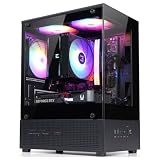
- Compact Micro-ATX Design - Space-saving case ideal for budget gaming and clean desktop setups
- 3 x Preinstalled FRGB Fans (3-pin DC) - Fixed RGB lighting with optimized airflow out of the box
- Hardware Support - Fits GPUs up to 280mm, ATX PSUs up to 140mm, and 155mm CPU air coolers
- HDD Support - Fits up to 3 x 2.5" HDD and 1 x 3.5" HDD (2 x 2.5" + 1 x Combo)
- Modern Front I/O - Includes USB Type-C and USB 3.0 for fast connectivity

- Quasi-Filter Mesh Panels: A mesh design comprised of over 57,000 precision-machined 1.5mm holes increases airflow and provides a compelling view of the components within your build
- Optimized for Cooling: With support for 280 and 360mm radiators and up to six fans, the AP201 is primed to deal with the thermal onslaught of high-performance hardware.
- Industry-Leading Spatial Efficiency: Despite a 33L footprint, the AP201 supports ATX PSUs up to 180 mm long, graphics cards up to 338 mm long, custom liquid cooling, and various storage devices.
- Tool-Free Side Panels: A simple yet secure clip mechanism allows chassis side panels to be easily removed and resistant to accidental dislodging.
- Sizeable Cable-Management: The AP201 features an extended motherboard tray with strategically placed cutouts and a 32 mm gap to tuck cables out of sight.

- Compact & Durable: Sleek design with sturdy 0.8T steel construction and a 17.1-liter total volume
- Minimal Yet Mighty: Supports standard ATX PSUs, 260mm length GPUs, and 137mm height CPU coolers
- High Airflow Design: Perforated front panel and pre-installed 80mm fan for optimal cooling
- 1 x USB 3.0, 1 x USB 2.0, 1 x 3.5mm Stereo AUX for easy device connections
- Despite its charming appearance, it's built with durable 0.8T steel for a robust and sturdy structure

- 1 case of 1 Packs, 1 Count Total
- 270° PANORAMIC TEMPERED GLASS: Features a sweeping tempered glass panel on three sides for a stunning, unobstructed view of your build.
- MICRO-ATX COMPATIBLE: Designed to support Micro-ATX motherboards, making it a compact yet capable choice for powerful gaming PC builds.
- 3 PRE-INSTALLED FANS: Comes with three fans already installed out of the box, providing immediate airflow and cooling for your components.
- USB 3.0 CONNECTIVITY: Includes a front-panel USB 3.0 port for fast and convenient data transfer and device connectivity.

- Front & side view tempered glass pillarless design.
- 3 x 120mm ARGB fans included.
- Supports up to 280mm radiator at top.
- I/O Ports: USB 3.0 x 2, HD Audio x 1.
- Max VGA Length: 340mm.

- JONSBO D32 STD Micro-ATX PC Case- Unmatched Price per Performance - An economical M-ATX chassis that is compatible with main popular hardware such as back connect motherboard, 240AIO, 365mm GPU , ATX(150-200mm) /SFX-L/SFX PSU (16A plug except) etc. easier to build your PC,More convenient.
- 【Small and Compact】 - Desktop dessert grade size control, mini case Bottom with magnetic dust proof net
- 【Water Cooling】: Top 240 AIO 【CPU Air Cooler】:164mm MAX (Intel CPU) or 163mm MAX (AMD CPU)
- 【FAN:】Top 120mm*2/140mm*2 Bottom 120mm*3/140mm*2 Rear 120mm*1
- 【GPU Length】: 365mm /14.37IN
Choosing the Right Micro-ATX Case: Your Guide to a Compact Build
Micro-ATX cases are perfect for building smaller, more manageable computers. They’re great for gaming, office work, or even as a media center. This guide helps you pick the best one for your needs.
Key Features to Look For
When you shop for a Micro-ATX case, keep these important things in mind:
- Size and Dimensions: Micro-ATX cases are smaller than standard ATX cases. Make sure the case fits your space.
- Motherboard Compatibility: It must support Micro-ATX motherboards. Most also fit Mini-ITX boards.
- Expansion Slots: Check how many slots it has for graphics cards and other add-ons.
- Storage Options: Look at how many hard drives (HDDs) and solid-state drives (SSDs) you can install.
- Cooling Support: Good airflow is vital. See how many fans it can hold and if it has space for liquid coolers.
- Front Panel Ports: USB ports and audio jacks on the front make connecting devices easy.
- Cable Management: This feature helps keep your build tidy and improves airflow.
Important Materials
Cases are usually made from a few common materials:
- Steel: This is the most common material. It’s strong and durable. Many cases use a mix of steel and plastic.
- Aluminum: Aluminum is lighter than steel. It can also help with cooling. Cases made mostly of aluminum tend to be more expensive.
- Tempered Glass: Many modern cases have tempered glass side panels. This lets you show off your computer’s insides.
Factors That Improve or Reduce Quality
Several things make a case good or not so good:
What Makes a Case Great
- Build Quality: A well-built case feels solid. It doesn’t bend or flex easily.
- Ease of Building: Cases with good cable management and tool-less drive bays make building a computer much simpler.
- Airflow Design: Cases with good ventilation and fan mounts help keep your components cool. This means your computer runs better and lasts longer.
- Dust Filters: Filters on the intake vents stop dust from getting inside. This keeps your components clean and cool.
What Can Make a Case Less Ideal
- Flimsy Materials: Thin metal or cheap plastic can make a case feel weak.
- Poor Airflow: Cases with few vents or small fan mounts can lead to overheating.
- Difficult Assembly: Cramped spaces and poor cable routing make building a computer frustrating.
- Lack of Features: Missing essential ports or drive bays can limit your build options.
User Experience and Use Cases
How you use your computer will influence the case you need.
Who Needs a Micro-ATX Case?
- Gamers: You can build a powerful gaming PC in a smaller form factor. Some cases offer good space for large graphics cards.
- Office Users: A compact PC saves desk space. It’s perfect for everyday tasks.
- Home Theater Enthusiasts: Small cases can fit easily into entertainment centers. They look neat and tidy.
- DIY Builders: If you enjoy building computers, a Micro-ATX case offers a fun challenge.
What to Expect in Daily Use
A good Micro-ATX case provides a clean look and easy access to your components. You’ll appreciate the space it saves. Cable management features make your build look professional. Good cooling ensures your computer runs smoothly, even when working hard.
Frequently Asked Questions (FAQ) about Micro-ATX Cases
Q: What is a Micro-ATX case?
A: A Micro-ATX case is a smaller computer chassis designed to hold Micro-ATX motherboards. They are more compact than standard ATX cases.
Q: Can I fit a full-size graphics card in a Micro-ATX case?
A: Many Micro-ATX cases can fit full-size graphics cards. You should always check the case’s specifications for maximum GPU length support.
Q: Are Micro-ATX cases good for gaming?
A: Yes, they can be excellent for gaming. You can build powerful gaming PCs in them, but you might have less space for extra components or advanced cooling.
Q: What’s the difference between Micro-ATX and Mini-ITX cases?
A: Mini-ITX cases are even smaller than Micro-ATX cases. They are designed for Mini-ITX motherboards, which are smaller than Micro-ATX boards.
Q: How many hard drives can I install in a Micro-ATX case?
A: This varies greatly by case. Some have space for only one or two drives, while others can hold several HDDs and SSDs.
Q: Do Micro-ATX cases have good airflow?
A: Many modern Micro-ATX cases are designed with good airflow in mind. Look for cases with mesh panels and ample fan mounts.
Q: Is building a PC in a Micro-ATX case difficult?
A: It can be a bit more challenging than a larger case due to limited space. However, good cable management features make it much easier.
Q: What are dust filters and why are they important?
A: Dust filters are mesh screens that block dust from entering your case. They help keep your components clean and prevent overheating.
Q: Can I use a Micro-ATX case for a quiet PC build?
A: Yes, many Micro-ATX cases support quiet cooling solutions and can be built to be very quiet. Good airflow also helps fans run at lower speeds.
Q: Where should I place my Micro-ATX PC?
A: You can place it on your desk, under your desk, or in an entertainment center. Its small size makes it versatile.