
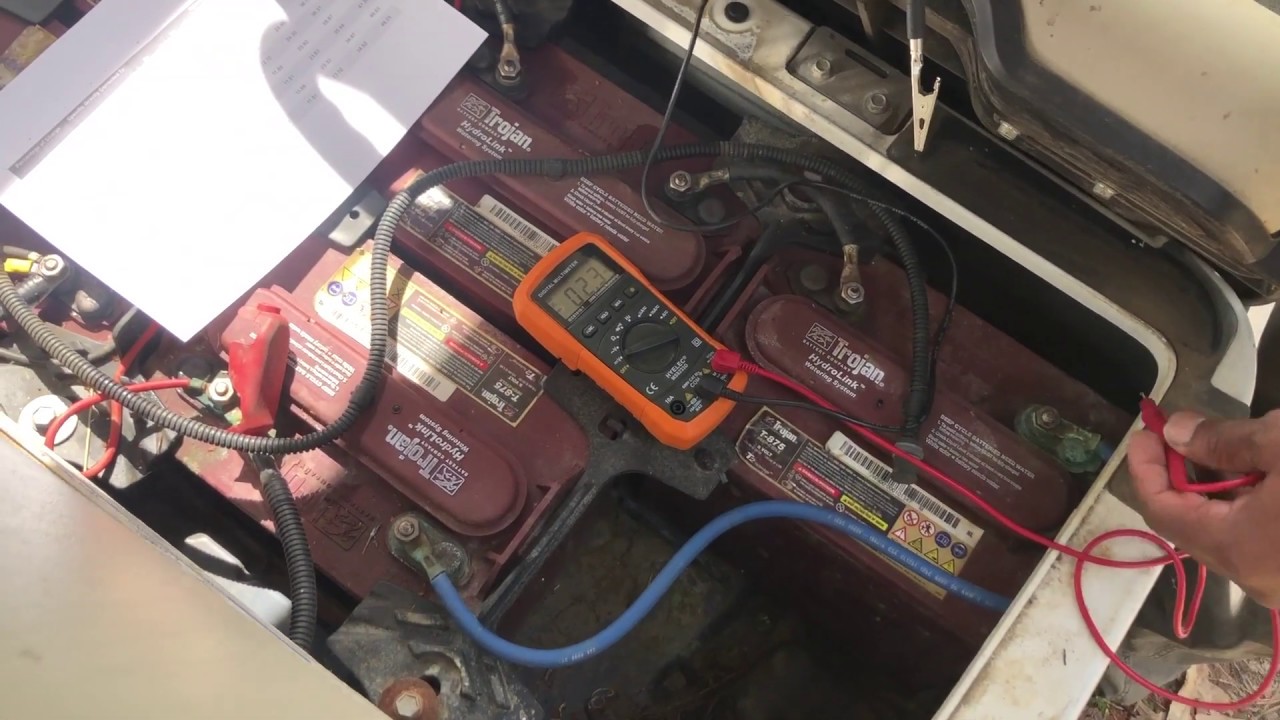
Image Source: i.ytimg.com
Master How To Test Golf Cart Batteries With Multimeter
What is a golf cart battery? Golf cart batteries are usually deep cycle lead-acid batteries. They are made to give power steadily over a long time. They can be drained and charged many times. Can I test golf cart batteries with a multimeter? Yes, using a multimeter is the best way to check their health. It helps you see how much power they have. What is a multimeter? A multimeter is a tool. It measures voltage, current, and resistance. For batteries, we use it to measure voltage. Why test golf cart batteries? You test them to see their charge. You also check if they are working right. This helps you fix problems early. Testing helps your batteries last longer.
Why Test Your Golf Cart Batteries?
Testing your golf cart batteries is very important. It keeps your cart running well. Regular checks save you money. They also stop bigger problems.
Prevent Breakdowns
Weak batteries can stop your cart. This can happen when you are far from home. Testing tells you if a battery is weak. You can fix it before it stops your cart.
Extend Battery Life
Batteries last longer with good care. Knowing their health helps you care for them. You can charge them correctly. You can also add water when needed. These steps make batteries last more years.
Save Money
Replacing golf cart batteries costs a lot. It is better to find a bad battery early. You might replace just one. Or you might fix a small issue. This costs less than buying a whole new set.
Gathering Your Tools for Battery Testing
You need a few simple tools. They help you test safely and well.
- Digital Multimeter: This is a must-have tool. A digital one is easy to read. It gives exact numbers.
- Safety Glasses: Battery acid can hurt your eyes. Always wear safety glasses.
- Rubber Gloves: These protect your hands. They keep acid off your skin.
- Battery Terminal Brush: Use this to clean dirty terminals. Clean terminals give better readings.
- Distilled Water: If you have flooded batteries, you will need this. It helps keep them full.
- Wrench: You might need this to loosen battery cables. Only do this if you know how.
Safety First: Important Precautions
Working with batteries needs care. They hold strong power. They also have acid. Follow these rules for safety.
- Wear Safety Gear: Always put on safety glasses and rubber gloves.
- Work in a Well-Aired Area: Batteries can let out gas. This gas can explode. Make sure air flows well where you work.
- No Metal Tools Near Terminals: A metal tool can cause a spark. This can be very dangerous. It can cause an explosion. Keep tools away from the battery top.
- No Smoking or Sparks: Do not smoke near batteries. Do not use anything that makes a spark.
- Know How to Clean Acid Spills: Have baking soda and water ready. Baking soda can stop acid from burning. Pour it on spills. Then rinse with water.
Getting to Know Your Multimeter
A multimeter is a powerful tool. It helps you see how your batteries are doing. It measures many things. For batteries, we care about voltage.
What is a Multimeter?
A multimeter is a device. It measures electricity. It can check direct current (DC) voltage. Golf cart batteries use DC voltage. It has probes (wires). One is red for positive. One is black for negative. It also has a screen for numbers. A dial lets you choose what to measure.
Voltmeter Settings for Golf Cart Batteries
Setting your multimeter correctly is key. It makes sure you get the right reading.
- Turn the Dial to DCV: Look for “DCV” or a “V” with a straight line. This means Direct Current Voltage.
- Choose the Right Range:
- For a single 6V, 8V, or 12V battery, set the range to 20V. This means the meter can read up to 20 volts.
- For a full pack, like 36V or 48V, set it higher. A 60V or 200V range is good. Make sure the range is higher than your pack’s full voltage.
- Connect the Probes:
- Plug the red probe into the “VΩmA” or “V” jack. This is for voltage.
- Plug the black probe into the “COM” jack. This is the common or negative side.
Steps to Test Your Golf Cart Battery Pack
Testing batteries is a step-by-step process. Do each step carefully for good results.
Preparations Before Testing
Before you touch your multimeter, get your batteries ready. This makes sure your readings are true.
- Charge Batteries Fully: First, fully charge your golf cart batteries. Plug in your charger. Let it run until it stops charging. This ensures you start with a full charge. This helps you get an accurate golf cart battery full charge voltage reading.
- Let Them Rest: This step is very important for a deep cycle battery voltage test. After charging, let the batteries rest. Wait at least 12 to 24 hours. This lets the voltage settle. It gives a more exact reading of the battery’s health. If you test right after charging, the voltage will be too high. This is called “surface charge.”
- Turn Off Cart: Make sure your golf cart is off. Take the key out. Set the forward/reverse switch to neutral. This stops any power draw.
- Clean Terminals: Look at the battery posts. Are they dirty or corroded? Use a battery brush to clean them. Dirty terminals can give wrong readings. They can stop current flow.
Testing the Total Battery Pack Voltage
This check tells you the overall health of your cart’s power system.
- Set Multimeter: Turn the dial to DCV. Set the range higher than your pack’s voltage. For a 36V cart, use a 60V or 200V range. For a 48V cart, use a 60V or 200V range.
- Find Main Terminals: Look for the main positive (+) and negative (-) terminals. These are usually where the thick cables go to the cart’s motor controller. The main positive terminal is usually the last positive post in the series connection. The main negative terminal is usually the first negative post.
- Connect Probes:
- Touch the red probe to the main positive (+) terminal.
- Touch the black probe to the main negative (-) terminal.
- Read the Display: The number on the screen is your total pack voltage. Check this against the golf cart battery voltage chart for full charge.
Testing Individual Golf Cart Battery Voltage
This step is key to troubleshooting golf cart battery issues. If one battery is bad, it can make the whole cart run poorly.
- Keep Multimeter Settings: Keep the dial on DCV. Set the range to 20V. This is perfect for single batteries.
- Identify Each Battery: Your golf cart has several batteries. A 36V cart has six 6V batteries. A 48V cart has four 12V batteries or six 8V batteries.
- Test Each Battery:
- Find the positive (+) and negative (-) posts on one battery.
- Touch the red probe to the positive (+) post of that battery.
- Touch the black probe to the negative (-) post of the same battery.
- Write down the voltage reading for each battery.
- Move to the next battery and repeat.
How to test 6V golf cart battery: Look for a voltage close to 6.37V (full charge).
How to test 8V golf cart battery health: A healthy 8V battery will show around 8.49V when fully charged and rested.
How to test 12V golf cart battery health: A healthy 12V battery will show around 12.7V when fully charged and rested.
Comparison: Look at all your individual golf cart battery voltage readings. They should be very close to each other. A difference of 0.2-0.5 volts or more between batteries shows a problem. This battery might be failing.
Interpreting Golf Cart Battery Readings
Reading the numbers correctly helps you know what to do next.
What the Numbers Mean
The voltage number tells you the charge level. It also tells you how healthy the battery is.
- Full Charge (Resting): This is the voltage after 12-24 hours of rest from a full charge. This is the most accurate health check.
- Discharged: A low voltage means the battery is drained.
- Healthy vs. Weak: If all batteries are close in voltage and at a good level, they are healthy. If one battery is much lower, it is weak.
Golf Cart Battery Voltage Chart
This chart helps you check checking golf cart battery charge levels. It shows the resting voltage for common golf cart battery types.
| Battery Type | 100% Charged (Resting) | 75% Charged | 50% Charged | 25% Charged | Discharged (0%) |
|---|---|---|---|---|---|
| 6V Battery | 6.37V | 6.22V | 6.09V | 5.95V | 5.79V |
| 8V Battery | 8.49V | 8.29V | 8.12V | 7.94V | 7.72V |
| 12V Battery | 12.7V | 12.4V | 12.2V | 12.0V | 11.6V |
| 36V Pack | 38.2V | 37.3V | 36.5V | 35.7V | 34.7V |
| 48V Pack | 50.8V | 49.6V | 48.8V | 47.6V | 46.4V |
Note: These are resting voltages after 12-24 hours. Voltage drops when the cart is in use.
Checking Golf Cart Battery Charge with Voltage
Use the table above. Find your battery type. Match your voltage reading to the chart. This tells you the charge level. For example, if your 6V battery reads 6.09V, it is about 50% charged. This is part of interpreting golf cart battery readings.
A fully charged golf cart battery full charge voltage is important. If your total pack voltage or individual battery voltage is lower than the 100% column after resting, it means:
* The battery is not fully charged.
* The battery is losing its ability to hold a charge.
Troubleshooting Golf Cart Battery Issues
When voltage readings are not right, you have a problem. This section helps with troubleshooting golf cart battery issues.
Common Problems and What They Mean
- Low Overall Voltage: If your whole pack reads low, it means the batteries are not holding a full charge. This can be from age. It can also be from not charging them enough.
- One Battery Much Lower Than Others: This is a big sign. If one battery is 0.5 volts or more lower, it is the weak link. It has a “dead cell” or is failing. It makes the whole pack perform badly.
- Fast Discharge: Batteries drain too quickly after a charge. This means they cannot hold power well. It can be due to old age or internal damage.
- Corrosion: White or blue stuff on the terminals. This stops good connections. It can cause power loss.
- Bulging Cases: If a battery case is swollen, it is dangerous. It means internal pressure is building up. This battery needs to be replaced right away.
Next Steps for Troubled Batteries
What do you do if you find a problem?
- Charge Again: If the voltage is low, give the batteries another full charge. Then let them rest and test again. Sometimes a good charge cycle fixes minor issues.
- Check Water Levels (for Flooded Batteries): If you have batteries with caps, check the water. The water (electrolyte) level must be above the plates. If it is low, add distilled water. Never use tap water. Low water hurts batteries.
- Equalize Charge: Some chargers have an equalize mode. This sends a higher voltage to all batteries. It helps balance them out. Only do this if your charger allows it. Be careful.
- Consider Replacement for Weak Cells: If one battery keeps showing low voltage, it needs replacing. You might need to replace the whole set. This is because a new battery with old ones can cause issues. It’s often best to replace all batteries at once. This ensures even performance.
Extending Your Golf Cart Battery Life
Good care makes batteries last. Follow these tips to get the most from your batteries.
- Regular Charging: Charge your batteries after every use. Do not wait for them to drain too low. Frequent charging is better for deep cycle batteries.
- Proper Water Levels: For flooded batteries, check water often. Add distilled water if needed. Always add water after charging, not before.
- Clean Terminals: Keep battery terminals clean and tight. Use a battery terminal brush. This ensures good electrical flow.
- Avoid Deep Discharges: Do not let your batteries go completely dead. This harms them over time. Try not to use them below 20% charge.
- Proper Storage: If storing your cart, fully charge batteries. Then, disconnect them. Or use a smart maintainer. Store them in a cool, dry place. Cold weather can hurt uncharged batteries.
Advanced Battery Testing
While a multimeter is great, other tools exist. They give more details.
- Load Testing: This test puts a “load” on the battery. It measures voltage while the battery is working hard. A battery can show good voltage when resting but drop fast under load. This means it is weak. Special tools are needed for load testing.
- Hydrometer for Specific Gravity: This tool is for flooded batteries. It measures the acid strength in each cell. Each cell should have the same reading. A low reading in one cell points to a bad cell. This is very exact but takes more care.
Final Words: Keep Your Cart Rolling
Testing your golf cart batteries with a multimeter is simple. It is a powerful way to keep your cart in top shape. You can spot problems early. You can fix them before they get big. Regular checks save you money and time. They also ensure your golf cart is always ready for your next ride. Make battery testing a regular part of your golf cart care. Your batteries, and your wallet, will thank you.
Frequently Asked Questions (FAQ)
Q1: Can I mix old and new golf cart batteries?
No. It is not a good idea. New batteries are strong. Old batteries are weak. Mixing them makes the new battery work harder. This can hurt the new battery. It makes both sets wear out faster. It is best to replace all batteries at once.
Q2: How often should I test my golf cart batteries?
Test them often. A good plan is to test them once a month. Or at least every three months. If your cart feels slow, test them right away. Regular testing helps catch problems early.
Q3: What if only one golf cart battery is bad? Do I replace just that one?
You can replace just the bad one. But it is usually not the best choice. A new battery with old batteries is a problem. The new battery will be stronger. It will take on more work. This will make it wear out faster. Most experts say to replace the whole set. This makes all batteries work evenly.
Q4: Can I overcharge my golf cart batteries?
Yes, you can. Overcharging can hurt batteries. It can cause them to heat up. It can also dry out the water. Use a smart charger. Smart chargers stop charging when batteries are full. This protects your batteries.
Q5: How long do golf cart batteries usually last?
Golf cart batteries last about 3 to 7 years. This depends on how you care for them. Good care makes them last longer. Bad care makes them wear out faster. Regular testing helps you make them last.