
Finding the right size golf clubs is key to playing your best game. You can tell what size golf clubs you need mainly by looking at your height and the distance from your wrist to the floor. This is because these measurements tell you how far you stand from the ball and how your arms hang when you swing. Using a golf club size chart is a common way to start figuring this out, but it’s often just a starting point. For the most accurate fit, especially if you play often, getting a custom golf club fitting is highly recommended.
Choosing the correct golf club size is more important than many new golfers realize. Think of it like wearing shoes that are too big or too small. You wouldn’t be able to walk or run properly, right? The same is true for golf. Clubs that are too long or too short for you can make your swing feel awkward and lead to bad habits. They can even cause pain. Using the correct golf club length helps you stand in a comfortable position, keep your balance, and hit the ball squarely. This means better shots and more fun on the course.
It’s not just about the total length of the club, though that’s a big part of it. Other things matter too, like the club’s lie angle and the stiffness of the shaft. But let’s start with the basics: how your body measurements connect to the standard golf club length and how to find a size that fits you well.
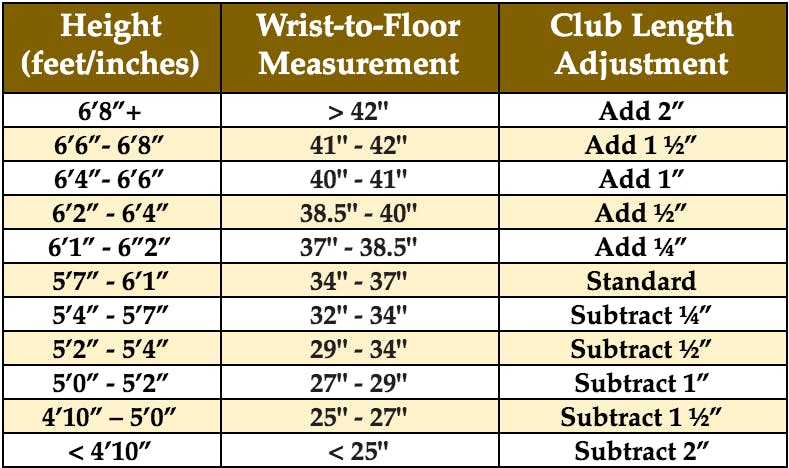
Image Source: curated-uploads.imgix.net
Why Size Matters in Golf Clubs
Using clubs that fit your body size and swing style is super important. It helps you:
- Stand right: The correct club length helps you get into a good posture over the ball.
- Swing smoothly: Clubs that fit let your arms and body move together in a balanced way.
- Hit the ball well: A proper fit makes it easier to hit the center of the clubface, sending the ball where you want it to go.
- Avoid problems: Using clubs that don’t fit can cause back pain or swing faults.
Finding the right size isn’t just for expert players. Even beginners will learn faster and feel more comfortable with clubs that fit them well from the start.
Key Ways to Figure Out Your Club Size
There are a few main ways people figure out what size clubs they need. They range from simple checks at home to detailed sessions with an expert.
- Using Height Charts: Many companies offer charts that suggest club lengths based only on your total height. This is a quick way to get a rough idea.
- Using Wrist-to-Floor Measurement: This is a more common and often better starting point than just height. It takes into account your arm length, which affects how you stand and swing.
- Trying Clubs: Simply holding and swinging different clubs can give you a feel for what works.
- Professional Custom Fitting: This is the best way. A trained fitter uses your body measurements, swing data, and your own feel to pick the perfect clubs for you.
Let’s look closer at the most common methods.
Using Your Height for Golf Clubs
Your total height is the simplest starting point. Most ready-made club sets are made for people of average height. If you are significantly taller or shorter than average, you will likely need clubs that are longer or shorter than the standard golf club length.
Here is a very basic idea of how height relates to club length:
- Very Short Adults (Under 5’0″): Often need junior clubs or women’s petite length clubs.
- Short Adults (5’0″ to 5’5″): May need clubs that are shorter than standard. Women’s standard length might fit.
- Average Height Adults (5’5″ to 5’10”): Standard length clubs usually work.
- Tall Adults (5’10” to 6’2″): May need clubs that are slightly longer than standard (+0.5 inches).
- Very Tall Adults (Over 6’2″): Often need clubs that are significantly longer than standard (+1 inch or more).
Important Note: Using only height is a very rough estimate. Two people of the same height can have different arm lengths, which changes how long their clubs should be. This is where the wrist-to-floor measurement comes in.
Figuring Out Your Wrist to Floor Measurement Golf
The wrist to floor measurement golf is a much more reliable way to estimate club length than just using your total height. It measures the distance from the crease in your wrist (where your hand meets your arm) down to the floor when you are standing up straight and letting your arms hang naturally by your sides.
Why is this measurement important? Because it shows how far your hands are from the ground when you are standing tall. When you take your golf stance, your hands will be some distance from the ground depending on your posture and how much you bend your knees. But the wrist-to-floor measurement gives a consistent reference point that relates directly to how upright or bent over you will be when addressing the ball with a club of a certain length.
Here’s how to measure your wrist to floor distance:
- Stand tall: Stand on a hard, flat surface like a floor. Do not stand on carpet.
- Stand straight: Keep your posture natural and straight. Do not slouch or lean.
- Let arms hang: Let your arms hang relaxed at your sides. Do not reach or stretch your fingers towards the floor.
- Have help: It’s easiest if someone else measures for you.
- Measure: The helper should measure the distance from the crease in your wrist (the fold closest to your hand) straight down to the floor. Use a measuring tape.
- Be accurate: Measure to the nearest quarter or eighth of an inch if possible.
This measurement is a key piece of information used in most golf club size chart systems that go beyond just total height.
Fathoming the Golf Club Size Chart
Most golf club size chart systems use both your total height and your wrist-to-floor measurement to suggest a starting club length. These charts look at where these two numbers intersect to recommend if you need clubs that are standard length, shorter, or longer, and by how much.
Here is a simplified example of how a chart might look:
| Player Height | Wrist to Floor Measurement | Suggested Club Length Adjustment (from Standard) |
|---|---|---|
| Under 5’0″ | Under 26″ | -2 inches (or Junior/Petite) |
| 5’0″ – 5’4″ | 26″ – 28″ | -1 inch to -1.5 inches |
| 5’0″ – 5’4″ | 28″ – 30″ | -0.5 inches to Standard |
| 5’5″ – 5’9″ | 29″ – 31″ | Standard |
| 5’5″ – 5’9″ | 31″ – 33″ | +0.5 inches |
| 5’10” – 6’2″ | 32″ – 34″ | Standard to +0.5 inches |
| 5’10” – 6’2″ | 34″ – 36″ | +0.5 inches to +1 inch |
| Over 6’2″ | Over 35″ | +1 inch or more |
Note: This is a very basic example. Actual charts from club makers or fitters are often more detailed.
To use a chart like this, you find your height in the left column and your wrist-to-floor measurement across the top row (or find where they meet if it’s a grid). The box where they meet will give you a suggested adjustment to the standard golf club length.
For example, if you are 5’7″ tall and your wrist-to-floor measurement is 30 inches, a chart might suggest you need standard length clubs. If you are 6’1″ with a wrist-to-floor of 35 inches, it might suggest clubs that are +1 inch longer than standard.
Remember, these charts give you a starting point. They are better than just guessing, but they don’t consider everything. Your swing, strength, and how you naturally stand to the ball also play a role.
Comprehending Standard Golf Club Length
What exactly is the standard golf club length? There isn’t one single length that is “standard” for all clubs. Instead, there are standard lengths for different types of clubs in a set. These lengths have been developed over time to suit what is considered an average male or female golfer.
Here are approximate standard lengths for some common clubs for men and women:
Approximate Standard Men’s Club Lengths:
- Driver: 45 – 45.75 inches
- 3-Wood: 43 inches
- 5-Wood: 42 inches
- Hybrid (e.g., 3H): 40.5 inches
- 4-Iron: 38 inches
- 7-Iron: 37 inches
- Pitching Wedge: 35.75 inches
- Sand Wedge: 35.5 inches
- Putter: 33 – 35 inches
Approximate Standard Women’s Club Lengths:
Women’s clubs are typically shorter than men’s clubs, often by about 0.5 to 1 inch, and are also lighter.
- Driver: 44 inches
- 3-Wood: 42 inches
- Hybrid (e.g., 3H): 39.5 inches
- 4-Iron: 37 inches
- 7-Iron: 36 inches
- Pitching Wedge: 34.75 inches
- Sand Wedge: 34.5 inches
- Putter: 32 – 34 inches
When a chart suggests you need clubs that are “+0.5 inches” or “-1 inch”, they mean you should add or subtract that amount from these standard lengths for each specific club in the set. So, if you need clubs +0.5 inches longer, a 7-iron for a man would be 37.5 inches instead of 37 inches.
These lengths are measured from the heel of the club head to the butt end of the grip.
How to Measure for Golf Clubs Yourself (Basic)
While professional fitting is best, you can do some basic measurements at home to get an idea of what size you might need. We already covered the wrist-to-floor measurement. Let’s add the total height measurement steps.
Measuring Total Height:
- Stand against a wall: Stand on a flat floor with your back against a wall. Take off your shoes.
- Stand straight: Stand as tall as you can, looking straight ahead.
- Use a flat object: Place a ruler or a flat book on top of your head, making sure it is level and touching the wall.
- Mark the spot: Lightly mark the wall with a pencil at the bottom edge of the ruler/book.
- Measure: Use a tape measure to measure the distance from the floor up to the mark.
Once you have your total height and your wrist-to-floor measurement, you can use these numbers with a golf club size chart from a club manufacturer’s website or a golf retailer.
Remember, these home measurements are just a starting point to estimate the correct golf club length for you. They are not a substitute for trying clubs or getting fitted.
Golf Club Shaft Length by Height and Other Factors
The chart based on height and wrist-to-floor gives you a starting point for the overall club length, which is mostly determined by the golf club shaft length by height and arm length. However, the shaft itself has other important properties.
The shaft is the long, thin part of the club connecting the grip to the club head. Shafts come in different materials (steel or graphite) and, importantly, different flexes (how much the shaft bends during the swing).
- Shaft Flex: This needs to match your swing speed. If you swing fast, you need a stiffer shaft (like Stiff or Extra Stiff). If you swing slower, you need a more flexible shaft (like Ladies, Senior, or Regular). Using the wrong flex shaft can cause the clubface to be open or closed at impact, leading to slices or hooks, even if the club length is right.
- Shaft Weight: Lighter shafts can help slower swingers increase speed. Heavier shafts offer more control for faster swingers.
While height and wrist-to-floor primarily determine the suggested shaft length, your swing speed and how you load the shaft during your swing will help a fitter decide on the best shaft material, flex, and weight for you. This is part of a full custom golf club fitting.
Grasping Golf Club Lie Angle
Beyond the length of the club shaft, another critical fitting factor is the golf club lie angle. The lie angle is the angle between the center of the shaft and the ground when the club head is resting naturally on the ground.
Imagine you are in your golf stance, setting the club behind the ball.
- Correct Lie Angle: The sole (bottom) of the club head sits perfectly flat on the ground.
- Lie Angle Too Upright: The toe of the club head (the part furthest from you) is off the ground, pointing slightly upwards.
- Lie Angle Too Flat: The heel of the club head (the part closest to you) is off the ground, pointing slightly upwards.
Why does this matter? Because the lie angle affects the direction the ball starts traveling.
- If the toe is up (lie is too upright), the clubface points slightly left of the target at impact (for a right-handed golfer). This can cause hooks or pulls.
- If the heel is up (lie is too flat), the clubface points slightly right of the target at impact (for a right-handed golfer). This can cause slices or pushes.
Someone who is tall with long arms might need a more upright lie angle because they stand taller. Someone who is short with shorter arms might need a flatter lie angle. Your swing also affects the lie angle you need. If you tend to dig the heel or toe into the ground, adjusting the lie angle can help.
During a custom golf club fitting, the fitter will watch you hit balls off a lie board (a plastic board that shows marks from the sole of the club) to see how the clubhead sits at impact. They can then bend the hosel (the part connecting the shaft to the head) to adjust the lie angle to fit your swing.
A basic golf club size chart based on height and wrist-to-floor might also suggest a lie angle adjustment (e.g., +1 degree upright or -2 degrees flat), but checking this on the range is much better.
Interpreting the Problems with Wrong Size Golf Clubs
Using clubs that are the wrong size can seriously hurt your game and even your body. Here are some wrong size golf clubs problems:
- Poor Posture: Clubs that are too long force you to stand too upright, while clubs that are too short force you to bend over too much. Neither position is balanced or powerful.
- Inconsistent Contact: When clubs don’t fit, it’s harder to consistently hit the center of the clubface (the sweet spot). This leads to weak shots, slices, hooks, and generally unpredictable ball flight.
- Swing Compensations: Your body is smart. If a club doesn’t fit, you will naturally make adjustments in your swing to try and make it work. These “compensations” are often unnatural and lead to bad habits that are hard to break. For example, with clubs that are too short, you might stand closer to the ball and lift up during the swing. With clubs that are too long, you might stand too far away and feel off-balance.
- Lie Angle Issues: As mentioned, incorrect club length often goes hand-in-hand with an incorrect lie angle. This makes it very hard to aim the clubface correctly at impact.
- Loss of Power and Control: A swing that isn’t comfortable or balanced can’t generate maximum clubhead speed or control the direction of the shot effectively.
- Physical Pain: Repeatedly swinging clubs that don’t fit can put strain on your back, wrists, elbows, or shoulders. This can lead to injuries over time.
- Slow Learning: Beginners using ill-fitting clubs will find it much harder to learn proper swing mechanics and make consistent contact. This can be frustrating and make golf less enjoyable.
Avoiding these wrong size golf clubs problems starts with getting clubs that are close to your ideal size, ideally through a fitting.
The Value of Custom Golf Club Fitting
While using a golf club size chart and your home measurements is a decent starting point, a custom golf club fitting is the best way to ensure your clubs are right for you. It takes into account not just your height and arm length but also how you swing the club.
What happens during a fitting?
- Interview: The fitter talks to you about your game, your goals, any problems you have, and what you want from new clubs.
- Physical Measurements: They will measure your height and your wrist-to-floor distance, just like you would at home, but with more precision.
- Swing Analysis: This is the most important part. You hit balls on a driving range or into a simulator. The fitter uses tools like launch monitors (e.g., TrackMan, Foresight) to gather data about your swing and the ball flight. This data includes:
- Clubhead speed
- Ball speed
- Launch angle
- Spin rate
- Attack angle
- Path
- Face angle
- Dynamic lie angle (how the lie angle is at impact)
- Club Testing: Based on your measurements and swing data, the fitter will have you try different clubs with varying lengths, lies, lofts, shafts (material, flex, weight), and club heads.
- Observation: The fitter also watches your posture, balance, and how the club interacts with the ground. They might use a lie board to check the lie angle at impact.
- Recommendations: Based on all the information, the fitter recommends specific club specs for you – the correct golf club length, lie angle, shaft type, grip size, and club head model.
Why is this better than just using a chart? A chart can suggest a length, but it doesn’t know if you have a very upright swing, a flat swing, a fast swing speed, or if you tend to stand closer or further from the ball than average for your height/arm length. A fitting sees all of this and fits the club to your actual swing.
Even if you buy a standard set of clubs, knowing your recommended length and lie angle from a fitting can help you choose a set that is closer to what you need or tell you if you need clubs bent to a different lie angle after purchase.
More Factors in Custom Fitting
While length and lie angle are key parts of determining the correct golf club length and overall fit, a full custom golf club fitting looks at more details:
- Grip Size: The thickness of the grip affects how you hold the club and how your hands release through impact. Grips that are too small can make you use your hands too much, leading to hooks. Grips that are too big can make it hard to properly release the clubface, leading to pushes or slices. A fitter measures your hand size and finger length to recommend the right grip size.
- Club Head Design: Different club heads are designed for different types of players. Some are made for maximum forgiveness (helping shots hit off-center), while others are designed for workability (allowing skilled players to shape shots). A fitter helps you choose a head design that matches your skill level and goals.
- Club Set Makeup: A fitter can help you decide which clubs you actually need in your bag. Do you need a 5-wood or a 3-hybrid? Should you carry 4 wedges or 3? They help build a set that covers the distances you hit the ball.
- Swing Weight: This is about how the weight feels when you swing the club. It’s a balance point measurement. Clubs can have the same total weight but different swing weights, making them feel heavy in the head or more balanced. Fitters can adjust this by adding weight to the head or grip.
All these elements work together to create clubs that feel right in your hands and help you make your best swing.
Checking Club Fit Before a Professional Fitting
If you are buying used clubs or can’t get a full fitting right away, you can do a simple check to see if a club is roughly the right length for you.
- Stand next to the club: Stand straight up, holding the club next to you with the clubhead on the ground.
- See where the grip comes up to: With most irons, the end of the grip should come up to about the base of your wrist when you are standing tall with your arm hanging naturally. This is a very, very rough check.
A slightly better check involves getting into your address posture (how you stand over the ball).
- Get in your stance: Take your normal golf stance with an iron behind the ball (or where the ball would be).
- Observe the clubhead: Look at how the sole of the clubhead rests on the ground. Is it sitting flat? Or is the toe or heel noticeably off the ground?
- Check your posture: Do you feel comfortably bent over from your hips? Or are you reaching or feeling cramped?
If the clubhead sole is sitting very unevenly on the ground, or you feel very uncomfortable in your stance, the club length (or lie angle) is likely not right for you.
Remember, these checks are not perfect. Your swing changes what happens at impact. But they can give you a basic idea if a set of clubs is wildly off for your size based on the height for golf clubs and how you naturally stand.
Recapping How To Tell What Size Golf Clubs You Need
To sum it up, finding the correct golf club length and overall fit involves several steps, moving from simple measurements to a detailed analysis of your swing.
- Start with Measurements: Your total height and, more importantly, your wrist to floor measurement golf are the key numbers.
- Use Charts as a Guide: Consult a golf club size chart based on these measurements to get a starting recommendation for club length adjustment (shorter or longer than standard golf club length). This also might suggest a starting point for golf club lie angle adjustment.
- Be Aware of Issues: Know the wrong size golf clubs problems like poor posture, inconsistent hitting, and pain.
- Consider Your Swing: Realize that swing speed affects shaft flex, and your swing path affects the dynamic lie angle needed.
- Prioritize Fitting: For the best results, get a custom golf club fitting. A professional fitter uses data and observation to match clubs perfectly to your body and swing.
Even if you can’t afford a full bag fitting, getting fitted for your most used clubs (like the driver or irons) can make a big difference. Many fitters also offer just a driver fitting or an iron fitting.
Choosing the right size golf clubs is a crucial step toward playing better golf and enjoying the game more. Don’t overlook this important factor!
Frequently Asked Questions (FAQ)
Q: Can I just buy a standard set of clubs based on my height?
A: You can, and many people do, especially when starting out. However, it’s like buying shoes based only on whether you are a man or a woman, without checking the size number. It’s a very rough guess. Using your height and wrist-to-floor measurement with a golf club size chart is a better starting point, but still not perfect. A custom golf club fitting is always the best option for finding the correct golf club length and ensuring the clubs truly fit your body and swing.
Q: How much difference does half an inch make in club length?
A: For many golfers, even half an inch can make a noticeable difference in how the club feels and how they stand to the ball. It can also slightly change the lie angle at impact and swing weight. While very skilled golfers might adjust easily, most players benefit from having clubs as close to their ideal length as possible. Small changes can lead to big improvements in consistency and comfort.
Q: Is a custom fitting expensive?
A: The cost of a custom golf club fitting varies. Some golf stores offer free fittings if you buy clubs from them. Others charge a fee, which might be applied towards the cost of clubs if you buy them. While there’s an upfront cost, many golfers find that hitting better shots and enjoying the game more is well worth the investment. Plus, well-fitting clubs can prevent you from developing bad habits or needing to buy new clubs sooner because the first set didn’t fit.
Q: How often should I get fitted for golf clubs?
A: It’s generally a good idea to get fitted when you are new to golf and buying your first set, or when you are looking to upgrade your clubs. You might consider getting refitted if you have significant changes in your physical size, strength, or swing technique, or if it’s been many years since your last fitting.
Q: Does grip size really matter?
A: Yes, absolutely. Grip size is often overlooked but is very important. Grips that are too big or too small can affect how your hands work during the swing, influencing how you release the clubface. This can lead to hooks or slices. A custom golf club fitting includes checking your hand size to recommend the right grip thickness.
Q: Can my existing clubs be adjusted?
A: Often, yes. The length of most clubs can be slightly adjusted (cut shorter or extended longer), although major length changes might affect shaft flex and swing weight. The lie angle of most forged irons and wedges can also be bent slightly by a qualified club fitter. Cast clubs are harder to bend but sometimes possible. Woods and hybrids are generally not adjustable for lie angle. A fitter can tell you what adjustments are possible for your current set.