
Image Source: golfdigestme.com
Putting Strategy: How To Read Greens Golf Like a Pro
Do you wonder what green reading means in golf? It means figuring out how your ball will roll on the putting surface. It helps you see where to hit your putt so it goes in the hole. Can you learn to read greens like a pro? Yes, you can! This guide will show you how. It will help you improve your golf putting strategy. You will learn important green reading techniques to make more putts.
Green reading is a key skill in golf. It helps you decide where to aim. It also helps you hit the ball with the right speed. Good green reading makes a big difference in your score. Let’s look at how the pros do it.
Grasping the Basics of Green Reading
Reading greens is like solving a puzzle. You need to gather clues. The goal is to find the best line for your putt. This line is not always straight. It curves because of how the green slopes. It also changes based on how fast the green is.
What to Look For First:
Before you even step on the green, start watching. Look at the land around the green. Hills and valleys nearby can tell you where water would flow. Water always flows downhill. This gives you a big clue about the overall slope of the green.
When you walk onto the green, take your time. Walk all around your ball and the hole. Don’t rush this step. It is very important.
Seeing the Big Picture
Imagine pouring water on the green. Where would it go? This is called the “fall line.” The fall line is the path water would take straight downhill. It tells you the steepest part of the green. Everything breaks away from this line.
Tips for Finding the Fall Line:
- Walk a Full Circle: Walk around the hole. Pay attention to how the ground feels under your feet. Does one side feel higher?
- Use Your Feet: Stand with your feet shoulder-width apart. Let your body feel which way it wants to lean. Your inner ear helps with balance. It can sense slopes.
- Look from Low to High: Stand behind your ball. Then, walk to the hole and look back at your ball. This helps you see the slope from different angles. It can make bumps and dips more clear.
Deciphering Slope Analysis Golf
Slope is the biggest reason a ball breaks. The steeper the slope, the more the ball will curve. Learning to read slopes is vital for break prediction putting.
How Slope Affects Your Putt:
- Uphill Putts: These putts are slower. The ball needs more power to reach the hole.
- Downhill Putts: These putts are faster. The ball needs less power. They also break more.
- Sidehill Putts: These are the trickiest. The ball will curve a lot. You must aim above the hole.
Ways to Analyze Slope
There are several ways to analyze green undulations. Each gives you more information.
-
Visual Inspection:
- Low Angle View: Get low to the ground. Look from behind your ball. Look from behind the hole. Look from both sides. This helps you see small bumps and dips you might miss when standing tall.
- Shadows: On sunny days, shadows can show slopes. The side of a bump facing the sun will be bright. The other side will be dark. This helps define contours.
- Hole Drainage: Look at the edges of the hole. Sometimes, one side of the cup looks a bit higher. This can show you the slope around the hole itself.
-
Feel with Your Feet:
- As you walk, pay attention to the pressure on your feet. If your weight shifts to your right foot, the ground slopes down to your left. Your body is a good sensor.
- Walk from your ball to the hole. Walk around the hole. Feel for changes in height.
-
The “Plumb Bob” Method:
- This is an old technique. Hold your putter out in front of you. Let it hang straight down. Close one eye. Line up the putter shaft with the hole. The green will look higher or lower on one side of the shaft. This shows you the slope.
- Caution: This method only works if your eyes are level. It also works best on simple slopes. It might not be perfect for complex greens.
-
AimPoint Golf:
- AimPoint is a modern green reading system. It uses your fingers to measure slope.
- You stand between your ball and the hole. You hold up your fingers to block out the hole. The number of fingers you need to block out the break tells you how much to aim left or right.
- AimPoint is very precise. It takes practice to learn. Many pros use it. It helps with break prediction putting by giving you a clear target line.
Table: How Slope Affects Putt Break
| Slope Type | Ball Speed | Break Direction | Aim Point |
|---|---|---|---|
| Uphill | Slower | Less Break | Aim slightly less break than flat |
| Downhill | Faster | More Break | Aim much more break than flat |
| Left-to-Right | Varies | Right | Aim Left of hole |
| Right-to-Left | Varies | Left | Aim Right of hole |
| Flat | Consistent | Minimal Break | Aim straight |
Judging Green Speed: A Crucial Skill
Green speed is how fast the ball rolls. A fast green means the ball rolls far with little effort. A slow green means you need to hit it harder. Judging green speed is vital for distance control. Without the right speed, even a perfect line will miss.
Factors That Change Green Speed
- Grass Length: Shorter grass means faster greens.
- Moisture: Dry greens are fast. Wet greens are slow. After rain, greens slow down a lot.
- Green Rollers: Courses use rollers to make greens smooth and fast.
- Time of Day: Greens might be slower in the morning due to dew. They speed up as they dry and get cut.
- Type of Grass: Different grasses roll at different speeds. Bentgrass is often faster than Bermuda grass.
How to Measure Green Speed
- Practice Putts: On the practice green, hit some putts. Pay attention to how far the ball rolls. This is your best guide for the day.
- Observe Others: Watch your playing partners. How far do their putts roll? This gives you clues about the speed.
- Listen to the Pro: Ask the golf pro or the caddy about the green speed. They often know.
- Feel the Green: Touch the grass. Is it soft and damp, or firm and dry?
- Stimp Meter (Not for Players): Golf courses use a “Stimp Meter” to measure speed. It’s a ramp that rolls a ball. The distance the ball travels tells the speed. You won’t use one, but knowing about it helps you understand how courses set speeds.
Remember: Speed and line work together. If your speed is off, your line will be off too. A putt hit too hard will cut across a break. A putt hit too soft will fall below the hole.
Interpreting Green Contours
Greens are rarely flat. They have various curves, bumps, and valleys. These are called contours and undulations. Analyzing green undulations helps you see the complex paths a putt might take.
Types of Contours You Will See
- Tiered Greens: These greens have two or more levels. If your ball is on one tier and the hole is on another, the putt will be very difficult. The ball will speed up or slow down greatly when it hits the slope between tiers.
- Bowl-Shaped Greens: These greens dip down in the middle. Putts to the center might seem easy. But if you hit it too hard, it can roll past and off the green.
- Turtleback Greens: These greens are higher in the middle and slope down on all sides. It’s tough to keep the ball on these greens if you miss.
- Subtle Bumps and Ridges: Even small bumps can make a big difference. They can create “double breaks” where the ball curves one way, then another.
Mapping the Green
- Walk Your Line: Walk the path your ball might take. Feel the ground. Look at the general flow of the land.
- Identify High and Low Spots: Find the highest point on your putting line. Find the lowest point. This helps you map the putt’s journey.
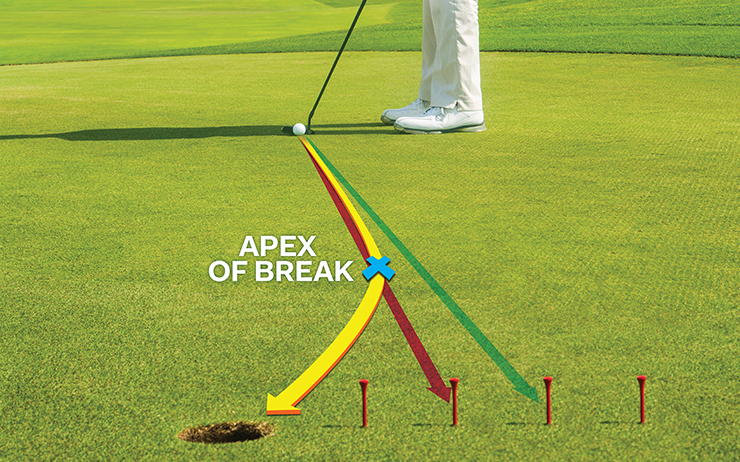
- Consider the Apex: The apex is the highest point your ball will reach on its break before it starts to turn towards the hole. Visualizing putting lines means seeing this apex.
Example of a Complex Green Contour:
Imagine a green that slopes mostly from left to right. But right before the hole, there is a small hump that causes a slight right-to-left break. This is a double break. You need to see both parts of the break. You must aim further left at first, then account for the second small break.
Reading Grain on Greens: The Hidden Factor
Grain is the direction the grass grows. It’s often overlooked by amateur golfers, but pros pay close attention. Grain affects both speed and break.
How Grain Affects Your Putt
- With the Grain: If you putt with the grain, the ball rolls faster. There is less friction. The ball breaks less.
- Against the Grain: If you putt against the grain, the ball rolls slower. There is more friction. You need to hit it harder. The ball might break more or less depending on the slope and how much the grain stands up.
- Across the Grain: If you putt across the grain, the ball might move slightly in the direction the grain points.
How to Spot the Grain
- Look for Color: Grass growing with the sun or away from you often looks shiny or lighter green. Grass growing against the sun or towards you looks dull or darker green.
- Look at the Hole: The edges of the hole can tell you a lot. The grass around the hole often grows towards the setting sun. If the grass on one side of the hole looks torn or ragged, the grain is growing in that direction. This is because the hole cutter pulls the grass as it spins.
- Observe Footprints: Sometimes, you can see how footprints in the dew or wet grass point. This indicates the grain’s direction.
- Putting History: On busy greens, the grain might be pushed in the direction of common putts.
Important Note: Grain usually has less effect than slope or speed. But on very fast, flat greens, grain can be the main factor for a small break.
Visualizing Putting Lines: Seeing the Path
Once you have analyzed the slope, speed, contours, and grain, it’s time to put it all together. Visualizing putting lines is about seeing the path your ball will take in your mind’s eye.
Steps to Visualize Your Putt
- Pick a Spot: After gathering all your clues, find a spot on the green where you want your ball to start. This is your aim point. It might be a blade of grass, a discolored spot, or a tiny divot.
- Trace the Line: From your ball, trace the entire path to your aim point, and then from your aim point to the hole. See the ball rolling, curving, and slowing down.
- Imagine the Ball: Think of the ball falling into the hole. Does it enter from the high side or the low side? This helps confirm your read.
- Walk the Line (Optional): Some pros like to walk the exact line their ball will take. This helps them feel the slope one last time and commit to the line.
- Commit: Once you have a line, trust it. Do not change your mind at the last second.
Power of Imagination:
Many top golfers use this technique. Jack Nicklaus famously said he never hit a putt without seeing it go into the hole first. Your mind can help your body make the right stroke.
Developing Your Golf Putting Strategy
Green reading is part of a larger golf putting strategy. It’s not just about seeing the line. It’s about knowing how to play it.
Key Elements of a Strong Putting Strategy
- Read from Both Sides: Always read your putt from behind the ball and from behind the hole. Sometimes, even from the side. This gives you different perspectives.
- The “High Side” Rule: On breaking putts, it’s almost always better to miss on the high side of the hole. If you miss on the low side, the ball will keep rolling away. If you miss on the high side, gravity can still pull it down towards the hole.
- Pace is King: As discussed, speed is as important as line. If you misread the break by a little but hit the putt with perfect speed, it might still go in or end very close. If you get the line perfect but the speed is off, you will likely miss by a lot.
- Practice Green Time: Use the practice green to hone your skills.
- Practice reading tricky breaks.
- Hit putts to different targets to feel different speeds.
- Hit putts from flat lies, uphill lies, and downhill lies.
- Don’t Over-Read: Sometimes, less is more. Don’t let yourself get confused by too many details. Focus on the main slope and the speed.
- Trust Your First Impression: Your first read is often the best. Don’t second-guess yourself too much. This can lead to paralysis by analysis.
Pre-Putt Routine
Having a good pre-putt routine helps you apply your green reading.
- Analyze: Walk around, get low, feel the slope. Take note of grain and speed.
- Visualize: Pick your aim spot. See the ball roll into the hole.
- Address the Ball: Get comfortable over the ball. Align your putter face to your aim spot.
- Stroke: Make a smooth, confident stroke.
Table: Common Putting Mistakes and Solutions
| Mistake | Effect on Putt | Solution |
|---|---|---|
| Not reading slope well | Misses left/right | Walk around the hole; use low angle view; feel with feet |
| Not judging speed | Too short/too long | Practice green speed; observe others; feel grass |
| Ignoring grain | Slight misses | Look for color changes; check hole edges |
| Not visualizing line | Lack of confidence | Pick an aim spot; trace the ball’s path in your mind |
| Overthinking | Hesitation, poor stroke | Trust your first read; stick to your routine |
| Hitting too hard downhill | Blows past hole | Lighten grip; shorter backstroke; focus on touch |
| Hitting too soft uphill | Doesn’t reach hole | Longer backstroke; focus on smooth follow-through |
Final Thoughts on Green Reading
Reading greens is a skill that gets better with practice. It’s not about being perfect. It’s about getting better each time. The more you play, the more you learn. Pay attention to how your putts react. What did you miss? What did you get right? Learn from every putt.
Good green reading saves strokes. It builds confidence. It makes golf more fun. So next time you are on the green, take your time. Be a detective. You will be amazed at how quickly your putting improves.
Frequently Asked Questions (FAQ)
Q1: How long does it take to learn to read greens like a pro?
A1: It takes time and practice. Pros spend years honing their skills. But you can see big improvements quickly by using these tips. Practice often. Learn from each putt you hit.
Q2: Is AimPoint golf worth learning for an amateur?
A2: AimPoint is a very good system. It can be very useful for amateurs. It takes practice to learn, but it gives you a clear method. If you play a lot and want to get serious about putting, it’s a great tool.
Q3: Does the brand of golf ball affect green reading?
A3: Not really. The ball’s weight and spin do not change how the green slopes or how fast it is. A better ball might roll more true, but it won’t change your read of the green.
Q4: What is the most important factor in green reading: slope, speed, or grain?
A4: Slope and speed are almost always the most important factors. Slope tells you the general path. Speed tells you how much that path will curve. Grain is usually a minor factor, except on very flat, fast greens. Focus on slope and speed first.
Q5: Should I use a golf app to help read greens?
A5: Some apps can show you green contours. This can be helpful for studying greens before a round. But during play, rules of golf might limit using them. Check the rules (Rule 4.3). Also, your own eyes and feel are best for actual putts. Use apps for learning, not as a crutch.