
Image Source: www.hagginoaks.com
Expert Guide: How To Measure Golf Clubs For Kids Accurately
What is the most important thing for young golfers? It is having the right clubs. Can you just buy any clubs for your child? No, you should not. Who needs to know this? All parents, coaches, and guardians of young golfers. Getting the right size clubs is very important. This guide will show you how to measure golf clubs for kids. It helps you pick the perfect set. This way, your child can learn and play golf better. It also makes the game more fun for them. This is the importance of proper junior golf club fit.
Why Proper Fit Matters So Much
Small clubs are key for young players. Think of a child wearing shoes that are too big. They will trip. They cannot run well. Golf clubs are the same. If clubs are too long, too short, or too heavy, kids struggle. They cannot swing well. This hurts their game. It can also make them not like golf.
Bad Fit Problems
A bad fit causes many problems. Your child might stand too far from the ball. Or they might stand too close. Their swing path changes. They might swing too flat or too upright. This means the club face hits the ball wrong. The ball will not go straight. It will not go far. This leads to frustration. It can make them quit golf.
Avoiding Injuries
Wrong size clubs can even cause injuries. Heavy clubs strain small muscles. Long clubs make kids bend too much. Short clubs make them reach. All of these put stress on their back, wrists, and shoulders. Over time, this can lead to pain. It can cause long-term problems. Proper size golf clubs for juniors prevent this. They let your child swing safely.
Building Good Habits
The right clubs help build good habits. When a club fits, a child can learn the right swing. They can make proper contact with the ball. They learn balance. They learn how to use their body well. These good habits stay with them. They are the base for better play later. A good fit lets them focus on learning. They do not have to fight the club. This is a key part of kids golf club fitting tips.
Grasping Club Measurement Basics
What is golf club length? It is the total length of the club. You measure from the top of the grip to the bottom of the club head. You measure along the shaft. This is a key step in measuring golf club length for kids.
Parts of a Club
Every golf club has parts. There is the grip. This is where your child holds the club. There is the shaft. This is the long stick part. Then there is the club head. This is the part that hits the ball. Knowing these parts helps you measure correctly.
Tools You Need
You only need a few simple tools. Get a measuring tape. A standard tape measure works fine. A yardstick also works. Make sure it is long enough. You will also need a flat surface. A floor or a table is good. A pencil and paper are handy. Use them to write down measurements.
Steps for Measuring Golf Club Length for Kids
Here is how to measure a golf club:
- Lay the club flat: Put the club on a flat floor. Make sure the sole of the club head is flat on the ground.
- Straighten the shaft: Make sure the shaft is straight. It should not be bent or twisted.
- Place the tape: Put the end of your measuring tape at the very top of the grip.
- Measure to the heel: Extend the tape down the shaft. Measure all the way to the heel of the club head. The heel is where the shaft meets the club head.
- Record the number: Write down the measurement in inches. This is the club’s length.
How To Measure Your Child
Measuring your child is as important as measuring the club. You need two main numbers. These are their height and their wrist-to-floor distance. This height-based golf club fitting for children is very helpful.
Getting Ready for Measurement
Make sure your child is ready. They should stand straight. Their feet should be together. They should not wear shoes. This gives the most accurate height.
How to Measure Height
- Find a wall: Stand your child against a flat wall. Make sure they are not leaning.
- Use a book: Place a thin book or ruler flat on top of their head. Make it touch the wall.
- Mark the spot: Make a small pencil mark on the wall. Mark where the bottom of the book is.
- Measure from floor: Use your tape measure. Measure from the floor up to the mark.
- Record height: Write down their height in inches.
Wrist-to-Floor Measurement
This measurement is also very important. It tells you how long their arms are. It helps choose the right club length.
- Stand straight: Have your child stand straight. Their arms should hang loosely at their sides.
- Relax hands: Their hands should be relaxed. Do not let them stretch or tense.
- Measure from floor: Use your tape measure. Measure from the floor to the crease in their wrist. This is the line where their hand meets their arm.
- Record number: Write down this measurement in inches.
Why Both Matter
Both height and wrist-to-floor matter. Height gives a general idea. It is good for a quick size check. Wrist-to-floor is more exact. It accounts for arm length. Some kids are tall but have shorter arms. Others are shorter but have long arms. Both measurements give the best fit. This helps you get the proper size golf clubs for juniors.
The Junior Golf Club Sizing Guide
This part will help you use your measurements. It will guide you to the right club size. This is your junior golf club sizing guide.
General Rules for Kids
Generally, golf clubs for kids are shorter and lighter. The club head is also smaller. This makes it easier for them to swing. It makes it easier to hit the ball. Do not just cut down adult clubs. Kid clubs are made for kids. They have special weight and flex.
Age-Appropriate Golf Club Size for Kids
Age is a starting point. It gives a rough idea. Remember, kids grow at different rates. One 6-year-old might be much taller than another. Always use age as a general guide. Then use height for a better fit.
Table 1: General Age-Based Junior Golf Club Sizing
| Age Range (Years) | Height Range (Inches) | Recommended Club Length Range (Inches) | What Clubs They Might Need |
|---|---|---|---|
| 2-4 | 36-42 | 20-26 | Putter, 7-iron, Driver |
| 5-6 | 42-46 | 26-30 | Putter, 7-iron, Wedge, Driver, Fairway Wood |
| 7-8 | 46-50 | 30-34 | Putter, Irons (7, 9), Wedge, Driver, Fairway Wood |
| 9-10 | 50-54 | 34-38 | Putter, Irons (7, 9), Wedge, Hybrid, Driver, Fairway Wood |
| 11-12 | 54-60 | 38-42 | Putter, Irons (6, 7, 8, 9), Wedge, Hybrid, Driver, Fairway Wood |
| 13+ | 60-65+ | 42-45+ | Transitioning to adult clubs |
Note: These are general ranges. Always use actual measurements for best fit.
Height-Based Golf Club Fitting for Children
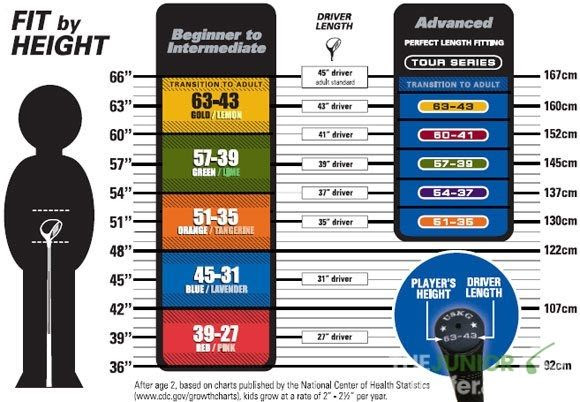
This is the most accurate way. It uses your child’s exact height. This is called a youth golf club length chart. It is a very good guide for how to choose junior golf clubs by height.
Table 2: Youth Golf Club Length Chart by Height (Recommended Driver/7-Iron Length)
| Child’s Height (Inches) | Driver Length (Inches) | 7-Iron Length (Inches) | General Age Range |
|---|---|---|---|
| 36 – 42 | 26 – 28 | 20 – 22 | 2-4 |
| 42 – 46 | 28 – 30 | 22 – 24 | 5-6 |
| 46 – 50 | 30 – 32 | 24 – 26 | 7-8 |
| 50 – 54 | 32 – 34 | 26 – 28 | 9-10 |
| 54 – 58 | 34 – 36 | 28 – 30 | 11-12 |
| 58 – 62 | 36 – 38 | 30 – 32 | 12-14 |
| 62 – 65+ | 38 – 40+ | 32 – 34+ | 14+ (Adult transition) |
Note: These lengths are approximate. Specific brands may vary slightly. The 7-iron is a good benchmark. Other clubs will be shorter or longer.
Considering Skill Levels
Skill level also matters a little. A total beginner might do well with fewer clubs. A more advanced player might want more clubs. But size is always number one.
Beginner Kids Golf Club Size Advice
For a beginner, simplicity is best. Do not overwhelm them. A beginner kids golf club size set often includes:
- A driver: For hitting long shots from the tee.
- A 7-iron: A good all-around club for many shots.
- A putter: For putting the ball into the hole.
Some sets might add a hybrid or a wedge. Start simple. Let them learn the basics. Then add more clubs as they grow.
Kids Golf Club Fitting Tips for Success
Beyond just length, other things matter. These kids golf club fitting tips help ensure a perfect fit.
Test Swing Matters
Always let your child swing the club. Even if it looks right by numbers, a swing test is key.
- Watch their posture: Do they stand tall and comfortable? Or are they bending too much? Are they reaching out?
- Look at the club head: When they address the ball, the sole of the club should sit flat on the ground. If the toe is up, the club is too long. If the heel is up, the club is too short.
- See their balance: Do they look balanced during the swing? Or do they struggle to stay upright?
Club Weight is Key
Kids need light clubs. Adult clubs are too heavy. Heavy clubs make it hard to swing fast. They make it hard to control the club. A light club helps them swing freely. It builds good tempo. Look for clubs made with lightweight materials.
Grip Size Counts
The grip is where their hands connect to the club. If the grip is too big, they cannot hold it right. Their fingers cannot wrap around it well. If it is too small, they might squeeze too hard.
- Check the grip: When your child holds the club, their fingertips should just touch the pad of their thumb. If there is a big gap, the grip is too big. If their fingers dig into their palm, the grip is too small.
- Soft grips: Kids often do better with softer grips. They are easier to hold.
When to Get New Clubs
Kids grow fast. They might need new clubs every year or two. Sometimes even sooner.
- Signs they need new clubs:
- They are reaching for the ball.
- The club head is standing on its toe.
- They are bending over too much.
- Their swing speed feels slow.
- They complain about the clubs being too short.
- Growth spurts: After a big growth spurt, re-measure them. Their club size might change quickly.
Making the Right Choice: How to Choose Junior Golf Clubs by Height
Now you have the numbers. You know the tips. How do you find the actual clubs? This section focuses on how to choose junior golf clubs by height.
Look at Specific Brands
Many brands make junior golf clubs. Companies like U.S. Kids Golf, Topflite, Callaway, and Ping all have junior lines. Each brand might have its own sizing system.
- U.S. Kids Golf: They are known for their height-based system. They color-code their clubs. This makes it easy to match their height to a club.
- Other brands: Many other brands also have age or height charts. Always check the brand’s specific chart. Do not just assume.
Think About Club Sets
Junior clubs often come in sets. These sets are simpler than adult sets. They usually have fewer clubs. This is good for beginners.
- Starter sets: These often have 3-5 clubs. They are perfect for very young kids. Or for those just starting out.
- Expanded sets: As kids grow, sets get bigger. They might have 7-10 clubs. These are for kids playing more often. They are also for those closer to adult sizes.
Used Clubs vs. New
Buying used clubs can save money. Kids outgrow clubs fast. Used clubs can be a good option.
- Check condition: Always check used clubs carefully. Look for dents or cracks on the club head. Check the grip for wear. Make sure the shaft is not bent.
- Right size: Even if used, the size must be right. Do not buy them just because they are cheap. They still need to fit your child.
- New clubs: New clubs come with warranties. They are in perfect shape. They are a great choice if your budget allows.
Getting Expert Help
Sometimes, it helps to get professional advice.
- Local pro shop: Most golf pro shops have staff who can help. They can measure your child. They can recommend brands. They can also let your child try clubs.
- Junior golf programs: If your child is in a junior golf program, ask the coach. They know a lot about fitting kids. They see many different clubs.
- Online resources: Many golf retailers have sizing tools online. Use them with your measurements. But remember, an in-person check is always best.
Conclusion
Measuring golf clubs for kids is not hard. But it is very important. You need to measure your child’s height. You also need their wrist-to-floor distance. Use these numbers with a youth golf club length chart. This helps you pick the best clubs. Remember the importance of proper junior golf club fit. It helps prevent injuries. It builds good swing habits. It makes golf fun for your child. Take the time to fit them right. They will enjoy the game more. They will play better. Happy golfing!
Frequently Asked Questions (FAQ)
Why can’t I just cut down old adult clubs for my child?
You should not just cut down adult clubs. Adult clubs are too heavy. Their shafts are too stiff. The club heads are too big and heavy for kids. Cutting them makes them shorter but does not fix the weight or flex. This makes it harder for kids to swing. They will struggle. It can hurt their development. Buy clubs made for kids.
How often should I measure my child for new golf clubs?
Measure your child every 6-12 months. Kids grow fast. A lot can change in a year. If they have a big growth spurt, measure them sooner. If they look uncomfortable with their clubs, measure them.
What happens if my child plays with clubs that are too long?
If clubs are too long, your child will stand too far from the ball. They might stand too upright. They will likely hit the ball off the heel of the club. They might also lose balance. This can lead to slices or poor contact. It also makes them struggle to get the club back to the ball properly.
What happens if my child plays with clubs that are too short?
If clubs are too short, your child will bend over too much. They will reach for the ball. They might hit the ball off the toe of the club. This can cause back pain. It can also lead to shanks or poor contact. They will struggle to maintain good posture.
Should I buy clubs my child can “grow into”?
No, do not buy clubs that are too big. This is a common mistake. Clubs that are too big will hurt their swing. They will make golf less fun. It is better for clubs to be slightly too short than too long. Buy clubs that fit them now. They might need new clubs sooner. But they will learn better. They will enjoy the game more.
What is the most important measurement for junior golf clubs?
Both height and wrist-to-floor measurement are important. Height gives a general idea. Wrist-to-floor gives a more exact fit. It tells you about their arm length. Use both together for the best results.
Do all junior golf club sets come with the same clubs?
No, they do not. Beginner sets usually have fewer clubs. They might have a driver, 7-iron, and putter. More advanced sets might add a fairway wood, hybrid, more irons, and a wedge. The number of clubs usually grows with the child’s age and skill.