
Image Source: www.hirekogolf.com
How To Determine Golf Shaft Length: Guide For Beginners
Finding the correct golf club length is a big step for new golfers. Many things affect how you hit the ball, and the length of your golf shaft is one of the most important. It plays a huge role in how the club feels, how you swing, and how well you hit the ball. Using clubs that are the wrong length can make learning golf much harder and can even cause bad habits in your swing. This guide will help you learn about golf shaft length and how to figure out what might be right for you.
Seeing Why Shaft Length Matters
The length of the golf shaft is not just a number. It changes many things about your swing. It impacts how far the ball goes. It also affects how straight the ball flies. A shaft that is too long or too short makes it hard to hit the ball just right.
Impact on Your Swing Path
Your swing path is the way the club moves through the air. It follows a path from the backswing to the downswing and through the ball. If your shaft is too long, you might stand too far away from the ball. This can make you swing the club more around your body. This often leads to hitting the ball sideways instead of straight. If your shaft is too short, you might stand too close. This can make you swing the club more up and down. This might make you hit the ground before the ball.
Impact on Club Head Speed
Club head speed is how fast the club head moves when it hits the ball. A longer shaft can help you swing the club head faster. Think of swinging a long stick versus a short one. The longer stick can create more speed at the end. More club head speed usually means the ball goes farther. But only if you can control the longer shaft well. If the shaft is too long to control, you lose speed because you can’t swing freely or you miss the sweet spot.
Impact on Hitting the Sweet Spot
The sweet spot is the best part of the club face to hit the ball. Hitting the sweet spot sends the ball farthest and straightest. The wrong shaft length makes it hard to hit this small spot every time. If the shaft is too long, you might hit the ball off the toe (the end part of the club face). If it is too short, you might hit it off the heel (the part closest to the shaft). Hitting off-center hurts how far and how straight the ball goes. It also feels bad.
Impact on Shot Consistency
Consistency means hitting the ball well again and again. Golf is hard because it needs you to do the same thing every time. Your stance, your grip, your swing path – they all need to be the same. The right shaft length helps you set up to the ball the same way each time. It helps you swing on the same path. This makes it easier to hit the ball the same way, shot after shot. If your clubs are the wrong length, every swing can feel different. This makes it very hard to be consistent.
So, getting the shaft length right helps your swing feel natural. It helps you hit the sweet spot more often. It helps you control where the ball goes. It also helps you hit the ball farther. For new golfers, this makes learning easier and golf more fun.
Grasping Standard Golf Club Lengths
When you buy golf clubs off the shelf, they come in ‘standard’ lengths. These lengths are made for the average golfer. But what is average? Golfers come in all shapes and sizes. They also have different ways of swinging the club.
What ‘Standard’ Means
‘Standard golf club length’ is a size set by club makers. They choose lengths that they think will work for most people. These lengths are based on things like average height and average arm length for adult men and women. But they don’t look at how you swing or your own body details.
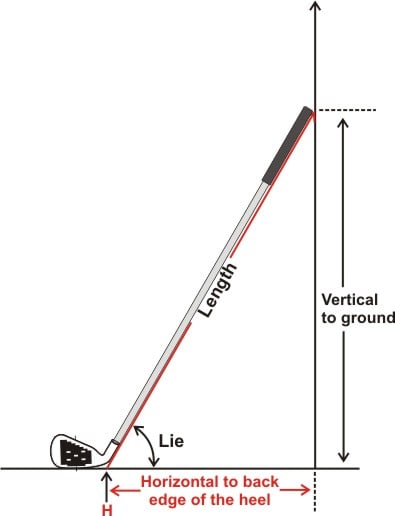
These standard lengths are usually measured from the heel of the club head (where the sole meets the shaft) up the shaft to the very end of the grip. This is the common way of ‘Measuring golf shaft’.
Typical Standard Lengths
Club lengths get shorter as the club number goes up. A driver is the longest club. A wedge or putter is the shortest. Here is a general idea of standard lengths for men and women.
| Club Type | Men’s Standard Length (approx. inches) | Women’s Standard Length (approx. inches) |
|---|---|---|
| Driver | 45 – 46 | 43 – 44 |
| 3-Wood | 43 | 41 |
| 5-Wood | 42 | 40 |
| 3-Iron | 39 | 37.5 |
| 4-Iron | 38.5 | 37 |
| 5-Iron | 38 | 36.5 |
| 6-Iron | 37.5 | 36 |
| 7-Iron | 37 | 35.5 |
| 8-Iron | 36.5 | 35 |
| 9-Iron | 36 | 34.5 |
| Pitching Wedge | 35.75 | 34.25 |
| Sand Wedge | 35.5 | 34 |
| Lob Wedge | 35.25 | 33.75 |
| Putter | 33 – 35 | 32 – 34 |
This table shows typical numbers. Different brands might have slightly different standard lengths.
This is a basic ‘Golf club size chart’. It gives you an idea of the difference in length between clubs. You can see that the length goes down by about half an inch between each iron. This helps you hit the ball different distances with different clubs.
Why Standard Isn’t Always Best for You
Standard lengths work okay for some people. But they might not be the ‘Correct golf club length’ for everyone. Your height is a factor, but it’s not the only one. Someone who is tall might have long arms or short arms. This changes how far they stand from the ball and how they swing. A short person might have long arms. They might need clubs longer than the standard for their height.
This is why a ‘Golf shaft length guide’ based only on height is not perfect. It’s a starting point, but it does not tell the whole story.
Measuring Your Body for a Starting Point
Before thinking about a fitting, you can take some simple body measurements. These give you a basic idea if standard clubs might be too long or too short for you.
Height
Your overall height is the first thing people look at. Taller people usually need longer clubs. Shorter people usually need shorter clubs.
- Stand up straight against a wall.
- Have someone mark your height.
- Measure from the floor to the mark.
This is the easiest step. But remember, it does not tell everything.
Wrist-to-Floor Measurement
This measurement is often more helpful than just height. It tells you how long your arms are compared to your height. This affects how far away you stand from the ball naturally.
- Stand up straight.
- Let your arms hang naturally at your sides.
- Have someone measure from the big crease in your wrist down to the floor.
- Make sure you are wearing the type of shoes you wear when you golf.
This measurement is very important. A person with long arms for their height will have a smaller wrist-to-floor number. They might need shorter clubs even if they are tall. A person with short arms for their height will have a larger wrist-to-floor number. They might need longer clubs even if they are short.
Using a Simple Chart Based on Measurements
Club makers sometimes use charts that combine height and wrist-to-floor measurements. These charts give a suggestion for adding or taking away length from standard clubs.
Here is a very simple example of how such a chart might look. This is just an example, not an exact rule.
| Height | Wrist-to-Floor | Suggested Change from Standard Men’s Length | Suggested Change from Standard Women’s Length |
|---|---|---|---|
| Under 5’5″ | < 30″ | -2 inches | -1.5 inches |
| Under 5’5″ | 30″ – 32″ | -1.5 inches | -1 inch |
| Under 5’5″ | > 32″ | -1 inch | -0.5 inches |
| 5’5″ – 5’9″ | < 32″ | -1 inch | -0.5 inches |
| 5’5″ – 5’9″ | 32″ – 34″ | Standard | Standard |
| 5’5″ – 5’9″ | > 34″ | +0.5 inches | +0.5 inches |
| 5’10” – 6’2″ | < 34″ | Standard | +0.5 inches |
| 5’10” – 6’2″ | 34″ – 36″ | +0.5 inches | +1 inch |
| 5’10” – 6’2″ | > 36″ | +1 inch | +1.5 inches |
| Over 6’2″ | < 36″ | +0.5 inches | +1 inch |
| Over 6’2″ | 36″ – 38″ | +1 inch | +1.5 inches |
| Over 6’2″ | > 38″ | +1.5 inches | +2 inches |
Again, this is a simplified example. Real fitting charts are more detailed.
This chart helps show that a taller person might need shorter clubs if they have very long arms (high wrist-to-floor number). A shorter person might need longer clubs if they have very short arms (low wrist-to-floor number).
Using a ‘Golf shaft length guide’ based on these measurements is a good start. It can help you see if standard clubs are likely way off for you. But it doesn’t look at your swing itself.
The Best Way: Getting a Golf Club Fitting
While measurements give you a starting point, the best way to find your ‘Correct golf club length’ is to get a professional ‘Golf club fitting’. A fitting is like seeing a tailor for your clothes. A club fitter helps make sure your clubs fit you and your swing.
What is a Golf Club Fitting?
A ‘Golf club fitting’ is a process where a trained person watches you hit golf balls. They use special tools and their knowledge to see how your clubs work for you. They look at many things:
- How you stand to the ball.
- Your swing path.
- Where you hit the ball on the club face.
- How fast you swing.
- The numbers the ball makes (like speed, spin, angle).
Based on this, they suggest changes to your clubs. This can include:
- Shaft length
- Shaft flex (how much the shaft bends)
- Club head type
- Lie angle (how the club sits on the ground)
- Grip size
The goal is to find the best setup for your swing so you can hit the ball better.
Why Fitting is Key for Length
Measurements like height and wrist-to-floor are static. They don’t move. Your golf swing is dynamic. It is full of movement. How you move the club and your body changes what length feels right and works best.
A fitter watches you swing. They can see if you have to bend over too much. They can see if you are reaching too far. They can see if the club head is hitting the ground in the wrong spot (too much heel or toe digging in).
They might have you hit balls with clubs of different lengths. You can feel the difference. They can also see the numbers from a launch monitor. This machine tracks the ball and club. It shows if a different length helps you hit the sweet spot more or hit the ball straighter.
Getting ‘Custom golf club length’ based on a fitting is much better than just guessing or using a chart. It makes sure the clubs are built for your unique swing.
Interpreting Length by Club Type
Shaft length works differently for different types of clubs. The ‘Impact of golf shaft length’ is felt in unique ways from your driver to your putter.
Driver Shaft Length Fitting
The driver is the longest club in the bag. It’s used to hit the ball as far as possible from the tee. ‘Driver shaft length fitting’ is very important.
- Distance vs. Control: A longer driver shaft can create more speed and distance. But it is also harder to control. It’s harder to hit the sweet spot. It’s harder to swing it on the right path.
- Missing the Sweet Spot: Even a little miss on the driver face can mean losing a lot of distance and hitting the ball crooked. A shaft that is too long often leads to hitting the ball off the toe.
- Finding the Right Balance: For many golfers, a slightly shorter driver shaft (maybe 1 inch less than standard) helps them hit the sweet spot more often. They might lose a little speed, but hitting the center makes up for it. It often leads to more fairways hit, which is good for your score.
A fitter will look at your swing speed and how often you hit the sweet spot with different length drivers. They help you find the length that gives you the best mix of distance and control.
Iron Shaft Length Chart and Fitting
Your irons are the clubs you use for most shots on the course. They are designed to hit the ball specific distances. The ‘Iron shaft length chart’ shows how irons get shorter as the number goes up (3-iron is longer than 9-iron).
- Distance Gaps: The length difference between irons (usually 0.5 inches) is designed to create distance gaps. You hit a 7-iron farther than an 8-iron because it’s longer and has less loft. If the length steps are wrong, your distance gaps might be uneven.
- Hitting the Ground: The length of your irons affects how the club head hits the ground. If the shaft is too long, the toe of the club might stick up, causing you to hit shots towards the heel. If the shaft is too short, the heel might stick up, causing you to hit shots towards the toe. Both mean missing the sweet spot.
- Lie Angle Link: Iron length and lie angle work together. Lie angle is the angle between the shaft and the ground when the sole is flat on the ground at impact. If the shaft is too long for you, the toe of the club might be off the ground at impact. If it’s too short, the heel might be off the ground. A fitter checks both length and lie angle to make sure the club sits correctly for your swing.
During an iron fitting, the fitter watches how the club sole hits a special board or mat. This shows if the lie angle is right. They change the length and lie angle until the club hits the ground flat for your swing.
Wedges and Putters
Wedges are used for short shots near the green. Putters are used on the green. Length is also important for these clubs.
- Wedges: Wedge length is usually close to the shortest iron. Too long can make short shots harder to control. Too short can make you bend over too much, which hurts your putting stroke.
- Putters: Putter length is very personal. Some people like longer putters to stand taller. Some like shorter ones to bend over more. The key is finding a length that lets your eyes be over or slightly inside the ball. It should also feel comfortable so you can make a smooth stroke. Putter fitting often focuses on length, lie, and grip.
Weighing DIY vs. Professional Fitting
You can use a ‘Golf shaft length guide’ online or measure yourself. This is a DIY (Do It Yourself) approach. Or you can go to a professional for a ‘Golf club fitting’.
DIY (Using Charts and Guides)
- Pros:
- It’s free or low cost.
- You can do it at home.
- Gives you a basic idea if standard clubs are likely wrong for you based on your size.
- Cons:
- Only looks at body size, not your actual swing.
- Does not use real data from hitting balls.
- Can’t check lie angle.
- Might lead you to the wrong length anyway.
- You don’t get to test different lengths easily.
Using a basic ‘Golf club size chart’ or a simple height/wrist chart is better than nothing. It’s a good way to start thinking about length. But it is not the best way to find the ‘Correct golf club length’.
Professional Golf Club Fitting
- Pros:
- Looks at your actual swing.
- Uses data from launch monitors.
- Lets you try different length shafts and club heads.
- Checks lie angle and other important factors.
- A trained expert helps you.
- Leads to ‘Custom golf club length’ tailored to you.
- Helps you hit the ball better and be more consistent.
- Cons:
- Costs money.
- Takes time.
- You need to go to a fitting center.
For beginners, a fitting is highly recommended. It sets you up with clubs that make learning easier. It helps you build good habits from the start. You don’t have to guess if your clubs fit.
Deciphering Signs Your Length Might Be Wrong
How do you know if the ‘Standard golf club length’ is not right for you? Your swing and your shots will give you clues. The ‘Impact of golf shaft length’ being wrong shows up in many ways.
Common Missed Shots
- Hitting the ground behind the ball (fat shots): This can happen if your clubs are too long. You might be standing too far away or bending over too much. It can also happen if the lie angle is too upright. The heel digs in first.
- Hitting the top of the ball (thin shots or topping it): This can happen if your clubs are too short. You might be standing too close. The toe might be sticking up too much if the lie is too flat.
- Hitting the ball off the toe or heel: As mentioned, too long often leads to toe hits. Too short often leads to heel hits. This means you are missing the sweet spot sideways.
- Shanking the ball: A shank happens when you hit the ball off the hosel (where the shaft meets the club head). This is often caused by standing too close or the club being too upright, which can be related to the shaft being too long.
Feel and Setup
- Feeling too far or too close to the ball: When you set up to the ball, do you feel like you are reaching? Or do you feel like you are crowded? This can be a sign the length is off.
- Feeling unbalanced during the swing: If the club is too long and heavy, you might feel off-balance. If it’s too short, you might feel crunched.
- Having to change your posture a lot: Are you bending your knees a lot? Or bending over way down? This might be your body trying to adjust to a club that doesn’t fit your natural stance.
- Difficulty setting up the same way: If the length feels awkward, it’s hard to get in the same setup position every time. This leads to inconsistency.
If you see these signs, it’s a good idea to think about your club length. Getting a ‘Golf club fitting’ can help figure out if length is the problem and find your ‘Correct golf club length’.
Fathoming the Fitting Process for Length
Let’s look a bit closer at what happens during a ‘Golf club fitting’ when the fitter is checking your shaft length.
Step 1: Talking to You
The fitter starts by asking you questions.
* What are your goals in golf?
* What kind of shots do you hit most often (good and bad)?
* What clubs do you struggle with?
* Have you had lessons?
* What is your general athletic ability?
They want to learn about you and your game. This helps them know what to look for.
Step 2: Taking Measurements
They will likely take some basic body measurements. Your height and wrist-to-floor measurement are common. They might also look at your hand size for grip fitting later. These measurements give them a starting guess, but it’s just a guess.
Step 3: Watching You Swing
You will hit balls on a driving range or into a net using your current clubs or some test clubs. The fitter stands and watches your posture and swing. They see how you stand, how you swing the club head, and how the club interacts with the ground.
Step 4: Using a Launch Monitor
This is a key part. You hit balls using special clubs. The launch monitor uses cameras or radar to track:
* Club head speed
* Ball speed
* Spin rate
* Launch angle
* Where you hit the ball on the face (some systems show this)
* Swing path
* Angle of attack (if the club is moving up or down at impact)
This data is very important. It gives clear facts about what your club is doing and what the ball is doing.
Step 5: Testing Different Lengths
Based on your measurements, swing, and the launch monitor data, the fitter will give you clubs with different shaft lengths to try.
- They might start with standard length.
- Then they might give you a club half an inch shorter.
- Then maybe a club half an inch longer.
As you hit each club, they watch you and look at the data. They see if a different length:
- Helps you hit the sweet spot more often.
- Helps you hit the ball straighter.
- Changes your launch angle or spin in a good way.
- Feels more comfortable for your swing.
- Helps the club sole hit the ground better (they might put tape on the sole or use a lie board).
You also tell them how the different lengths feel to you. Feel is important too.
Step 6: Checking Lie Angle (Especially for Irons)
For irons, after finding a good length, they often check the lie angle. You hit balls off a lie board or use tape on the sole. A mark on the tape shows where the sole hit the board.
* Mark towards the toe means the club is too flat (heel up).
* Mark towards the heel means the club is too upright (toe up).
* Mark in the middle means the lie is about right.
They will change the lie angle on the test club and have you hit again until the mark is in the middle. This makes sure the club sits correctly when you hit the ball. Length and lie angle are linked for irons.
Step 7: Making a Recommendation
After all the testing, the fitter will tell you what they think is the ‘Correct golf club length’ for you for each type of club (driver, irons, etc.). They might suggest adding or taking away a specific amount from the standard length. They might also suggest a different shaft flex or grip size.
Step 8: Building or Adjusting Your Clubs
If you are buying new clubs, they will be built to the ‘Custom golf club length’ the fitter suggests. If you have clubs already, some golf shops can change the length of your current shafts (cutting them shorter or adding to them). They can also bend irons to change the lie angle.
Getting a fitting is the most accurate ‘Golf shaft length guide’ because it uses data from your actual swing.
Putting It All Together: Getting Your Correct Golf Club Length
For a beginner, thinking about shaft length might seem like too much. You are just trying to hit the ball! But using clubs that fit you makes the learning process much smoother.
- Start by looking at a basic ‘Golf club size chart’ to see standard lengths.
- Measure your height and wrist-to-floor. See if a simple chart suggests you might need longer or shorter clubs than standard. This gives you a starting idea.
- Pay attention to how your current clubs feel. Are you hitting a lot of fat or thin shots? Are you missing the sweet spot often? These can be signs the length is off.
- The best step is to get a ‘Golf club fitting’. This is where an expert watches your swing and uses data to find your ‘Correct golf club length’. They can help you get ‘Custom golf club length’ for your clubs.
- A fitting considers more than just height. It looks at your swing, how you hit the ball, and how the club feels.
- Remember the ‘Impact of golf shaft length’ on your swing path, speed, contact, and consistency. Getting it right helps you hit the ball better and enjoy golf more.
Don’t be afraid to ask questions during a fitting. The fitter is there to help you. Finding the right shaft length is an important part of building a golf set that works for you. It helps you build a consistent swing and improve your game faster.
Frequently Asked Questions (FAQ)
h4 What is the average golf club length?
The average golf club length, also called ‘Standard golf club length’, changes by club type and whether it’s for a man or woman. Drivers are the longest, usually 45-46 inches for men and 43-44 inches for women. Irons get shorter as the number goes up, going from around 39 inches for a men’s 3-iron down to 35.5 inches for a wedge. Putters are usually 33-35 inches.
h4 Can I figure out my correct golf club length by just using my height?
Height is a starting point, but it’s not enough on its own. Your arm length matters a lot too. Someone with long arms for their height might need shorter clubs than a chart based only on height suggests. Using a wrist-to-floor measurement along with height is better, but the best way is a ‘Golf club fitting’.
h4 How is golf shaft length measured?
Golf shaft length is usually measured from the heel of the club head (where the sole meets the shaft) straight up the shaft to the very end of the grip. This is the standard way of ‘Measuring golf shaft’.
h4 What happens if my golf clubs are too long?
If your golf clubs are too long, you might stand too far from the ball. This can make you hit shots off the toe of the club. It can also make you hit the ground behind the ball (fat shots). Longer clubs are also harder to control, which can make your shots go crooked and hurt your consistency.
h4 What happens if my golf clubs are too short?
If your golf clubs are too short, you might have to bend over too much. This can make you hit the ground after the ball (thin shots) or hit the top of the ball. Short clubs can also make you hit shots off the heel of the club face. It can make your swing feel crunched and uncomfortable.
h4 How much does a golf club fitting cost?
The cost of a ‘Golf club fitting’ can be different depending on where you go and what kind of fitting you get. A full bag fitting will cost more than just a driver or iron fitting. Costs can range from $50 to $300 or more. Some places might not charge for the fitting if you buy clubs from them.
h4 Can I change the length of my current golf clubs?
Yes, you can often change the length of your current clubs. A club repair person can cut shafts shorter. They can also add to steel shafts to make them longer (this is harder and less common with graphite). Changing length can change the feel and weight of the club, so it’s best to have a professional do it, ideally after a fitting.
h4 Do women’s golf clubs just have shorter shafts?
Women’s golf clubs are usually shorter than men’s standard clubs. They also often have lighter shafts and different club head designs to help slower swing speeds. But like men, a woman’s ‘Correct golf club length’ depends on her height, arm length, and swing, not just a standard size. Getting a fitting is important for women too.
h4 Does driver shaft length really affect distance?
Yes, driver shaft length has a big ‘Impact of golf shaft length’ on distance. A longer shaft can create faster club head speed, which usually means more distance. But only if you can hit the sweet spot. For many players, a slightly shorter driver shaft (even an inch) helps them hit the sweet spot more often. This can make the ball go straighter and sometimes even farther because solid contact is more important than just raw speed.
h4 Is a golf club size chart enough to determine my length?
A ‘Golf club size chart’ showing standard lengths or suggesting changes based on height and wrist-to-floor can be a basic ‘Golf shaft length guide’. It gives you an idea. But it does not watch your swing or use data. For the most accurate ‘Correct golf club length’ that fits your swing, a professional ‘Golf club fitting’ is needed. It leads to ‘Custom golf club length’ that performs best for you.
h4 What is an iron shaft length chart?
An ‘Iron shaft length chart’ simply lists the standard lengths for each iron in a set (e.g., 5-iron, 6-iron, 7-iron). It shows the typical difference in length between each club, which is usually half an inch. This difference helps create distance gaps between your irons.
h4 Is ‘Custom golf club length’ only for advanced players?
No, ‘Custom golf club length’ is very helpful for beginners too! Beginners are still learning their swing. Using clubs that fit helps them learn good movements and make better contact sooner. It makes the game less frustrating and more fun from the start. It can prevent bad habits that come from trying to swing clubs that are the wrong size.