
How long is a standard golf driver? A standard golf driver length for men is usually around 45 to 45.75 inches. For women, it’s typically a bit shorter, often around 44 inches. These lengths can vary slightly between manufacturers, but they fall within a common range that most golfers use. The rules set by golf’s governing bodies also play a big part in how long a driver can be.
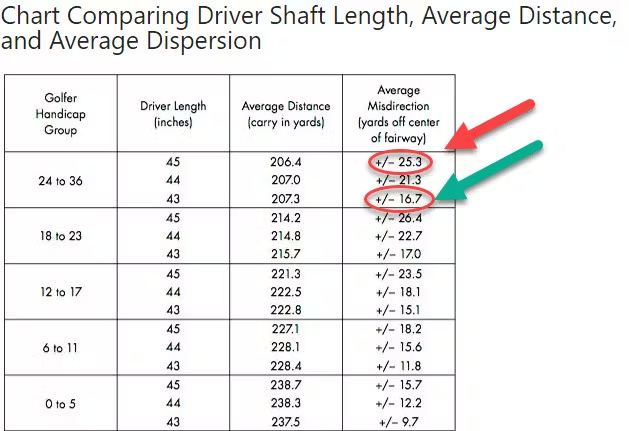
Image Source: curated-uploads.imgix.net
Deciphering Standard Driver Length
Let’s talk about what a standard golf driver length means. When you buy a driver off the rack, it comes at a certain length. This length is what companies think works for most people. It’s a kind of average.
For many years, the standard length for men’s drivers was 45 inches. Some companies made them 45.5 inches. Recently, some go up to 46 inches right off the shelf. This is the standard golf driver length you see in golf stores.
Women’s drivers are usually shorter. This is because many women golfers are shorter than men. They also tend to swing the club at a different speed. A shorter club can be easier to control for many women. The typical length for women’s drivers is around 44 inches.
Seniors often use clubs designed for slightly slower swing speeds. Sometimes, senior drivers are the same length as men’s standard drivers but have a more flexible shaft. Other times, they might be slightly shorter, like 44.5 inches.
Junior drivers are much shorter. Their length depends on the child’s age and height. Club sets for kids come in different sizes for different age groups. The driver length gets longer as the child grows.
So, the idea of a “standard” length isn’t just one number. It changes based on who the club is made for. But the most common standard golf driver length you hear about is that 45 to 45.75 inch range for men.
Average Driver Length and Its Meaning
What is the average driver length people actually play with? This is a bit different from the standard length a club is sold at. Some golfers buy a standard driver and keep it as is. Others might get the shaft cut down a bit.
The average driver length used by amateur golfers can be close to the standard length, maybe slightly shorter as some people trim their shafts. It’s hard to get an exact average for all golfers everywhere. But we can look at what professionals use.
Tour pro driver length is often shorter than what you see in stores. Many tour players use drivers that are between 44 and 45 inches long. Some might even go a little shorter than 44 inches.
Why do tour pros use shorter drivers than the standard length sold to amateurs?
* Control: A shorter club is often easier to hit straight. Pros care a lot about hitting the fairway.
* Consistency: Shorter clubs can lead to more consistent contact with the ball. Hitting the center of the clubface is very important.
* Speed: While a longer club can create more speed, pros swing so fast already. The small loss in speed from a shorter club is worth the gain in control and solid contact.
So, the average driver length among skilled players, like tour pros, is often shorter than the average driver length found on the shelf in a golf shop. This tells us that “standard” doesn’t always mean “best” for everyone.
Golf Driver Length Regulations: The USGA Rules
Golf has rules for everything, including how long your clubs can be. The main rule-making bodies are the USGA (United States Golf Association) and The R&A (Royal and Ancient Golf Club of St Andrews). They have rules about driver shaft length. These are important golf driver length regulations.
The maximum driver length USGA allows is 48 inches. This rule is key for competitive golf. You cannot use a driver longer than 48 inches in a game played under the Rules of Golf.
This rule about maximum driver length USGA sets applies to most golfers, not just pros. If you play in a club tournament or any official competition, your driver must follow this rule.
There’s a bit more to the rule than just the length. How you measure the club matters. The USGA has a specific way to measure driver length. We will talk about how to measure driver length later. But know that the measurement includes the club head. It is measured from the heel of the club head to the grip cap along the shaft.
Why have a maximum driver length USGA rule? It’s about keeping the game fair and not letting technology or equipment changes make golf too different. A much longer driver could potentially help some players hit the ball much farther, maybe making courses too short. The 48-inch limit is there to put a cap on this.
It’s worth noting that while 48 inches is the max, almost no one uses a driver this long. Even the longest standard drivers sold are typically 46 inches. Most pros and amateurs play clubs well under the 48-inch limit.
Here is a simple look at the main golf driver length regulations:
Table: Key Golf Driver Length Regulation
| Aspect | Rule / Limit | Governing Body | Notes |
|---|---|---|---|
| Maximum Club Length | 48 inches (121.92cm) | USGA / The R&A | For all clubs except putters. Includes head. |
| Minimum Club Length | 18 inches (45.72cm) | USGA / The R&A | Applies to all clubs. |
| Measurement Method | Specific method | USGA / The R&A | From heel of head to grip cap along shaft. |
These driver shaft length rules are important if you play golf in competitions. For casual play with friends, you might not worry as much, but it’s good to know the official rules.
Interpreting How Length Affects Your Game
The length of your driver shaft has a big effect on how you swing and how the ball flies. It’s not just a small detail. It changes several things.
Effect on Swing Speed
A longer shaft can help you swing the club head faster. Think of swinging a weight on a string. A longer string lets the weight travel a bigger circle. This can make the weight go faster at the end of the circle. The same idea applies to a driver. A longer shaft means the club head travels a bigger arc. If you can swing it at the same pace, the club head speed at impact can be higher. Higher club head speed usually means more ball speed. More ball speed means the ball goes farther. This is part of why companies started making standard drivers longer – to promise more distance.
Effect on Control and Accuracy
While a longer shaft can boost speed, it often makes the club harder to control. A longer lever is harder to swing precisely. It can be tougher to hit the sweet spot on the club face. It can also be harder to swing the club on the right path. This can lead to shots that curve more or go off line. This is why accuracy (hitting the fairway) can suffer with a driver that is too long for you.
Effect on Solid Contact
Hitting the ball in the center of the club face (the sweet spot) gives you the most power and the best direction. It also feels the best! With a longer driver, it can be harder to hit the sweet spot consistently. You might hit the ball more towards the heel or toe of the club. Hits off the center lose speed and can go sideways. Even a small miss off the center can cost you a lot of distance and accuracy. A shorter driver can make it easier to hit the center of the face more often.
Effect on Swing Weight
The length of the club also affects its swing weight. Swing weight is about how heavy the club feels when you swing it. It’s a balance measurement. A longer club, even with the same head weight, will feel heavier during the swing. This can make it harder to control the club face through impact.
So, there is a trade-off with driver length:
* Longer shaft = potential for more speed and distance (driver length distance connection).
* Shorter shaft = potential for more control, accuracy, and solid contact.
Finding the right length for you is about finding the best balance between these things.
Grasping Optimal Driver Length
What is the optimal driver length? This is the big question. It’s the length that helps you hit the ball both far and straight consistently. And the answer is different for every golfer.
There is no magic number for optimal driver length. It depends on several factors about you:
* Your height and arm length: These affect your posture and how you set up to the ball.
* Your swing speed: How fast you swing the club.
* Your skill level and coordination: How well you can control the club through the swing.
* Your physical strength and flexibility: How easily you can handle swinging a club of a certain length and weight.
For one golfer, 45 inches might be perfect. For another, 44 inches or even 43 inches might be much better.
How do you find your optimal driver length? This often involves trying different lengths.
* Testing: If possible, try drivers of different lengths at a golf store or fitting center. See which one feels best and gives you good results (distance and accuracy).
* Looking at Contact: Pay attention to where you hit the ball on the club face. If you consistently miss the center with a longer driver, a shorter one might help you hit the sweet spot more often.
* Watching Ball Flight: Do you hit a lot of slices or hooks? Sometimes, a club that is too long makes it harder to control the club face, making these bad shots worse.
* Considering Consistency: Are you hitting good shots sometimes but really bad shots others? A shorter, more controllable driver might help you hit more consistent shots, even if the absolute longest shot isn’t quite as far.
Remember the tour pro driver length is often shorter than standard. This is because consistency and accuracy are key for them. They find their optimal driver length helps them hit fairways under pressure. Most amateur golfers would likely benefit from prioritizing control and solid contact over maximum possible speed from an extra-long shaft. Many golfers might find their optimal driver length is shorter than the standard length they bought.
How to Measure Driver Length
Knowing how long your driver is or how long a club you are thinking of buying is important. There is a specific way to measure driver length according to the rules of golf. This is how to measure driver length correctly.
You don’t just lay the club on the ground and measure in a straight line. The official measurement follows the line of the shaft.
Here are the steps how to measure driver length:
1. Lay the club down with the sole (bottom) of the club head resting on a flat surface, like the floor.
2. Hold the club so the shaft points up and slightly away from you. The club face should be aiming straight up or slightly towards you.
3. Imagine a line that goes from the heel of the club head straight up parallel to the shaft. The heel is the part of the club head closest to the shaft.
4. Place the end of a measuring tape at the point where the heel meets the ground (or the flat surface).
5. Extend the measuring tape along the back of the shaft all the way to the top of the grip (the grip cap).
6. Make sure the tape is tight against the shaft and follows its angle.
7. The number on the tape at the very top of the grip is the official length of the club.
This method ensures everyone measures clubs the same way. It’s slightly different from just putting the club on a ruler. This is the method used to check golf driver length regulations.
Visualizing the Measurement
Imagine the club standing up slightly leaning back. The measurement starts at the point on the ground right below the heel and goes straight up along the back of the shaft to the top of the grip.
Understanding how to measure driver length is useful if you want to check if a club meets the maximum driver length USGA rule or if you plan to cut down your shaft.
Custom Driver Length Options
What if the standard driver length isn’t right for you? This is where custom driver length options come in. You don’t have to stick with the length the club came with. Many golfers choose to have their driver shaft adjusted.
Getting a driver custom fitted means a golf club expert helps you find the right specs for your swing, including length. Custom driver length options allow you to get a driver that is shorter or potentially longer (up to the 48-inch limit) than standard.
Why choose a custom driver length?
* Better Fit: A length that matches your physical size and swing style helps you set up comfortably and swing better.
* Improved Contact: As discussed, a shorter length can make it easier to consistently hit the sweet spot.
* More Control: A length that feels right in your hands gives you better control over the club face and swing path.
* Optimizing Performance: A fitter can help you test different lengths to see which one gives you the best combination of distance and accuracy. This is about finding your optimal driver length.
How is a custom length achieved?
* Cutting Down: The most common way is to cut a standard shaft from the grip end. After cutting, a new grip is put on. Cutting down a shaft makes the club shorter. It also makes the club feel lighter in terms of swing weight. Often, weight is added to the club head to bring the swing weight back up.
* Using a Different Shaft: Custom fitting might involve using a shaft that is made to be played at a certain shorter length, or trimming a longer raw shaft to the desired length from the tip end before assembly (less common for just length adjustment on a driver).
Custom driver length options are available from club fitters and even many golf stores. It’s an investment in your game. Instead of playing a club that might be too long and costing you fairways, you can get one tailored to you.
Think about the average driver length used by tour pros. Many are using custom lengths that are shorter than the standard length sold to amateurs. This is a big hint that custom fitting the length is a good idea for many golfers.
Driver Length, Distance, and Control
Let’s look closer at the connection between driver length distance and control. It’s a key point in choosing the right driver.
As we said, a longer driver has the potential to create more club head speed. More speed can mean more distance. This is simple physics: a longer lever moves the end faster.
However, turning that potential speed into actual distance requires hitting the ball well.
* Center Contact: You need to hit the ball on the sweet spot. Missing the sweet spot, especially towards the heel or toe, reduces ball speed a lot. Even a slight miss can cost 10-20 yards or more. With a longer club, hitting the sweet spot is harder.
* Launch Angle and Spin: For maximum distance, you need the right launch angle (how high the ball starts) and spin rate (how fast the ball spins). Hitting the ball on the wrong part of the face with an ill-fitting length can mess up these numbers.
So, while a longer driver can produce a higher top speed, a shorter driver might help you:
* Hit the center of the face more often.
* Swing on a better path, controlling curves (slices/hooks).
* Maintain better balance during the swing.
Hitting the center of the face with a slightly slower swing from a shorter club often results in more ball speed and better direction than swinging a longer club faster but hitting it off-center.
Imagine this:
* Driver A: 46 inches. Swing speed 105 mph. Hit off-center (halfway to the toe). Ball speed 140 mph. Ball curves off target. Distance 240 yards.
* Driver B: 44.5 inches. Swing speed 102 mph. Hit solid on the center. Ball speed 150 mph. Ball goes straight. Distance 260 yards.
This example shows how a small loss in swing speed from a shorter club can be more than made up for by better contact and control. The driver length distance relationship isn’t just about raw speed; it’s about effective speed transferred to the ball on a good line.
Many average golfers struggle with drivers that are too long for them. They gain a little speed but lose a lot of control and hit fewer fairways. For most amateurs, increasing accuracy and consistent solid contact will lower their scores more than trying to squeeze out a few extra yards with a longer, harder-to-control driver.
Consider your own game. Are you hitting the fairway consistently? Are you hitting the center of the face? If not, your driver length might be too long, even if it’s the standard length you bought. Exploring custom driver length options could be very helpful.
Interpreting Tour Pro Driver Length Choices
We mentioned that tour pro driver length is often shorter than the standard length sold to amateurs. Why is this the case?
Pros are extremely skilled golfers. They can control the club very well. Yet, many choose shorter drivers. This highlights the importance of consistency and accuracy even at the highest level.
Typical tour pro driver length is often between 44 inches and 45 inches. Some may go a little longer, some a little shorter. This range is below the typical 45.5 to 46 inches often found in stores.
Reasons tour pros use shorter drivers:
* Accuracy is King: Hitting the fairway is crucial for scoring well. Being just off the fairway can mean a bad lie or needing to hit over trees. A shorter driver helps them find the short grass more often.
* Consistent Contact: Pros aim to hit the center of the face almost every time. A shorter club makes this easier, ensuring maximum energy transfer and predictable ball flight.
* Control of Trajectory and Spin: Length affects how they can control the ball flight. A shorter club can give them better feel and control to hit draws, fades, or different trajectories when needed.
* Managing Pressure: Under pressure, even the best swings can falter slightly. A shorter, more controllable driver is more forgiving of minor swing flaws than a super-long one.
Pros are not worried about getting every last yard if it means hitting fewer fairways. They have plenty of speed already. Their goal is to put the ball in the best position for their next shot.
This preference for shorter lengths among the best players suggests that recreational golfers might also benefit from considering a slightly shorter driver than the standard length.
Considering Golf Driver Length Regulations in Practice
How do the golf driver length regulations affect you?
The main rule is the 48-inch maximum driver length USGA rule. For almost all golfers, this rule won’t matter day-to-day. Standard drivers are shorter than this. Even custom drivers rarely go past 46 inches for performance reasons. The 48-inch limit is there to prevent extreme designs, not to limit typical play.
However, if you are modifying a club yourself or having a custom club built, you need to be aware of this rule if you plan to play in official events. Make sure your driver is 48 inches or less when measured correctly.
The more important “regulations” for most golfers are their own body and swing. Your physical makeup and how you swing set practical limits on what driver length will work best for you. Ignoring these personal “regulations” is a common mistake. Using a driver that is too long because it’s “standard” or promises more distance can hurt your game.
The rules about minimum club length (18 inches) are really for novelty clubs and don’t affect drivers.
So, while the official golf driver length regulations are simple (under 48 inches), the more complex part is finding the right length for you within that limit.
Making the Right Choice: Standard vs. Custom
Given that the standard golf driver length might not be optimal for everyone, what should a golfer do?
- Start with Standard: If you are new to golf or unsure, buying a standard length driver is fine to start. Most players learn with a standard club.
- Pay Attention: As you play, notice how well you hit the driver. Are you hitting the center? Are your shots going straight or curving a lot? Do you feel in control?
- Consider Trying Shorter: If you struggle with consistency or accuracy, consider trying a shorter driver. You can test drivers at a store, or if you have a standard driver, you can have the shaft cut down. Cutting down a shaft by 1 or 1.5 inches is a common adjustment.
- Get Fitted: The best way to find your optimal driver length is through a custom fitting session. A good fitter will watch your swing, measure things, and have you hit drivers of different lengths and with different shafts. They can help you see the results (ball speed, launch, spin, accuracy) from different lengths and find the one that performs best for you. This is the best way to explore custom driver length options.
Don’t be afraid to play a driver shorter than standard. Remember the average driver length among pros is often shorter. The goal is better golf, not just having the longest club. A shorter driver might lose a little maximum speed, but it could gain you a lot of consistency and confidence.
Think of it this way: A shorter driver might mean your longest drive is 5-10 yards shorter. But if it also means you hit 3 more fairways per round, your scores will likely improve a lot more. Better control and consistency from the tee makes the rest of the hole easier.
Summary of Key Points:
- Standard Length: Around 45-46 inches for men, 44 inches for women. Varies by brand.
- Maximum Length: 48 inches according to USGA/R&A rules.
- Optimal Length: Different for everyone. It’s the length that balances distance, accuracy, and consistency for your swing. Often shorter than standard.
- Measurement: Specific method from heel on ground up the back of the shaft to the grip cap.
- Impact: Longer can mean more speed potential; shorter can mean more control and better contact.
- Custom Options: You can get drivers cut down or fitted to a specific length.
- Tour Pros: Many use drivers shorter than standard amateur length.
Your driver is the club you hope to hit the farthest. But hitting it far off the fairway doesn’t help your score. Finding the right length, whether it’s standard or a custom fit, is key to making your driver a weapon that puts you in good position, not trouble.
Frequently Asked Questions about Driver Length
Let’s answer some common questions people have about how long their golf driver should be.
h4> Can a Driver Be Too Long?
Yes, absolutely. For most golfers, a driver that is too long is a bigger problem than one that is too short. A driver that is too long makes it harder to control the club head, hit the center of the face consistently, and swing on the correct path. This leads to missed fairways, loss of distance from off-center hits, and frustration. The standard length drivers sold today might be too long for many amateur golfers.
h4> Does Shorter Driver Mean Less Distance?
Not necessarily. While a shorter shaft might reduce your maximum potential club head speed slightly, it can lead to better contact on the sweet spot. Hitting the sweet spot with a slightly slower swing speed often sends the ball farther and straighter than swinging a longer club faster but hitting off-center. For many players, a shorter driver actually leads to more consistent distance and total distance when factoring in accuracy.
h4> What is the Legal Driver Length in Golf?
The legal driver length for play under the Rules of Golf is a minimum of 18 inches and a maximum of 48 inches. The 48-inch maximum driver length USGA rule is the key limit for drivers.
h4> How Do I Know If My Driver is Too Long?
Signs your driver might be too long include:
* Consistently missing the center of the club face (hitting heel or toe).
* Struggling with accuracy (hitting big slices or hooks).
* Feeling off balance during your driver swing.
* Having a hard time controlling the club head through impact.
* Inconsistent distance – some shots go far, others are short mis-hits.
If you experience these issues, trying a shorter driver length could help.
h4> Is a 46-inch Driver Standard?
Yes, 46 inches is at the upper end of what is considered a standard golf driver length by many manufacturers today, especially with graphite shafts. Many drivers are sold at 45.5 inches or 45.75 inches as well. However, just because it’s standard doesn’t mean it’s the optimal driver length for every golfer.
h4> Do Women’s Drivers Have Different Lengths?
Yes. Standard women’s drivers are typically shorter than men’s drivers, usually around 44 inches. They also often have lighter, more flexible shafts suited to generally slower swing speeds.
h4> Can I Cut Down My Driver Shaft?
Yes, you can have your driver shaft cut down. This is a common way to adjust driver length. It is usually cut from the grip end. After cutting, a new grip is put on. Be aware that cutting the shaft reduces the swing weight, making the club feel lighter during the swing. You might need to add weight to the club head to restore swing weight. It’s best to have this done by a professional club fitter or club builder.
h4> How Important is Driver Length for Beginners?
Driver length is quite important for beginners. A driver that is too long can make learning to hit the ball cleanly and consistently very difficult. Beginners often benefit from slightly shorter clubs that are easier to control. This helps them make solid contact and build confidence. Focusing on making good contact with a controllable length is much better than swinging hard at a too-long club and missing the ball or hitting it poorly.
h4> Where Can I Get a Custom Driver Length?
You can get custom driver length options at most golf pro shops that offer club fitting, dedicated custom fitting centers, and many larger golf retail stores with fitting bays. They can assess your swing and recommend an optimal driver length for you.