
Image Source: cdn.mos.cms.futurecdn.net
How Is Slope Calculated Golf For Handicap Index
How is Slope calculated in golf? Slope is a number that shows how hard a golf course is for golfers who are not scratch players (bogey golfers) compared to scratch players. Trained course raters figure it out using simple formulas based on how many strokes scratch and bogey golfers are expected to take on the course. This Slope number is a key piece used to find your Course Handicap for any golf course, which then ties back to your Handicap Index.
Golf is a great game. People of different skill levels can play together. They can have a fair game. How? Through the handicap system.
The handicap system lets a player who shoots 100 compete fairly with a player who shoots 75. The better player gives strokes to the other player.
But golf courses are different. Some courses are easy. Some courses are hard. A handicap needs to work on any course you play. This is where Slope Rating comes in.
The USGA Handicap System used Slope Rating for many years. Now, the World Handicap System (WHS) uses it too. Slope Rating helps make sure your handicap works no matter where you play.
Fathoming the Core Numbers
Before we look at Slope, we need to know about two other numbers. These numbers describe the difficulty of a golf course. Raters figure these out.
The Course Rating
This number tells us how hard a course is for an expert golfer. We call an expert golfer a “scratch golfer.” A scratch golfer is someone who can play at a zero handicap. They can shoot par or better on average courses.
The USGA Course Rating (also called Scratch Rating) is the expected score for a scratch golfer playing from a specific set of tees on a course. For example, a Course Rating might be 72.0. This means a scratch golfer should shoot about 72 on that course from those tees.
The Bogey Rating
This number tells us how hard a course is for a less-skilled golfer. We call this a “bogey golfer.” A bogey golfer is someone who plays at about an 18 handicap. They usually take one shot over par on most holes.
The Bogey Rating is the expected score for a bogey golfer playing from the same set of tees. For example, a Bogey Rating might be 90.0. This means a bogey golfer should shoot about 90 on that course.
Raters find both the USGA Course Rating and the Bogey Rating. They do this by looking at how different things on the course affect scores for these two types of players.
The Course Rating Calculation Steps
How do the raters get the Course Rating and Bogey Rating? This is a careful process. It is part of the USGA Rating System, now used globally in the World Handicap System.
Raters are trained. They walk the course hole by hole. They look at many things.
These things make a course harder or easier.
- Length: Longer holes are harder. Raters use tables based on length.
- Obstacles: Raters count and measure obstacles. These include:
- Bunkers: How many? How deep? Where are they?
- Water Hazards: Where are they? Do you have to hit over them?
- Trees: How dense are they? How tall? Do they block shots?
- Rough: How thick is it? How tall?
- Out of Bounds: Is it close to fairways or greens?
- Extreme Rough: Are there areas where a ball is almost always lost?
- Green Shape and Slope: Are the greens flat or very hilly? Are they fast? How hard is it to make a putt?
- Fairway Width: Are fairways wide or narrow?
- Elevation Changes: Does the course go up and down hills a lot?
- Doglegs and Forced Carries: Do you have to hit over water or bunkers? Do holes bend sharply?
- Wind: Do common wind conditions make the course play harder?
- Altitude: Playing at high places makes the ball go farther.
Raters look at where a scratch golfer’s tee shot usually lands. They look at where a bogey golfer’s tee shot usually lands. Then they look at the obstacles from those spots to the green.
They give a numerical value to each obstacle for each type of player (scratch and bogey). Obstacles often affect bogey golfers more than scratch golfers. For example, a bunker near the green might be easy for a scratch golfer to get out of. But it could take a bogey golfer two or three shots to get out.
Raters add up these obstacle values for every hole. They add this to the score expected based on length alone. This gives them the expected score for the scratch golfer (USGA Course Rating) and the bogey golfer (Bogey Rating) for that set of tees.
This whole process is the Course Rating Calculation. It leads to the two base numbers: USGA Course Rating and Bogey Rating.
The Slope Rating Formula
Now we come to Slope Rating. This number tells us how much more difficult the course is for the bogey golfer compared to the scratch golfer.
If a course is easy for everyone, the Bogey Rating will be only a few strokes higher than the USGA Course Rating. If a course is very hard for less-skilled players but still manageable for experts, the Bogey Rating will be many strokes higher than the USGA Course Rating.
The difference between these two ratings is key. Slope Rating takes this difference and scales it.
The Slope Rating Formula is simple:
Slope Rating = (Bogey Rating - USGA Course Rating) x 11.3
Let’s look at this formula closely.
(Bogey Rating - USGA Course Rating): This part finds the difference in expected scores between the bogey golfer and the scratch golfer. A bigger difference means the course gets harder faster as a player’s skill goes down.x 11.3: This is a standard number used in the system. It scales the difference. The number 11.3 was chosen because it makes the average Slope Rating across many courses equal 113.
Seeing How the Formula Works
Let’s use some examples.
Example 1: An Average Course
- USGA Course Rating = 72.0
- Bogey Rating = 82.0
- Difference = 82.0 – 72.0 = 10 strokes
- Slope Rating = 10 x 11.3 = 113.0
A Slope of 113 means the course has average difficulty relative to skill level. The bogey player is expected to shoot 10 strokes higher than the scratch player.
Example 2: A Hard Course
- USGA Course Rating = 74.0
- Bogey Rating = 88.0
- Difference = 88.0 – 74.0 = 14 strokes
- Slope Rating = 14 x 11.3 = 158.2
The Slope Rating is 158.2. Slope Ratings are rounded to the nearest whole number. So, the Slope Rating would be 158 or 159. Self-correction: Max slope is 155. The difference can’t be 14 strokes for a 74 CR. Let’s adjust the Bogey Rating to fit the range.
- USGA Course Rating = 74.0
- Bogey Rating = 87.7 (This would give a difference of 13.7, close to the max difference allowed)
- Difference = 87.7 – 74.0 = 13.7 strokes
- Slope Rating = 13.7 x 11.3 = 154.71
Rounded up, the Slope Rating would be 155. This shows a course where the bogey golfer is expected to score almost 14 strokes higher than the scratch golfer. This course gets much harder as your skill goes down. This means it has a high Course Difficulty Rating for the average player.
Example 3: An Easy Course
- USGA Course Rating = 69.0
- Bogey Rating = 77.0
- Difference = 77.0 – 69.0 = 8 strokes
- Slope Rating = 8 x 11.3 = 90.4
Rounded down, the Slope Rating would be 90. This shows a course where the bogey golfer is expected to score only 8 strokes higher than the scratch golfer. This course does not get much harder as your skill goes down. It has a low Slope Rating.
Interpreting the Slope Number
What does the Slope Rating number mean?
- The Range: Slope Ratings for 18 holes must be between 55 and 155.
- 55 is the easiest possible Slope. These courses do not penalize less-skilled players much more than experts.
- 155 is the hardest possible Slope. These courses penalize less-skilled players much more than experts.
- The Average: A Slope Rating of 113 is the average. It is the standard point.
- Above 113: A course with a Slope Rating higher than 113 is harder for the bogey golfer compared to the scratch golfer. The gap between their scores grows faster on these courses.
- Below 113: A course with a Slope Rating lower than 113 is easier for the bogey golfer compared to the scratch golfer. The gap between their scores does not grow as fast on these courses.
It is important to know that Slope Rating is not just about how hard a course is for everyone. It’s about how the difficulty changes based on skill level. A course could have a high USGA Course Rating (hard for scratch golfers) but a low Slope Rating (difficulty doesn’t increase much for bogey golfers). Or it could have an average USGA Course Rating but a very high Slope Rating.
How Slope Affects Your Handicap Index
Your Handicap Index is a number that shows your playing ability. It is based on how you play on courses with average difficulty (Slope 113). Your Handicap Index stays the same no matter which course you play.
But you don’t play on a course with an average Slope every time. This is why you need a Course Handicap for each course you play.
Your Course Handicap tells you how many strokes you get on that specific course from that specific set of tees. The Slope Rating is used to figure out your Course Handicap.
The formula for Course Handicap is:
Course Handicap = Handicap Index x (Slope Rating / 113)
Let’s see this in action.
Example: A golfer has a Handicap Index of 15.0.
-
On a course with Slope 113:
- Course Handicap = 15.0 x (113 / 113) = 15.0 x 1 = 15.0
- Rounded to the nearest whole number, their Course Handicap is 15. They get 15 strokes.
-
On a hard course with Slope 140:
- Course Handicap = 15.0 x (140 / 113) = 15.0 x 1.238… = 18.57…
- Rounded to the nearest whole number, their Course Handicap is 19. They get 19 strokes. The higher slope gives them more strokes because the course is harder for players at their skill level.
-
On an easy course with Slope 90:
- Course Handicap = 15.0 x (90 / 113) = 15.0 x 0.796… = 11.94…
- Rounded to the nearest whole number, their Course Handicap is 12. They get 12 strokes. The lower slope gives them fewer strokes because the course is easier for players at their skill level.
This is how Slope Rating makes the game fair. It adjusts your Course Handicap based on how hard the course is for your skill level. A high Slope gives you more strokes. A low Slope gives you fewer strokes.
Grasping the Handicap Differential
Your Handicap Index changes over time based on your recent scores. To update your Handicap Index, you first calculate something called a Handicap Differential for each round you play.
The Handicap Differential shows how well you played in a round, adjusted as if you played on a course with standard difficulty (Slope 113).
The formula for Handicap Differential is:
Handicap Differential = (Adjusted Gross Score - USGA Course Rating) x 113 / Slope Rating
Let’s break this down.
Adjusted Gross Score: This is your raw score, adjusted based on rules like Net Double Bogey maximum per hole (Part of the World Handicap System rules).USGA Course Rating: The expected score for a scratch golfer on that set of tees.113 / Slope Rating: This is the key part that uses the Slope. It scales your score based on how hard the course was relative to standard.
Seeing the Differential Calculation
Let’s look at how Slope affects your Handicap Differential. Imagine a golfer shoots an adjusted score of 90. The USGA Course Rating is 72.0.
-
On a course with Slope 113:
- Handicap Differential = (90 – 72.0) x 113 / 113
- Handicap Differential = 18 x 1 = 18.0
-
On a hard course with Slope 140:
- Handicap Differential = (90 – 72.0) x 113 / 140
- Handicap Differential = 18 x 0.807… = 14.53…
- Rounded to one decimal place, the Handicap Differential is 14.5.
-
On an easy course with Slope 90:
- Handicap Differential = (90 – 72.0) x 113 / 90
- Handicap Differential = 18 x 1.255… = 22.59…
- Rounded to one decimal place, the Handicap Differential is 22.6.
Look at the results: 18.0, 14.5, and 22.6.
When the golfer shot 90 on the hard course (Slope 140), their Handicap Differential (14.5) was lower (better) than on the standard course (18.0). This is because the system knows they played a hard course. Their 90 was a better score for them on that hard course than it would have been on an average course.
When the golfer shot 90 on the easy course (Slope 90), their Handicap Differential (22.6) was higher (worse) than on the standard course (18.0). This is because the system knows they played an easy course. Their 90 was a worse score for them on that easy course than it would have been on an average course.
Your Handicap Index is found by taking your best Handicap Differentials from your last 20 scores (usually the best 8). So, playing a hard course can give you a better differential, which can help lower your Handicap Index over time. Playing an easy course gives you a worse differential, which can make it harder to lower your Handicap Index.
This is the genius of the system. It makes sure your Handicap Index truly reflects your ability, no matter which rated course you play on.
Learning About Course Difficulty Rating
The Course Difficulty Rating really includes two numbers: the USGA Course Rating and the Slope Rating.
- USGA Course Rating: This tells you how hard the course is for the best players.
- Slope Rating: This tells you how hard the course is for other players compared to the best players.
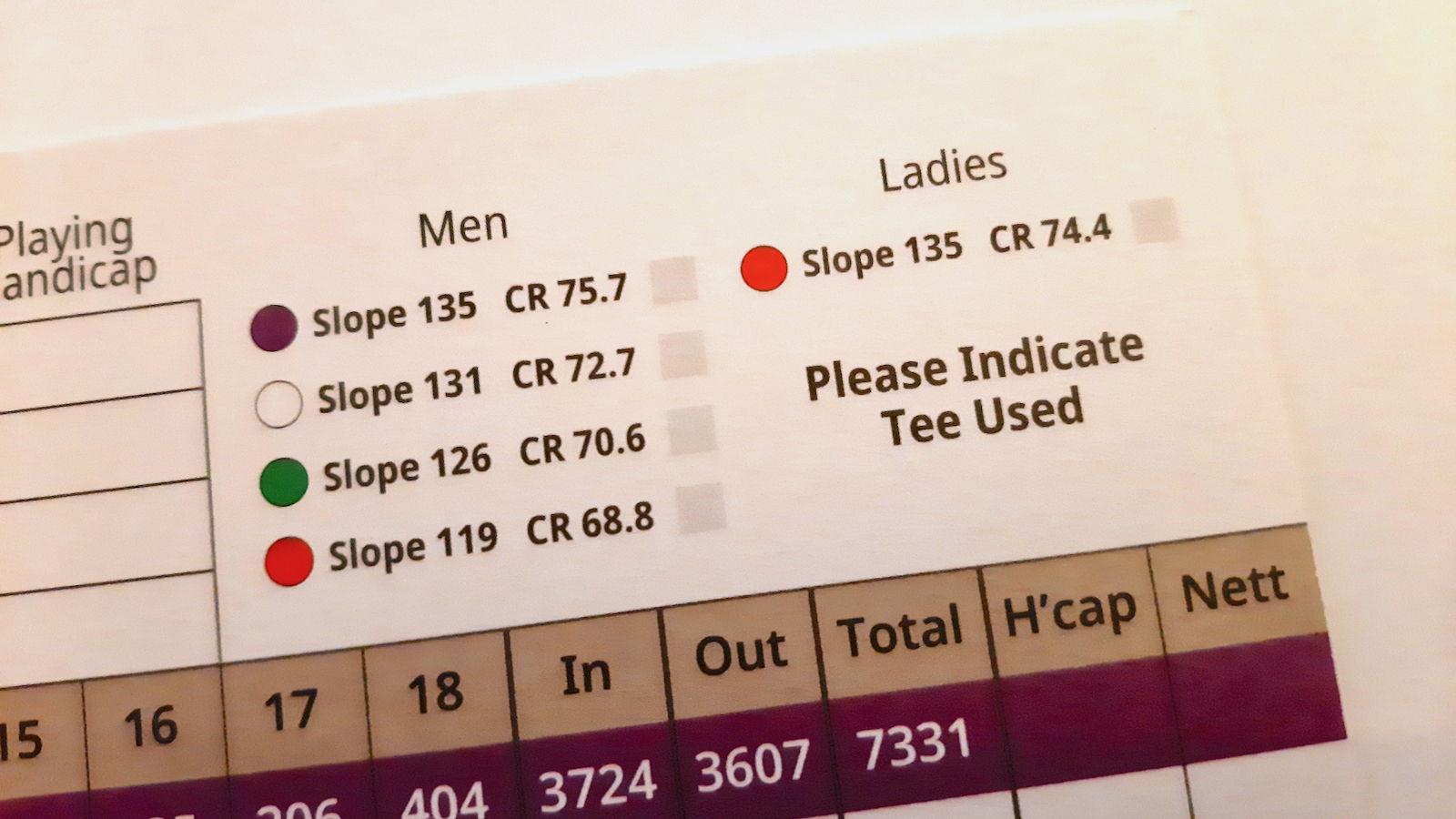
Together, these numbers paint a full picture of the course’s difficulty for golfers of all skill levels. When you look up a course rating, you will see both numbers for each set of tees (like Blue tees, White tees, Red tees).
Table: Example Ratings for Different Tees
| Tees | USGA Course Rating | Bogey Rating | Slope Rating Formula | Slope Rating |
|---|---|---|---|---|
| Black | 74.5 | 88.2 | (88.2 – 74.5) x 11.3 = 13.7 x 11.3 | 155 |
| Blue | 72.1 | 84.8 | (84.8 – 72.1) x 11.3 = 12.7 x 11.3 | 144 |
| White | 70.0 | 81.5 | (81.5 – 70.0) x 11.3 = 11.5 x 11.3 | 130 |
| Red | 68.5 | 78.8 | (78.8 – 68.5) x 11.3 = 10.3 x 11.3 | 116 |
| Forward | 66.0 | 76.0 | (76.0 – 66.0) x 11.3 = 10.0 x 11.3 | 113 |
Note: Bogey Ratings in this table are examples used to reach the Slope Rating. Actual Bogey Ratings are not always published, but they are calculated by the raters.
Look at the table. The Black tees are longest and hardest for everyone. The USGA Course Rating is highest (74.5). The Red and Forward tees are shorter and easier. Their USGA Course Ratings are lower (68.5 and 66.0).
Now look at the Slope Rating. The Black tees have a very high Slope (155). The difference between the expected score for a scratch player and a bogey player is large. This means the obstacles and length hurt the bogey player a lot more than the scratch player from these tees.
The Forward tees have a Slope of 113, which is average. The difference between the expected score for a scratch player and a bogey player is exactly 10 strokes. On this set of tees, the difficulty increases for the bogey player at the standard rate.
This shows that a course can be hard for scratch players (high Course Rating) but only average in how the difficulty changes for bogey players (average Slope). Or it can be average for scratch players but very hard for bogey players (high Slope).
Why is this Important?
The goal of handicapping is fair play. Without Slope Rating, a handicap would only be good for the course where you got it.
Imagine you got your handicap on an easy, open course (low Slope). Your handicap would seem lower than it should be if you played a tight, long course with lots of trouble (high Slope). If you went to the hard course, you would not get enough strokes to make it a fair game.
With Slope Rating, your Handicap Index is adjusted for the difficulty difference for your skill level on any course. Your Course Handicap gives you the right number of strokes.
This system, from the USGA Rating System roots to the modern World Handicap System, lets golfers compete fairly worldwide.
The Raters and the Process
The work of the course raters is very important. They are volunteers or staff trained by governing bodies like the USGA or other bodies under the World Handicap System.
They follow detailed rules and steps. They look at about 460 different measurements and observations on an 18-hole course. These are split into:
- Playability Factors: Length, roll, wind, altitude, temperature.
- Obstacle Factors: Topography, fairway, green target, bunkers, cross hazards, lateral hazards, recovery and rough, trees, green surface, psychological.
They look at these factors for both the scratch golfer and the bogey golfer. They give stroke values for how these factors affect each player’s score.
For example, a wide-open fairway might get 0 strokes for fairway obstacle for both players. A very narrow fairway might add 0.5 strokes for the scratch golfer and 1.5 strokes for the bogey golfer, because the bogey golfer is more likely to miss the fairway and be penalized.
These stroke values are added up for each hole and then for the total 18 holes. This leads to the total stroke values for the scratch and bogey golfers. Length is a major factor, but the obstacle values are key to finding the difference that drives the Slope Rating.
The rating process is redone every few years or if the course changes much (like adding new bunkers or changing the length). This keeps the ratings current and fair.
Connecting It All
Let’s put it all together.
- Golf course raters use the USGA Rating System (now part of the World Handicap System).
- They calculate the USGA Course Rating (Scratch Rating) and the Bogey Rating for each set of tees.
- The difference between these two numbers is used in the Slope Rating Formula.
- The formula is
Slope Rating = (Bogey Rating - USGA Course Rating) x 11.3. - Slope Rating measures how much harder the course is for a bogey golfer compared to a scratch golfer. It ranges from 55 to 155, with 113 being average.
- Your Handicap Index is a measure of your skill level on a standard course (Slope 113).
- To play on a specific course, you use your Handicap Index and the course’s Slope Rating to find your Course Handicap.
Course Handicap = Handicap Index x (Slope Rating / 113).- A higher Slope gives you a higher Course Handicap.
- When you post a score, you calculate a Handicap Differential.
Handicap Differential = (Adjusted Gross Score - USGA Course Rating) x 113 / Slope Rating.- This adjusts your score back to what it would have been on a standard course.
- A high Slope gives you a better (lower) differential for a given score.
- Your Handicap Index is updated using your best Handicap Differentials.
The Slope Rating is a vital link in the chain. It connects the raw difficulty ratings of a course to your personal handicap, making the game fair wherever you play under the World Handicap System. It is a crucial part of the Course Difficulty Rating.
Frequently Asked Questions
h4. What is the lowest and highest possible Slope Rating?
The lowest Slope Rating allowed is 55. The highest is 155.
h4. Is the Slope Rating the same for all sets of tees on a course?
No. Each set of tees (like Back tees, Middle tees, Forward tees) will have its own USGA Course Rating and its own Slope Rating. This is because the length and how obstacles affect players change based on which tees you play from.
h4. Does the Slope Rating ever change for a course?
Yes, it can. Golf courses are re-rated on a schedule (often every 10 years). Also, if a course owner makes big changes, like building new bunkers, changing greens, or making the course longer or shorter, the course can be re-rated sooner. These changes can affect both the USGA Course Rating and the Bogey Rating, which changes the Slope Rating.
h4. Who calculates the Slope Rating?
Trained teams of course raters do this job. They are authorized by golf governing bodies, like the USGA in the United States, or other national associations that are part of the World Handicap System.
h4. Is Slope Rating used outside the USGA Handicap System?
Yes. The concept of Course Rating and Slope Rating, pioneered by the USGA, is now a core part of the World Handicap System (WHS). The WHS is used in many countries around the world, making handicaps more portable and fair for golfers traveling to different regions.
h4. Does a higher Slope Rating mean the course is harder for everyone?
Not exactly. A higher Slope Rating means the course is relatively harder for bogey golfers than it is for scratch golfers. A course could have a very high USGA Course Rating (hard for experts) but an average Slope (difficulty scales normally). A course could have an average Course Rating but a very high Slope, meaning it’s much harder for the average player than for the expert. Slope measures how the difficulty spreads based on skill.