
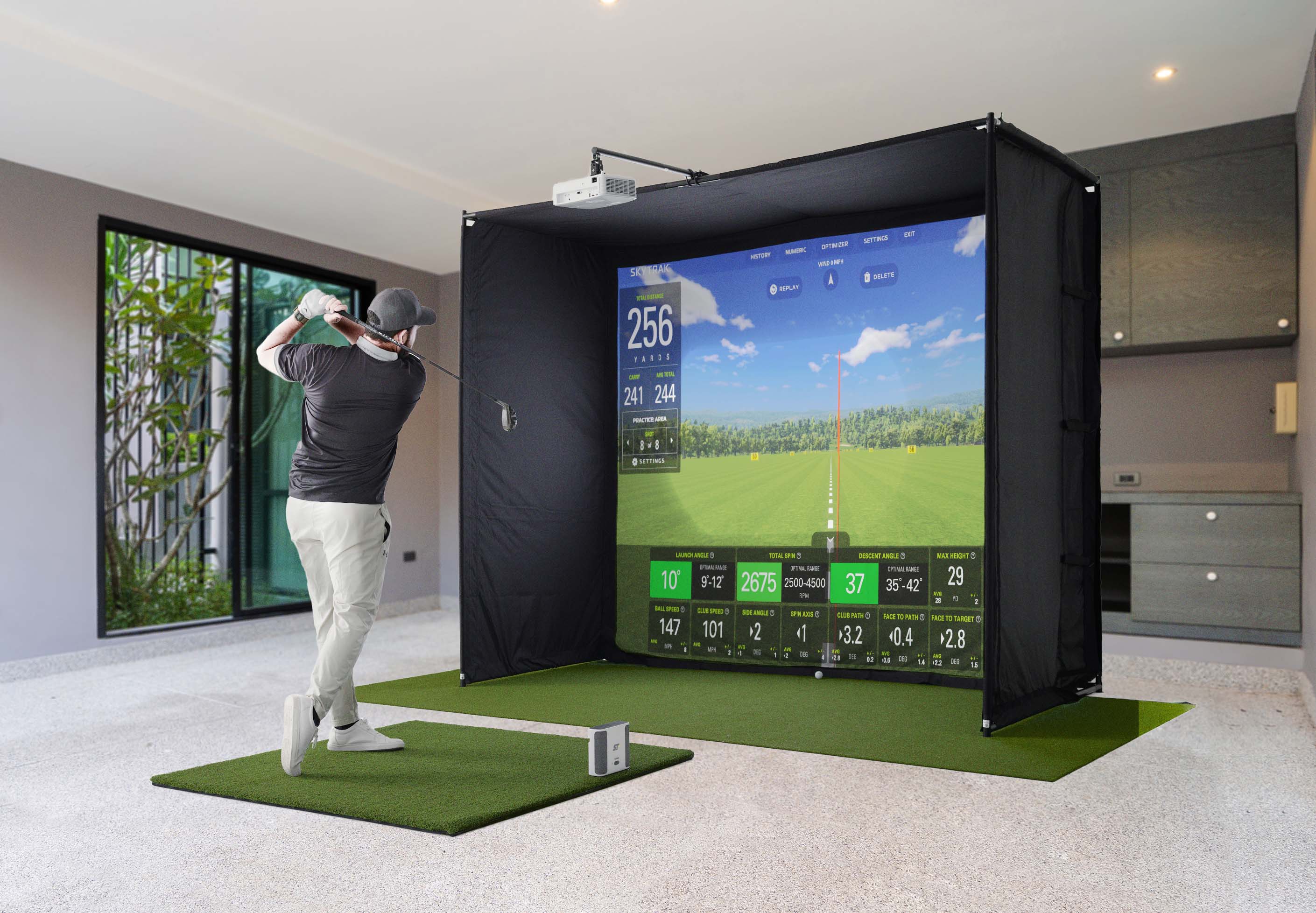
Image Source: www.playbetter.com
How High Do Ceilings Need To Be For Golf Simulator?
Most golf simulator setups need a ceiling height of at least 9 to 10 feet. This height offers enough room for most golfers to swing freely. For the best play and to avoid hitting your ceiling, a room height of 10 feet or more is often seen as the optimum golf simulator ceiling. This provides good vertical clearance for golf simulator swings. It also makes sure your golf simulator enclosure height and impact screen height golf simulator fit well.
Why Ceiling Height Matters for Your Golf Simulator
Ceiling height is a big deal when setting up a golf simulator. It is not just about fitting equipment. It is about how you swing and how safe you are. A low ceiling can make you change your swing. This can hurt your game. It can also cause damage to your clubs, the ceiling, or even you. Proper golf simulator space requirements start with enough ceiling room.
If your ceiling is too low, you might hit it with your club. This can be bad. It can break your club or your ceiling. It can also cause a shock. A higher ceiling gives you freedom. You can swing naturally. This means you can get better at golf.
- Safety First: No one wants to hit the ceiling. This can break things or cause injury.
- True Swing: A low ceiling makes you hold back. This stops you from taking a full, real swing.
- Equipment Fit: Some golf simulator parts, like cages or nets, need a certain height. The impact screen height golf simulator is key.
- Better Play: When you feel free, you play better. This makes your practice more useful.
What Impacts the Right Ceiling Height?
Many things change how high your ceiling needs to be. It is not just one number for everyone. Here are the main things to think about:
Golfer Height and Stature
Tall golfers need more room above them. A 6-foot-tall golfer will likely need more vertical clearance for golf simulator play than a 5-foot-tall golfer. When you swing a golf club, your hands go above your head. The top of your club goes even higher.
Think about your height. Then add the length of your arms and the club. This will give you a rough idea of how high your club will go. Tall players might find a 9-foot ceiling too low. They might need 10 feet or more for comfortable home golf simulator ceiling height.
Golf Club Length
Different golf clubs are different lengths. A driver is the longest club. It needs the most space. A wedge or iron is shorter. It needs less space. Most golfers swing a driver fastest. This makes the club go higher.
- Driver: Needs the most height. A driver is about 45 inches long. When you swing, the club extends. This means the tip goes up.
- Irons: Shorter than drivers. They still need good space.
- Wedges: The shortest clubs. They still need room for a full swing.
Always plan for your longest club. This is almost always your driver. If you have enough room for your driver, other clubs will be fine.
Golf Swing Path
Not everyone swings the same way. Some people have a flat swing. Their club stays lower. Others have a steep swing. Their club goes very high. A steep swing needs more ceiling height.
To check your swing:
1. Stand in your planned golf simulator space.
2. Hold your longest club, like a driver.
3. Take a slow practice swing. Do not hit anything.
4. Watch where the club goes. Does it come close to the ceiling?
5. Have someone else watch you. They can see better.
This test helps you know your own golf simulator swing clearance. If your swing is very steep, you will need more than the minimum ceiling height golf simulator.
Equipment Dimensions
The simulator itself takes up space. This includes the enclosure, screen, and projector.
- Golf Simulator Enclosure Height: Most enclosures are about 8 to 8.5 feet tall. If your ceiling is 9 feet, you will have less than a foot of space above the enclosure. This might feel cramped. A 10-foot ceiling gives you more air above the enclosure.
- Impact Screen Height Golf Simulator: The screen is part of the enclosure. It goes from the floor up. Its top edge will be close to the enclosure height.
- Projector: Where you put the projector also matters. Some projectors hang from the ceiling. They need space. They also need to be far enough from the screen. This affects the room’s total indoor golf simulator dimensions.
Minimum Ceiling Height Golf Simulator Needs
The lowest you can go is usually 8.5 to 9 feet. This is the absolute minimum ceiling height golf simulator. It might work for some people. But it is not ideal for many golfers.
- 8.5 Feet: This is very tight. Only very short golfers with flat swings should try this. You might have to use only irons or wedges. Drivers will be tough.
- 9 Feet: This is often the stated minimum. For many golfers, especially those under 6 feet tall, this can work. You might still need to be careful with your driver swing. It means you have very little vertical clearance for golf simulator play.
With a 9-foot ceiling:
1. You must check your swing carefully.
2. You might need to adjust your setup.
3. Tall friends might not be able to play.
It is better to have more space than less. Always aim for more if you can.
Recommended Golf Simulator Room Height
Most experts suggest 10 feet or more. This is the recommended golf simulator room height for good reason. It offers a much better experience.
- 10 Feet: This height gives most golfers, even taller ones, enough room to swing a driver freely. You will feel less worried about hitting the ceiling. This provides excellent golf simulator swing clearance.
- 11+ Feet: If you have 11 feet or more, you are in great shape. This is the ideal. You will have plenty of vertical clearance for golf simulator play. This lets you swing with full power and natural form. It is the optimum golf simulator ceiling height for nearly everyone.
| Ceiling Height (Feet) | Golfer Comfort | Club Type | Notes |
|---|---|---|---|
| 8.5 | Very Tight | Irons/Wedges Only | Not recommended for most. |
| 9 | Tight | Most Clubs (Careful Driver) | Minimum for many, but still restrictive for some. |
| 10 | Good | All Clubs (Comfortable Driver) | Recommended for most golfers. |
| 11+ | Excellent | All Clubs (Full Freedom) | Optimum golf simulator ceiling height. |
Home Golf Simulator Ceiling Height Specifics
When setting up a home golf simulator, ceiling height is often the biggest limit. Basements, garages, and spare rooms are common spots. Each has its own ceiling height.
- Basements: Many basements have lower ceilings, often 8 feet or less. This makes them tough for golf simulators. Check your basement ceiling height first. You might need to change your swing or only use short clubs.
- Garages: Garages often have higher ceilings. This makes them a good choice for a golf simulator. Garage door tracks can be an issue. You might need to move them.
- Spare Rooms: Some rooms have higher ceilings, especially in newer homes. Older homes might have lower ceilings. Always measure your room’s exact height.
For home use, always go for the highest ceiling you can get. This gives you more options. It also makes your setup more useful for different golfers. A 10-foot home golf simulator ceiling height is a great goal.
Grasping Golf Simulator Space Requirements
Ceiling height is just one part of the puzzle. You also need to think about width and depth. These indoor golf simulator dimensions all work together.
Width Needs
You need enough side-to-side room. This is for your swing and for safety.
- Swing Room: You need space to swing back and through. This means room for your club on both sides of your body.
- Stance: You need room to stand comfortably.
- Safety: You do not want to hit walls or other things.
Most setups need a width of at least 10 feet. 12 to 15 feet is better. This gives you more room to move. It also lets you put the hitting mat in the center.
Depth Needs
Depth is the distance from the screen to the back wall. This is for:
- Ball Flight: The ball needs room to fly a bit before hitting the screen.
- Swing Follow-Through: You need room to finish your swing.
- Projector Distance: The projector needs to be a certain distance from the screen. This makes the image fit the screen.
Most setups need a depth of 15 feet or more. 20 feet is great if you have it. This allows for comfortable play and good projector placement.
Scrutinizing Golf Simulator Enclosure Height
The golf simulator enclosure is the frame that holds your impact screen and side nets. It is a key part of your setup. Its height directly relates to your ceiling.
- Standard Enclosure Heights: Most pre-made enclosures are 8 feet tall. Some are 8.5 feet. A few are 9 feet.
- Ceiling Clearance: If your enclosure is 8 feet tall and your ceiling is 9 feet, you only have 1 foot of space above it. This is not much. It can make the room feel small. It also gives little room for ceiling-mounted items like projectors.
- Custom Enclosures: If your ceiling is very high (like 11+ feet), you might want a custom taller enclosure. This makes the screen fill more of the wall. This looks better and feels more immersive.
When planning, check the specific golf simulator enclosure height for the model you like. Make sure it fits your room.
The Significance of Impact Screen Height Golf Simulator
The impact screen is where the ball hits. It is a big part of the visual experience.
- Screen Size: The screen’s height is usually part of the enclosure’s height. If the enclosure is 8 feet tall, the screen will be a bit less than 8 feet tall. This is because there is a frame above and below the screen.
- Hitting Zone: You want the ball to hit the middle of the screen. This means the screen needs to be tall enough to catch shots from drives to chips.
- Visuals: A taller screen fills more of your vision. This makes the simulation feel more real.
A good impact screen height golf simulator helps you feel like you are on a real course.
Vertical Clearance for Golf Simulator Play
This term means the total open space from the floor to the ceiling. It is the most important number. It tells you if you can swing freely.
- Check Your Swing: As mentioned, do a slow swing test. See how close your club gets to the ceiling.
- Add a Buffer: Even if your club clears the ceiling, add a few inches as a buffer. This is for safety and comfort. A small mistake in your swing could cause a hit.
- Consider Different Swings: If different people will use the simulator, think about all their swing types. A child’s swing is different from an adult’s.
Good vertical clearance for golf simulator play means peace of mind. You can focus on your golf shot, not on hitting the ceiling.
The Optimum Golf Simulator Ceiling Setups
What does an optimum golf simulator ceiling look like? It means a setup where height is not a problem.
- 10-12 Feet of Height: This range is ideal. It allows for any golfer and any club. It gives you true golf simulator swing clearance.
- Open Space: No beams, pipes, or ducts hanging down in the swing path.
- Projector Placement: Enough room for a ceiling-mounted projector that casts a clear image.
- Aesthetics: The room does not feel cramped. It feels open and ready for golf.
If you are building a new space, aim for this optimum golf simulator ceiling height. If you are using an existing room, try to get as close as possible.
Other Indoor Golf Simulator Dimensions and Considerations
Beyond height, width, and depth, other parts of your room matter.
Lighting
Good lighting is key. You need bright, even light. Avoid shadows. This helps the cameras track the ball and club better. Do not have lights right above your swing path. They might get hit.
Flooring
You need a good hitting mat. This protects your clubs and body. Under the mat, you might want padding. This can help with impact. The rest of the floor should be soft. Carpet or artificial turf is good. This makes balls roll smoothly.
Power
You will need power outlets for:
* Projector
* Launch monitor
* Computer
* Lights
* Other accessories
Plan for enough outlets. Think about where they should go to avoid tripping hazards.
Noise
Golf simulators can be loud. The ball hitting the screen makes noise. The fan in the projector makes noise. Think about soundproofing if noise is an issue for others in your home.
Planning Your Space: Measurement and Visualization
Before you buy anything, measure everything twice.
- Measure Ceiling Height: Measure from the floor to the lowest point of your ceiling. Look for beams, lights, or ducts.
- Measure Width: Measure from wall to wall.
- Measure Depth: Measure from the wall where the screen will go to the back wall.
- Mark Your Swing: Use a long stick or even a club. Take practice swings. Mark where your club goes highest. Mark your widest swing points.
- Use Blue Tape: Put blue painter’s tape on the floor and walls. Mark where the screen will go. Mark where the hitting mat will be. This helps you see the golf simulator space requirements.
Thinking about these indoor golf simulator dimensions helps you plan.
What if Space is Limited? Compromises and Solutions
Sometimes, you just cannot get the perfect 10-foot ceiling. What then?
- Shorter Clubs: If your ceiling is very low (8.5-9 feet), you might only be able to use irons or wedges. This is okay for chipping and putting practice. It is not great for full rounds.
- Open Ceiling: In a basement or garage, you might see exposed joists or beams. If the ceiling is high between the joists, you can hit there. Just be very careful not to hit a joist. This is a common way to get a bit more vertical clearance for golf simulator use.
- No Enclosure: Some setups use just a net or impact screen. This saves a little height. But it also means less safety for stray shots.
- Projector Placement: If you cannot mount a projector on the ceiling, use a short-throw projector on the floor. Or put it on a shelf behind you. This saves ceiling space.
- Adjust Your Swing: As a last resort, some golfers change their swing slightly. They might flatten it a bit. This is not ideal for real game play. It might mess up your outdoor swing.
It is always best to find a space that fits your full swing. But if you cannot, these compromises might let you still enjoy a simulator. Just know what you are giving up.
Conclusion
The height of your ceiling is the most important factor for a golf simulator. While 9 feet is often the minimum ceiling height golf simulator needs, 10 feet or more is the recommended golf simulator room height. This provides good golf simulator swing clearance. It ensures a safe and comfortable playing area. It also allows for the best indoor golf simulator dimensions.
To find your ideal height, consider your own height, your swing style, and the length of your clubs. Especially think about your driver. The goal is to have an optimum golf simulator ceiling that gives you full freedom. This freedom helps you take real swings. It helps you get better at golf.
Always measure your space carefully. Plan for your golf simulator enclosure height and impact screen height golf simulator. Remember, more height is always better. It gives you a top-notch golf simulator experience at home.
Frequently Asked Questions (FAQ)
Q1: What is the absolute lowest ceiling height I can have for a golf simulator?
The absolute lowest is usually 8.5 feet. But this is very tight. It is only for very short golfers with flat swings. You might only use irons or wedges.
Q2: Can a 9-foot ceiling work for a golf simulator?
Yes, a 9-foot ceiling can work. It is often the minimum. Many golfers under 6 feet tall can use a driver here. You will need to check your swing carefully. It is not ideal, but it is often possible.
Q3: How much space above my head do I need to clear the ceiling?
You need enough room for your club to go above your head during your swing. A buffer of at least 6-12 inches between your club’s highest point and the ceiling is smart. This gives you peace of mind and safety.
Q4: Does my height matter more than my club length?
Both matter a lot. Your height sets your basic stance. Your club length, especially your driver, determines how far your club extends. Your swing path then decides how high that club goes. A tall golfer with a steep swing needs the most height.
Q5: Will a ceiling-mounted projector hit my golf club?
It can if it is in your swing path. It is vital to place the projector out of the way. Some projectors hang low. Others are flat to the ceiling. Short-throw projectors can sit on the floor or a shelf. This avoids ceiling contact.
Q6: Do I need a different ceiling height if I only want to practice chipping and putting?
No, if you only chip and putt, you need much less ceiling height. A standard room height of 8 feet is usually fine. Chipping and putting swings are much shorter. They do not go high above your head.
Q7: Should I worry about ceiling fans or light fixtures?
Yes, absolutely. Any hanging items are a risk. They can get hit by your club. Remove them or make sure they are well out of the way of your swing path. This applies to your vertical clearance for golf simulator use.
Q8: What if my ceiling has uneven parts, like beams or ducts?
Measure to the lowest point of any beam or duct. That lowest point is your true ceiling height. You must make sure your swing clears this lowest point. You can sometimes hit between beams if they are wide enough apart. But this needs careful planning.