
As an Amazon Associate I earn from qualifying purchases.
Choosing Glue Plastic can be confusing because instant adhesives, plastic cements, gels, and two-part bonders suit different repairs. The wrong formula may run, set too quickly, or fail to fill a gap.
Start with the job: consider the plastic or material involved, whether you need a precise tip or brush, how much working time you have, and whether the bond must handle gaps or impacts.
These five picks were selected from the supplied product features to cover structural repairs, small household fixes, 3D printing, model building, and controlled low-volume application.
You will find the strongest gap-filling option first, followed by versatile applicators and specialist choices for detailed plastic work.
Our Top 5 Glue Plastic Picks at a Glance
| Product | ||
|---|---|---|
 |
J-B Weld Plastic Bonder Gap-Filling Plastic Repairs |
Check Price |
 |
Gorilla Super Glue Brush And Nozzle Flexible Household Application |
Check Price |
 |
3D Printing Super Glue Gel 3D Printed Parts |
Check Price |
 |
Tamiya Extra Thin Cement Plastic Model Building |
Check Price |
 |
Loctite Super Glue Liquid Small Precise Repairs |
Check Price |
Top 5 Glue Plastic: Detailed Reviews
1. J-B Weld Plastic Bonder
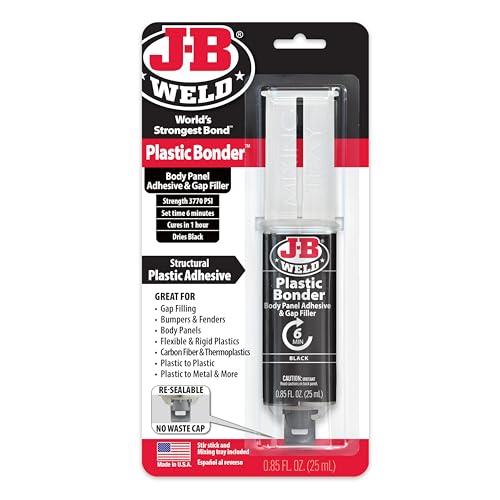
For Glue Plastic repairs, J-B Weld Plastic Bonder is a 25 ml, two-part urethane adhesive designed for strong, lasting bonds and gap filling. Its 1:1 mixing ratio keeps preparation straightforward, while the black finish suits dark components and body-panel-style repairs. It sets in 15 minutes and can be sanded after 30 minutes, so you can shape the repair relatively soon. The formula works with thermoplastics, thermosets, carbon-fibre composites, coated metals, concrete and PVC, making it useful indoors or outdoors.
What We Like:
- The 1:1 ratio makes the two-part system simple to prepare.
- It sets in 15 minutes for quicker repair work.
- You can sand it after 30 minutes to refine the repair.
- Its 3770 psi tensile strength supports durable bonding.
- The gap-filling formula works across plastics, composites, PVC and more.
What Could Be Improved:
- The black cured finish may show on light-coloured or visible repairs.
- It is not an instant adhesive, so you must allow 15 minutes for setting.
- The two-part system requires mixing, unlike a ready-to-use single adhesive.
Buy it if you need a strong, gap-filling bond for plastic, composite or PVC parts, especially where a black finish is acceptable and sanding matters. Skip it for clear repairs, tiny instant fixes or projects where mixing two components adds unnecessary work.
2. Gorilla Super Glue Brush And Nozzle
For Glue Plastic repairs, Gorilla Super Glue with its two-way applicator gives you a practical choice between a fine brush and precision nozzle. The brush spreads adhesive across broader areas, while the tip helps you place small amounts accurately on detailed parts. Its clear formula bonds plastic along with glass, wood, metal, ceramic, rubber, leather and paper. It sets in 10–45 seconds without clamping, and the anti-clog cap helps keep the bottle usable between repairs. The 12 g bottle suits general household jobs and model-related fixes.
What We Like:
- The brush handles broader repairs without needing a separate tool.
- The precision tip helps you control small glue applications.
- Fast setting means many repairs need no clamp.
- The clear finish is unobtrusive on visible joins.
- The anti-clog cap helps reduce drying and blocked applicators.
What Could Be Improved:
- The 10–45-second setting time leaves limited opportunity to reposition parts.
- The small 12 g bottle may not suit frequent or large repair work.
- You need to choose the applicator carefully, since excess glue can be difficult to control on delicate areas.
Buy it if you want one versatile adhesive for household repairs, plastic parts and small projects, especially where brush or nozzle control matters. Skip it if you need extended adjustment time or regularly repair large areas that require substantial adhesive coverage.
3. 3D Printing Super Glue Gel
This Glue Plastic adhesive is a no-drip cyanoacrylate gel made for PLA, ABS, PETG, TPU, ASA, and nylon parts. Its thick formula stays on vertical seams, gaps, complex joints, and support structures instead of running, which makes post-processing and layer repairs easier to control. The precision tip and anti-clog needle help you apply small amounts cleanly. The 1.76 oz tube suits frequent repairs, print farms, and prototyping, while resistance to heat up to 110 °C and humidity supports outdoor prints, RC components, and mechanical fits.
What We Like:
- The no-drip gel stays put on vertical bonds and awkward joints.
- It works across a broad range of common 3D-printing filaments.
- The precision tip helps you control application and reduce mess.
- The anti-clog needle helps keep the nozzle usable between applications.
- The large 1.76 oz tube suits frequent repairs and high-volume making.
What Could Be Improved:
- The thick gel may be less suitable than a runnier adhesive for very fine, tightly fitting seams.
- Its 110 °C heat resistance has a defined limit, so hotter applications need another solution.
- The large tube may be more adhesive than occasional users need.
Buy it if you regularly repair, assemble, or post-process 3D-printed parts and want controlled application on vertical or uneven surfaces. It also suits print farms and frequent makers. Skip it if you need a very thin adhesive for narrow seams or only make occasional small repairs.
4. Tamiya Extra Thin Cement
For Glue Plastic model work, Tamiya Extra Thin Cement combines a fast-drying, high-strength formula with a fine 0.3mm tip. That narrow applicator supports intricate details and controlled cement placement, helping you apply only where needed. The sturdy plastic construction is designed for lasting use, while the adhesive also suits arts and crafts and woodworking projects. Each pack includes two 40ml tubes, giving you useful запас for longer projects or separate work areas. It is intended for securely bonding surfaces, particularly where careful, neat application matters.
What We Like:
- The 0.3mm tip gives you precise control around small model details.
- The fast-drying formula helps bonded surfaces secure quickly.
- Two 40ml tubes provide extended project support.
- The sturdy plastic construction is designed for lasting use.
- Its stated uses include model building, arts and crafts, and woodworking projects.
What Could Be Improved:
- The narrow tip requires careful handling and may feel slow for covering larger areas.
- Fast drying leaves less time to adjust parts after application.
- A two-pack may be more glue than you need for a small, occasional project.
Buy it if you build plastic models or need controlled cement application for intricate work. The fine tip is the main reason to choose it. Skip it if you need to cover broad surfaces quickly or only require a small amount of adhesive for one minor repair.
5. Loctite Super Glue Liquid
Glue Plastic repairs are simple with Loctite Super Glue Liquid, a two-pack of 0.07 fl oz self-piercing tubes for small household, craft, and hobby jobs. The liquid formula works on porous and non-porous materials, including most hard plastics, wood, metal, rubber, leather, paper, and ceramic. It sets in 15 to 30 seconds without clamping, while the transparent finish helps keep repairs discreet. The compact tubes pierce themselves, so you avoid searching for a pin and can apply adhesive with less mess.
What We Like:
- Sets quickly, usually within 15 to 30 seconds.
- The self-piercing tubes need no separate pin or unclogging tool.
- Transparent drying suits visible repairs and craft projects.
- Works across most hard plastics plus wood, metal, rubber, leather, paper, and ceramic.
- The two-pack gives you a spare tube for another repair.
What Could Be Improved:
- Each 0.07 fl oz tube contains very little adhesive, so it is better suited to small repairs than larger projects.
- It works on most hard plastics, not necessarily every plastic type.
- The liquid formula can be less forgiving than a gel if you need to fill a gap or reposition parts.
Buy it if you need a compact adhesive for small, precise repairs on plastic and other common materials, especially where a clear finish and quick setting matter. Skip it for large gaps, broad surfaces, or plastic types outside the stated compatibility, where a gap-filling or material-specific adhesive should serve you better.
How To Choose Glue Plastic
Glue Plastic choices vary because a neat model-building joint needs a different approach from a repair that must bridge a visible gap. Start by identifying the job, then match the adhesive’s intended use, handling style, and tolerance for mess. The right choice should make the repair easier, not simply bond the materials in theory.
How to choose Glue Plastic for the job
First, decide whether you need gap filling or a tight, close-fitting bond. Uneven breaks, missing edges, and joins with a small space between surfaces call for a product intended to fill gaps. Closely fitted parts, such as model components, usually benefit from an adhesive designed for controlled assembly rather than a thick blob that can obscure detail.
Check the material and project type
Read the product label for the plastics and applications it covers before buying. A hobby project, household repair, and 3D-printed part may each need a different formulation or application method. If the item has a specialised surface, confirm compatibility first and test on an unseen area where possible.
Choose control over speed
Application style matters as much as bonding strength. A brush or nozzle can help you place adhesive more accurately, while a gel can be easier to keep where you apply it. For tiny repairs, a liquid formula may suit precise placement, but it can spread quickly. Consider whether you need working time to align parts or prefer a fast, direct application.
Think about the finish and your working habits
Look at how visible the joint will be and whether the adhesive could affect the appearance of the finished piece. You should also consider the container: an applicator that matches your project can reduce waste and cleanup. Follow the label’s instructions for surface preparation, application, joining, and handling, and store the adhesive as directed after use.
Which Glue Plastic Should You Choose?
J-B Weld Plastic Bonder is the best overall pick here because its gap-filling focus suits a broad range of awkward plastic repairs. Gorilla Super Glue Brush And Nozzle is the best alternative if you want a more flexible household application method. Choose 3D Printing Super Glue Gel, Tamiya Extra Thin Cement, or Loctite Super Glue Liquid instead when your project specifically calls for 3D-printed parts, model building, or small precise repairs.