
Do you ever feel like numbers are playing hide-and-seek with your finances? For anyone managing a business, big or small, keeping track of money can feel like a big puzzle. That’s where a good accounting calculator comes in, but boy, can choosing one be confusing! There are so many buttons and features, it’s easy to feel overwhelmed and wonder if you’re picking the right tool for the job.
Imagine having a calculator that just *gets* what you need. It handles the tricky calculations quickly and accurately, freeing up your time to focus on growing your business instead of getting lost in spreadsheets. In this post, we’ll break down what makes a great accounting calculator and how to pick the perfect one for your needs. Get ready to say goodbye to number headaches and hello to smoother financial management!
Top Calculator For Accounting Recommendations
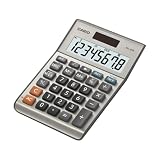
- LARGE EIGHT-DIGIT DISPLAY – Clear and easy-to-read 8-digit display, perfect for everyday calculations and ensuring accurate results in home or office settings.
- TAX & CURRENCY EXCHANGE FUNCTIONS – Effortlessly handle tax calculations and convert home currency to other currencies for easy financial management.
- GENERAL PURPOSE CALCULATOR – Ideal for a wide range of applications, from basic math to business and personal use, with memory keys for quick storage and recall.
- USER-FRIENDLY KEYBOARD – Easy-to-use layout, featuring square root, percent calculation, and simple functions that make it perfect for everyday tasks.
- COMPACT & PORTABLE DESIGN – Space-saving design that fits easily on any desk or in a briefcase, making it ideal for both home and office use.

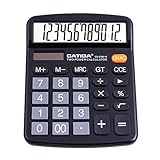
- [LARGE DISPLAY] - The huge LCD screen that clearly displays big numbers makes it easy to read from afar, and it’s aesthetically pleasing.
- [SENSITIVE AND BIG BUTTONS] - Your calculation process will be faster and smoother with this calculator’s responsive buttons. Once pressed, the buttons quickly register and display the corresponding number on the screen. The big size of the buttons prevents you from hitting the wrong button.
- [DUAL POWER DESIGN] - This calculator utilizes both the solar power and battery power (battery included). The solar panel, as long as you use it in a lit environment, will power up the calculator thoroughly.
- [VERSATILE PURPOSES] -This calculator is designed for many occasions: business, office, home, basic budgeting, school, and more. Use it to assist your personal finance or just a quick calculation session.
- [FUNCTIONALITIES] - Add, subtract, multiply, divide, backspace, grand total, CE, %, M+/M-/MRC, On/AC Button, and Auto Power-Off. The calculator will turn itself off after about 6 minutes of being idle.

- Two-way Power Desk Calculator: Use solar power or battery power,In the case of sunlight or light, it can also be used without battery (Provide 2 AA batteries, only 1 needed).
- Optimized for Desk Use: The angled display offers a better viewing angle, especially when placed on a flat surface.
- Ergonomic Screen Tilt: Reduces neck strain with a user-friendly viewing angle, naturally aligning with your line of sight for a more comfortable experience.
- 10-Key Calculator with Large Buttons: Easy-to-use design follows computer keyboard layout.
- Desktop Basic Office Calculator:Perfect for daily use in offices, businesses, schools, retail stores, shopping centers, and home offices.

- Two-way Power Desk Calculator: Use solar power or battery power,In the case of sunlight or light, it can also be used without battery (Provide 2 AA batteries, only 1 needed).
- Optimized for Desk Use: The angled display offers a better viewing angle, especially when placed on a flat surface.
- Ergonomic Screen Tilt: Reduces neck strain with a user-friendly viewing angle, naturally aligning with your line of sight for a more comfortable experience.
- 10-Key Calculator with Large Buttons: Easy-to-use design follows computer keyboard layout.
- Desktop Basic Office Calculator:Perfect for daily use in offices, businesses, schools, retail stores, shopping centers, and home offices.

- PROFESSIONAL FINANCIAL CALCULATOR : Built-in TVM, IRR, NPV. Engineered for business analysts, real estate investors, accountants, and finance students.
- ADVANCED CASH FLOW & AMORTIZATION : Execute time value of money, break-even analysis, depreciation schedules, and bond pricing. Trusted for professional exam prep, MBA coursework, and banking certifications.
- CATIGA CF-300 : Flip-open hard case with a snap-close design for a secure fit. Compact and portable: designed for daily professional use in office, classroom, or on-site.
- ALL-IN-ONE FOR PROFESSIONALS : From NPV/IRR for real estate analysis to statistical calculations for business analysts. Handles probability, linear regression, and complex financial formulas.
- MORTGAGE, LOAN & INVESTMENT CALCULATOR : Covers bond pricing, loan amortization, investment analysis, and exam-level computations. Your go-to accounting calculator, business calculator, and real estate calculator in one device.

- Keys That Feel Right: Smooth, well-spaced keys with natural resistance allow you to move quickly and confidently—no re-learning or finger fatigue.
- Sharp, Color-Coded Printing: Prints 2.5 lines per second in black for positive and red for negative values—quiet, crisp, and easy to read at a glance.
- Big, Bright Display You Can Trust: The 12-digit fluorescent screen is clear from any angle, so totals are easy to catch without squinting or second-guessing.
- Designed for Speed and Comfort: Ergonomic key shapes follow your fingers’ natural motion—helping you type faster and make fewer mistakes.
- Built to Last, Easy to Maintain: Our heavy-duty design withstands daily use, featuring standard ribbons and paper rolls that are simple to replace.

- FAST TWO-COLOR PRINTING – Prints at 2.0 lines per second with dual-color output (black/red) for easy distinction between positive and negative values.
- CHECK, CORRECT & RE-PRINT – Review and correct up to 150 steps before printing; use re-print and after-print functions for efficient documentation.
- TAX & BUSINESS FUNCTIONS – Includes cost/sell/margin, mark-up/mark-down, tax calculation keys, and currency exchange for quick financial operations.
- BIG DISPLAY & EASY INPUT – Features a 12-digit LCD and large, clearly spaced plastic keys for comfortable, accurate data entry.
- UPGRADED DESIGN – New version of the HR-100TM, ideal for taxes, bookkeeping, and accounting with clock/calendar printouts, subtotal & grand total, and percent functions.

- Fundamental, two-line calculator that combines statistics and advanced scientific functions for high school math and science
- Two-line display shows the entry and calculated result at the same time for easy understanding of the calculation
- Fraction features, conversions, and basic scientific and trigonometric functions
- Solar and battery powered
- Approved for use on SAT, ACT and AP exams
Choosing the Right Calculator for Accounting: Your Essential Guide
When you’re dealing with numbers, accuracy is super important. That’s why having the right calculator for accounting tasks makes a big difference. This guide will help you pick the best one for your needs.
Key Features to Look For
What makes a good accounting calculator? Here are the things you should check:
1. Basic Functions:
Every calculator has these. Look for addition (+), subtraction (-), multiplication (*), and division (/).
2. Percentage Button (%):
This helps you quickly figure out discounts, markups, and taxes. It saves you time.
3. Grand Total (GT) Button:
This button adds up all the numbers you’ve entered throughout your session. It’s great for summing up lists of expenses or income.
4. Memory Functions (M+, M-, MR, MC):
These let you store numbers and recall them later. M+ adds a number to memory, M- subtracts, MR recalls the stored number, and MC clears the memory.
5. Tax Calculation Buttons:
Some calculators have special buttons for adding or subtracting tax. This makes tax calculations much easier.
6. Cost/Sell/Margin (CSM) Buttons:
These are helpful for business owners. They let you quickly calculate the cost, selling price, or profit margin of an item.
7. Display Size and Readability:
A large, clear display is a must. You want to see the numbers easily without squinting. Look for a display that shows at least 10-12 digits.
8. Power Source:
Many accounting calculators use both solar power and a battery. This means they work even in dim light and won’t die on you if the battery runs out.
Important Materials and Build Quality
The way a calculator is made matters for how long it lasts and how it feels to use.
1. Durable Plastic Casing:
A sturdy plastic body protects the calculator from everyday bumps and drops. It should feel solid in your hands.
2. Responsive Buttons:
The buttons should be easy to press and give a good “click” feedback. You don’t want buttons that stick or feel flimsy. Rubber or silicone button pads are often used for a good feel.
3. Clear Display Material:
The screen should be made of a material that prevents glare and is easy to read from different angles. LCD (Liquid Crystal Display) is common and efficient.
Factors That Improve or Reduce Quality
What makes one calculator better than another?
Factors That Improve Quality:
- Brand Reputation: Well-known brands often make more reliable products.
- Build Material: Higher-quality plastics and components mean a longer-lasting calculator.
- Ergonomics: A design that fits comfortably in your hand makes it easier to use for long periods.
- Clear Display: A bright, easy-to-read screen reduces errors.
Factors That Reduce Quality:
- Flimsy Construction: A calculator that feels cheap or wobbly probably won’t last.
- Sticky or Unresponsive Buttons: These make calculations frustrating and can lead to mistakes.
- Poor Display Readability: Glare or small numbers make it hard to use.
- Lack of Essential Functions: If it’s missing key buttons like GT or memory, it’s not ideal for accounting.
User Experience and Use Cases
How does a calculator feel to use, and what jobs is it good for?
1. Ease of Use:
A good accounting calculator is intuitive. You shouldn’t have to guess how to use the buttons. The layout should be logical.
2. Speed and Efficiency:
With the right features, you can do calculations much faster. Buttons like GT and tax calculation speed things up.
3. Accuracy:
A reliable calculator gives you the correct answers every time. This is the most important thing for accounting.
Common Use Cases:
- Students: For homework, tests, and understanding accounting concepts.
- Small Business Owners: For tracking sales, expenses, and managing budgets.
- Bookkeepers: For daily financial record-keeping.
- Anyone needing to manage personal finances: For budgeting, tracking bills, and saving.
Frequently Asked Questions (FAQ) About Accounting Calculators
Q: What are the main Key Features of an accounting calculator?
A: Key features include basic functions, percentage, grand total (GT), memory functions (M+, M-, MR, MC), tax calculation buttons, and Cost/Sell/Margin (CSM) buttons. A clear, large display and dual power source (solar/battery) are also important.
Q: Can I use a regular calculator for accounting?
A: For simple math, yes. But for serious accounting, a dedicated accounting calculator has special functions that save time and reduce errors, like the GT and CSM buttons.
Q: How important is the display on an accounting calculator?
A: Very important! A large, clear, and easy-to-read display helps you see your numbers without mistakes. Look for one that shows at least 10-12 digits and doesn’t have too much glare.
Q: What does the ‘GT’ button do?
A: ‘GT’ stands for Grand Total. It adds up all the numbers you’ve calculated during your session. It’s like a running total for everything you’ve entered.
Q: Are solar-powered calculators good enough?
A: Many accounting calculators use both solar and battery power. This is the best option because it works in bright light using solar and keeps working in dim light or if the solar panel is covered, thanks to the battery.
Q: What are ‘M+’ and ‘M-‘ buttons for?
A: These are memory buttons. ‘M+’ adds the number on the display to the calculator’s memory. ‘M-‘ subtracts the number from memory. They help you keep track of specific numbers while you do other calculations.
Q: How do I know if a calculator is good quality?
A: Good quality means it feels sturdy, has responsive buttons, and a clear display. Brands that have been around a long time often make reliable calculators. It should feel solid, not cheap or flimsy.
Q: Is a calculator with tax buttons really necessary?
A: If you frequently deal with sales tax or value-added tax (VAT), tax buttons make calculating it much faster and more accurate. It’s a great time-saver.
Q: What are the CSM buttons used for?
A: CSM stands for Cost, Sell, and Margin. These buttons help you quickly figure out the profit margin, selling price, or cost of an item when you know two of the three values. They are very useful for retail and sales.
Q: How long should an accounting calculator last?
A: With good care, a well-made accounting calculator can last for many years. A durable plastic casing, quality buttons, and a reliable power source contribute to its longevity.