
A golf scramble is a team game. It is a fun way to play golf. Each player on a team hits the ball. Then the team picks the best shot. All players then hit from that spot. This repeats until the ball is in the hole. This guide will show you how to play a golf scramble like a pro.
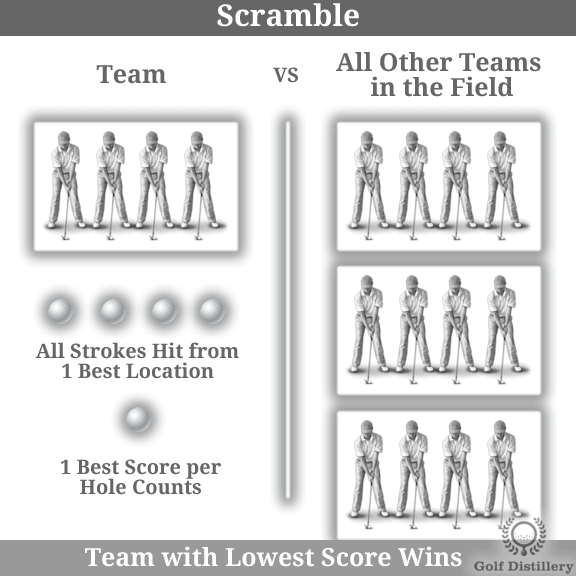
Image Source: www.golfdistillery.com
The Core of a Golf Scramble
Golf is great. Playing it with friends is even better. The golf scramble lets you do just that. It is a popular game format. Many charity events use it. Even new players can have fun. It helps everyone enjoy the course.
What is a Golf Scramble?
A golf scramble is a team game. Most teams have four players. All players hit a tee shot. The team looks at all the balls. They choose the best one. Then, all players pick up their own ball. They drop it at the spot of the chosen ball. Each player hits again from there. This goes on for every shot. They do this until the ball is in the hole. The team records one score for each hole. This makes the game faster. It also lowers scores. It helps everyone feel good about their play.
Golf Scramble Rules: The Basics
Knowing the rules is key. They keep the game fair. They also make it fun. Here are the main golf scramble rules:
- Team Size: Most often, teams have four players. Sometimes it is two or three.
- Starting Play: Everyone hits their first shot from the tee box.
- Picking the Best Shot: After all balls are hit, the team decides. They pick the best ball. This spot becomes the new starting point.
- Marking the Spot: The best ball is marked. All other balls are picked up.
- Hitting from the Spot: Players drop their ball within a set distance. This is usually one club length. The distance can change. Check local rules. This distance must not get closer to the hole. Also, the ball must stay in the same part of the course. (e.g., rough to rough, fairway to fairway).
- Putting Green Rules: On the green, placing the ball is common. You can put the ball within a few inches. Again, do not move closer to the hole.
- Keeping Score: Only one score counts per hole. This is the team’s score.
- Pace of Play: Play moves fast. Teams move together. This helps everyone finish on time.
Why Play a Scramble?
Scrambles are very popular. They offer many good points:
- Fun for All: New players can join. They do not feel pressure. Better players can hit bold shots.
- Teamwork: It builds team spirit. You work together for one goal.
- Less Pressure: One bad shot does not ruin the hole. You have teammates to back you up.
- Faster Play: Fewer strokes count. This can speed up the game.
- Lower Scores: You always hit from a good spot. This helps score low.
- Social Aspect: It is a great way to meet people. You can chat and laugh.
Best Ball vs Scramble Golf: What’s the Difference?
People often confuse these. Both are team games. But they work differently.
- Best Ball Golf: In best ball, each player plays their own ball. They play it from start to finish. At the end of the hole, the team takes the lowest score. If Player A gets a 4 and Player B gets a 5, the team score is 4. No one moves their ball.
- Scramble Golf: In a scramble, everyone hits from the same spot. This is the best shot. You share the whole journey of the ball. Everyone contributes to every shot.
Think of it like this: Best ball is like a relay race. Each person runs their own leg. Scramble is like a team effort. Everyone pushes the same car down the track.
Building Your Dream Team
A good team is important. It makes the scramble fun. It also helps you score low.
Player Roles and Strengths
Think about what each player does best. A balanced team is strong.
- The Long Hitter: This person drives the ball far. Their main job is the tee shot. They set up short second shots. This player often hits first. This lets others play safe.
- The Straight Hitter: This player hits the ball very straight. They may not hit it furthest. But they keep it in play. Their shots are safe. They often hit second or third. This ensures a usable ball.
- The Short Game Master: This player is great around the green. They chip well. They putt well. They save strokes. Their shots near the hole are key. This person should putt last.
- The All-Around Player: This player is good at everything. They can fill any role. They can make the clutch shot. This person often hits last on many shots. They can be aggressive. They know a good shot is already there.
Here is a table showing ideal team roles:
| Player Type | Key Strength | Role in Scramble | Order of Play (Typical) |
|---|---|---|---|
| The Long Hitter | Drives ball far | Gets the team close to the green | 1st |
| The Straight Hitter | Hits ball accurately | Ensures a safe, playable shot | 2nd or 3rd |
| The Short Game Pro | Excellent chipping/putting | Saves strokes around the green | Last (on putting) |
| The All-Arounder | Consistent in all areas | Versatile, can play aggressive or safe | Last (on full shots) |
Crafting Your Golf Scramble Strategy
Playing smart wins games. It is not just about hitting the ball. It is about working together. This is where winning golf scramble tactics come in.
Winning Golf Scramble Tactics
Good strategy is a must. Every shot matters.
- Play Order is Key: Do not just hit in any order. Think about it.
- Tee Shots: Long hitter first. They try for a big drive. If they miss, safe hitters follow. The last player can then be bold. They know a good shot is already down.
- Approach Shots: The straight hitter might go first. They get it on the green. Then others can try risky shots. They aim for closer to the hole.
- Putting: The best putter putts last. Others try to gauge the speed. They read the break. They give the best putter information.
- Aggressive vs. Safe: Know when to be bold. Know when to be careful.
- If you have a great drive, take risks with the next shot.
- If no one hit a good shot, play it safe. Get a ball in the fairway.
- Communicate: Talk to your team. Ask about the lie. Talk about wind. Discuss club choice.
- Learn from Others: Watch your teammates’ shots. See how the ball flies. See how it rolls. This helps you with your shot.
- Stay Positive: Golf can be hard. Bad shots happen. Encourage each other. A good attitude helps everyone play better.
Playing a Golf Scramble Guide: On-Course Decisions
Every hole is different. Make smart choices for each one.
Tee Shot Strategy
This is often the first big decision.
- Longest and Straightest: The goal is simple. Get the ball as far as possible. But it must be in a good spot.
- Order of Play:
- The Crusher: The longest hitter goes first. They try to blast one down the middle. This sets a high bar.
- The Safe Bet: The next player aims to keep the ball in play. They want to ensure a usable shot. This takes pressure off the last players.
- The Risk Taker: If two good shots are in play, the third or fourth player can go for broke. They might try to cut a corner. They might aim for a very long drive. This can get you closer to the green.
- Considering the Hole:
- Par 3s: On short holes, accuracy is key. Aim for the green.
- Par 4s and 5s: Distance matters. But so does a good lie. You want to be in the fairway.
Approach Shot Strategy
After the drive, you need to get to the green.
- Green Light or Red Light:
- Green Light: If you are far out, and the first player hits a good shot, others can attack the flag.
- Red Light: If no one has a good shot yet, play safe. Aim for the center of the green. Avoid hazards.
- Reading the Green: Look at the slope. Where do you want your ball to land? Where do you want it to roll?
- Wind and Obstacles: Always factor these in. Talk to your team about them.
Short Game and Putting Strategy
This is where you save strokes.
- Chipping:
- If the first chip is good, the next player can try to chip it in.
- If the first chip is bad, the next player must play it safe. Get it close to the hole.
- Putting: This is perhaps the most important area for order of play.
- First Putters: They try to get a read on the putt. They hit the ball. The team watches how it breaks. They see how fast it rolls.
- Middle Putters: They use the info from the first putter. They try to get it very close. They might even try to make it.
- Last Putter (The Closer): This is usually the best putter. They have seen the line. They have seen the speed. They have the best chance to sink the putt.
- Leave the Flag In or Out? This is a debate. For a scramble, leaving it in can help. A ball might hit it and drop in. It is legal. Most teams leave it in unless it is very close.
Team Golf Scramble Tips for Each Hole
Play smart on every hole.
- Hole 1 (First Tee Jitters): Start strong but safe. Get a good tee shot in the fairway. This builds confidence.
- Par 3s: Focus on hitting the green. Do not try heroic shots. Make par a safe bet. Try for birdie if the first shot is great.
- Par 4s: Get a good drive. Then aim for the green in two. Use the putting strategy to sink the putt.
- Par 5s: These are chances for birdies or eagles.
- Long Hitter: Try to get a huge drive.
- Second Shot: Try to get close to the green. Or even on it in two.
- Third Shot: This is often a chip or pitch. Get it very close.
- Blind Shots/Hazards: Be extra careful. Send someone forward to look. Know where to aim.
Advanced Scramble Formats and Rules
Scrambles have many types. Knowing them helps.
Texas Scramble Golf Format: A Deeper Dive
The Texas scramble golf format adds a twist. It ensures all players contribute.
- The Key Rule: Each player must have at least X number of drives counted. “X” is usually 3 or 4.
- How it Works: Teams keep track of each player’s drives. By the end of the round, everyone must have hit a certain number of drives that were chosen.
- Strategy: This makes strategy more complex.
- You cannot always pick the longest drive. You might need to pick a shorter one to meet the drive quota.
- Keep a running tally. Know who still needs to have drives counted.
- If a weaker player hits a decent drive, pick it. Even if a stronger player hit it further. This saves you later.
- Benefits: It makes all players feel important. It stops one or two players from carrying the team entirely.
Handicap Rules Golf Scramble: Making it Fair
Many scrambles use handicaps. This levels the playing field. It makes it fun for all skill levels.
- Why Use Handicaps? A team of very good golfers might win easily. Handicaps help amateur teams compete.
- How They Work: Each player has a handicap. This is a number that shows their skill. A lower number means a better player.
- Calculating the Team Handicap: This can be tricky. There are common ways:
- Percentage of Combined Handicaps: Each player’s handicap is taken. A percentage of each is added up. For example, 20% of Player A’s, 15% of Player B’s, 10% of Player C’s, and 5% of Player D’s.
- Fixed Percentage of Total: All handicaps are added. Then a fixed percentage is taken (e.g., 20% of the total).
- Specific Formulas: Some tournaments use a set formula. It might be: (Player A’s handicap + Player B’s handicap + Player C’s handicap + Player D’s handicap) * a certain percentage.
- Applying the Handicap: The calculated team handicap is subtracted from the team’s gross score. This gives the net score. The team with the lowest net score wins.
- Example:
- Team’s gross score: 68
- Team’s handicap: 8
- Team’s net score: 68 – 8 = 60
- Important: Always check the tournament’s specific handicap rules golf scramble. They can vary a lot.
Other Scramble Variations
Scrambles are flexible. There are other fun ways to play.
- Shamble: A shamble starts like a scramble. Everyone hits a drive. The best drive is chosen. BUT then, each player plays their own ball from that spot. They play it until the hole. The lowest score among the team members on that hole is the team score. It mixes scramble and best ball.
- Modified Scramble: This often has a limit. For example, you must use at least 2 drives from each player. Or, certain players must putt.
- Blind Scramble: Teams are made up on the spot. You might not know your teammates. This promotes meeting new people.
Avoiding Pitfalls and Improving Play
Even pros make mistakes. Knowing common errors helps you avoid them.
Common Golf Scramble Errors to Steer Clear Of
Watch out for these easy-to-make mistakes:
- Not Communicating: Silent teams play poorly. Talk about everything.
- No Clear Strategy: Just hitting the ball does not work. Plan your shots.
- Ignoring Team Strengths: Do not have the worst putter putt last. Play to each person’s best skill.
- Being Too Aggressive: You do not need to hit a miracle shot every time. Sometimes a safe shot is best.
- Not Keeping Track of Drives (in Texas Scramble): This is a big one. You might lose shots if you do not meet the quota.
- Forgetting to Mark the Ball: Always mark the chosen ball. This prevents rule breaks.
- Dropping Incorrectly: Make sure you drop within one club length. Do not get closer to the hole.
- Playing Too Slowly: Keep up with the group in front. Be ready to hit when it is your turn.
- Not Having Fun: This is a social game. Enjoy it. Do not let bad shots ruin the day.
Beginner Scramble Golf Tips for New Players
If you are new to golf or scrambles, these tips are for you:
- Do Not Feel Bad: Everyone hits bad shots. Your team will help.
- Learn the Rules: Ask your team for help with rules.
- Focus on Your Best Shot: If you drive well, focus on that. If you chip well, do that.
- Watch and Learn: Watch how your teammates play. Ask questions.
- Bring Good Cheer: A positive attitude is helpful.
- Do Not Be Afraid to Say “I’ll Play It Safe”: If you are not confident, just get the ball in play.
- Practice Short Putts: Many putts are missed from close range. Make those count.
- Have Fun: This is the most important tip. Enjoy the game and the company.
Practicing for Scramble Success
You can practice for scrambles.
- Drive for Show, Putt for Dough: Practice driving. But spend extra time on putting. This is where most strokes are saved.
- Chip and Pitch Practice: Practice shots around the green. Get them close.
- Team Practice: If you can, practice with your team. Learn each other’s games.
- Decision Making: Think about different scenarios. “If this happens, then we do this.”
Mindset and Etiquette
How you act on the course matters. It makes the game better for everyone.
Playing Smart and Having Fun
- Stay Positive: A good mood is contagious. It helps the whole team.
- Support Your Teammates: Cheer for good shots. Offer a kind word for bad ones.
- Focus on the Next Shot: Do not dwell on past mistakes. The scramble format lets you forget them.
- Enjoy the Social Aspect: Chat, laugh, and make friends. It is a big part of the game.
- Remember It is a Game: It is meant for enjoyment.
Scramble Etiquette: Respecting the Game
Good manners on the course are key.
- Be Ready to Hit: When it is your turn, be prepared.
- Walk at a Good Pace: Keep up with the group in front.
- Respect the Course: Repair divots. Fix ball marks on the green. Rake bunkers.
- Do Not Talk During a Swing: Be quiet when others are hitting.
- Do Not Walk in Putting Lines: Stay clear of where others plan to putt.
- Do Not Step on Someone’s Ball: Be careful where you walk.
- Be Polite: Say please and thank you.
Conclusion
Playing a golf scramble is a thrill. It is a fantastic mix of fun, challenge, and teamwork. By following this guide, you now know the golf scramble rules. You have learned top golf scramble strategy. You know how to build a strong team. You understand different formats like the Texas scramble golf format. You also know about handicap rules golf scramble. You have many team golf scramble tips. Even if you are a beginner, you have good scramble golf tips. You can now avoid common golf scramble errors. So, gather your friends. Head to the course. Use these winning golf scramble tactics. You will be playing a golf scramble like a pro in no time! Go out and enjoy the game!
Frequently Asked Questions (FAQ)
Is a golf scramble good for beginners?
Yes, a golf scramble is great for beginners. You do not need to be a great golfer. Your team helps cover any bad shots. It is less pressure. You can learn from better players.
How many drives do you need in a Texas scramble?
It depends on the rules of the event. Often, each player must contribute at least 3 or 4 drives. Always check the local rules before you play.
Do handicaps count in a golf scramble?
Yes, often they do. Most charity or formal scrambles use team handicaps. This makes the game fair for all skill levels. The way handicaps are figured can vary.
Can you drop your ball anywhere in a scramble?
No, you cannot drop your ball anywhere. You must drop it within one club length of the chosen ball. This must not get you closer to the hole. It must also stay in the same type of area (e.g., fairway, rough, bunker).
What is the ideal team for a golf scramble?
A balanced team is ideal. This means you want a long hitter, a straight hitter, a good short game player, and a consistent all-around player. This mix covers all needs on the course.
What happens if all players hit a bad shot?
If all players hit a bad shot, you must pick the best one. Even if it is in a bad spot (like the rough or a bunker). You play from there. This is why having a “safe” player is important.
Can you leave the flag in when putting in a scramble?
Yes, under current golf rules, you can leave the flagstick in when putting. It is a smart move in a scramble. The ball can hit the flag and drop in.