
Image Source: images.saymedia-content.com
Troubleshoot: How To Check Solenoid On Golf Cart Fast
Is your golf cart not starting? Does it just sit there with no power? A common reason for this problem is a faulty solenoid. This key part acts like a big switch. It lets power flow from your battery to the motor. Checking the solenoid can save you time and money. This guide will show you how to do it fast and safely. We will look at what a solenoid does, how to test it, and what to do if it is bad. We will also cover common issues like when your golf cart solenoid clicks but won’t start. You will learn to use a multimeter to check the solenoid. This includes a solenoid continuity test and a solenoid voltage drop test. We will also explain how to bypass the golf cart solenoid for a quick check. This helps in golf cart solenoid troubleshooting.
Solenoid Basics: What Is It?
A golf cart solenoid is an electric switch. It connects the battery to the starter motor or controller. Think of it as a gate for power. When you turn the key and press the pedal, a small electric signal goes to the solenoid. This signal tells the solenoid to close its contacts. This lets a lot of power flow from the battery to the motor. Without a working solenoid, your cart cannot get the power it needs to move.
Most golf carts have one main solenoid. It is often a cylinder shape. You will find it near the battery or the motor. It has two large posts and two small posts. The large posts are for the main power flow. The small posts are for the signal that tells the solenoid to work.
Signs of a Bad Solenoid
Knowing the signs of a bad solenoid helps you fix your cart quickly. These are common symptoms of bad golf cart solenoid.
No Click When Starting
When you press the pedal, you should hear a “click” sound. This sound comes from the solenoid. It means the solenoid is trying to work. If you hear no click at all, the solenoid may not be getting power. Or it might be completely dead. This is a clear sign.
One Click, Then Nothing
Sometimes, you hear a single click. But the cart does not move. The motor does not even try to turn. This often means the solenoid clicked. But it failed to send power to the motor. The internal contacts might be worn out. They might be stuck. This is a common issue for a golf cart solenoid click no start problem.
Repeated Clicking
If you hear many rapid clicks, it means the solenoid is trying to work. But it cannot stay closed. This can happen if the battery is low. The solenoid needs enough power to pull its contacts shut. If it does not get enough power, it just keeps clicking. It tries to work, but fails. This can also be a sign of a weak solenoid coil.
Slow Cranking
This is less common for solenoids. But a bad solenoid can make the motor crank slowly. This is like the solenoid is not fully letting power through. It is acting like a partial block. This can also be a symptom of a weak battery or bad cables. So, check those first.
No Power to the Cart
If your golf cart has no power, the solenoid is a likely cause. This issue means the main power path is blocked. The solenoid is the first big switch in this path. A dead solenoid will stop all power from reaching the rest of the cart’s system. This is part of how to diagnose golf cart no power issues.
Other Reasons Your Cart Won’t Start
Before you test the solenoid, check other easy things. This helps diagnose golf cart no power problems.
- Battery: Is the battery charged? A weak battery is the most common reason for a cart not to start. Use a voltmeter to check its charge.
- Battery Cables: Are the cables clean and tight? Loose or rusty cables stop power flow. Check both ends of each cable.
- Fuses: Many carts have fuses. These protect the system. A blown fuse can stop power. Check any main fuses.
- Ignition Switch: The key switch tells the solenoid to work. A bad switch means no signal to the solenoid.
- Controller/Motor: These are bigger problems. But if the solenoid is fine, they might be next on the list.
Tools You Will Need
Having the right tools makes the job easy and safe.
- Multimeter: This is a must-have tool. It measures voltage, resistance, and continuity. You will use it often for test golf cart solenoid with multimeter checks.
- Wrenches/Socket Set: You might need these to loosen battery terminals or solenoid wires.
- Safety Glasses: Always protect your eyes.
- Gloves: Protect your hands.
- Wire Brush: For cleaning rusty terminals.
- Jumper Cables (Optional): For a quick bypass test. Only use these carefully.
Safety First: Before You Begin
Working with electricity can be risky. Always put safety first.
- Turn Off Cart: Make sure the key is off. Put the forward/reverse switch in neutral.
- Disconnect Battery: Always disconnect the main negative battery cable first. This stops power flow. It prevents accidental shorts.
- Wear Safety Gear: Put on safety glasses and gloves.
- Work in a Dry Area: Never work on an electric cart in wet conditions.
Finding Your Solenoid
The solenoid is usually easy to spot. It is a small, round metal can or a square box. It has four terminals. Two are large. Two are small. It is often found near the battery pack or the motor. Sometimes, it is under the seat or in the battery compartment.
Step-by-Step Solenoid Checks
Now, let us get into how to check the solenoid. We will do this fast and with simple steps. This is golf cart solenoid troubleshooting made easy.
Check 1: Visual Inspection
A quick look can tell you a lot.
- Look at the Wires: Are all the wires connected tightly? Are there any loose wires?
- Check for Corrosion: Look for rust or green gunk on the terminals. This stops electricity from flowing well. Clean any corrosion with a wire brush.
- Inspect the Solenoid Body: Is the solenoid cracked or melted? This points to big internal damage.
- Confirm Wiring: Briefly look at your golf cart solenoid wiring diagram if you have one. Make sure wires go to the right places. For most golf carts, the large terminals connect to the battery and the motor/controller. The small terminals connect to the ignition switch and pedal switch.
Check 2: Listen for the Click Test
This is the fastest check.
- Reconnect Battery: Reconnect the main negative battery cable.
- Turn Key On: Put the key in the “ON” position.
- Press Pedal: Press the accelerator pedal all the way down.
- Listen: Listen closely for a single, clear “click” sound. It should come from the solenoid.
- No Click: The solenoid is not getting power or is dead. Move to multimeter tests.
- One Click: The solenoid is trying to work. But it might not be sending power through. Move to multimeter tests.
- Repeated Clicks: Your battery might be low, or the solenoid is weak. Charge the battery first. Then test again. If it still clicks fast, test the solenoid.
Check 3: Multimeter Tests
This is the most accurate way to test golf cart solenoid with multimeter. You will do two main tests: a voltage test and a resistance (continuity) test.
Test A: Solenoid Voltage Check (Main Terminals)
This check sees if power is getting to the solenoid and through it. This helps with solenoid voltage drop test analysis.
- Set Multimeter: Turn your multimeter to measure DC Volts (VDC). Set it to a range above 12V (e.g., 20V).
- Test Large Terminals (Input):
- Place the black probe on the negative post of your main battery.
- Place the red probe on one of the large terminals of the solenoid. It should be the one coming directly from the positive battery cable.
- You should see battery voltage (e.g., 12.6V for a 12V system, or 38V for a 36V system, etc.).
- If no voltage, check the main battery cable and its connections.
- Test Large Terminals (Output when activated):
- Keep the black probe on the main battery negative post.
- Place the red probe on the other large terminal of the solenoid. This terminal goes to the motor or controller.
- Have someone turn the key on and press the pedal.
- What to Look For:
- Good Solenoid: You should see almost the same voltage as your battery (e.g., 12V or 38V). If it is much lower (like 2V or 0V), the solenoid is bad. It is not letting power through.
- Solenoid Voltage Drop Test: If the voltage drops a lot when the solenoid activates (e.g., from 38V to 30V), the solenoid is weak. It is causing too much resistance. This means it is likely bad.
Test B: Solenoid Coil Resistance Check (Small Terminals)
This check tests the small coil inside the solenoid. This coil pulls the contacts together. This is a solenoid continuity test.
- Disconnect Battery: Disconnect the main negative battery cable again. Safety first!
- Disconnect Small Wires: Remove the two small wires from the two small terminals of the solenoid. Keep track of which wire goes where, though for this test, it does not matter.
- Set Multimeter: Turn your multimeter to measure Ohms ($\Omega$). Use a low range, like 200 ohms.
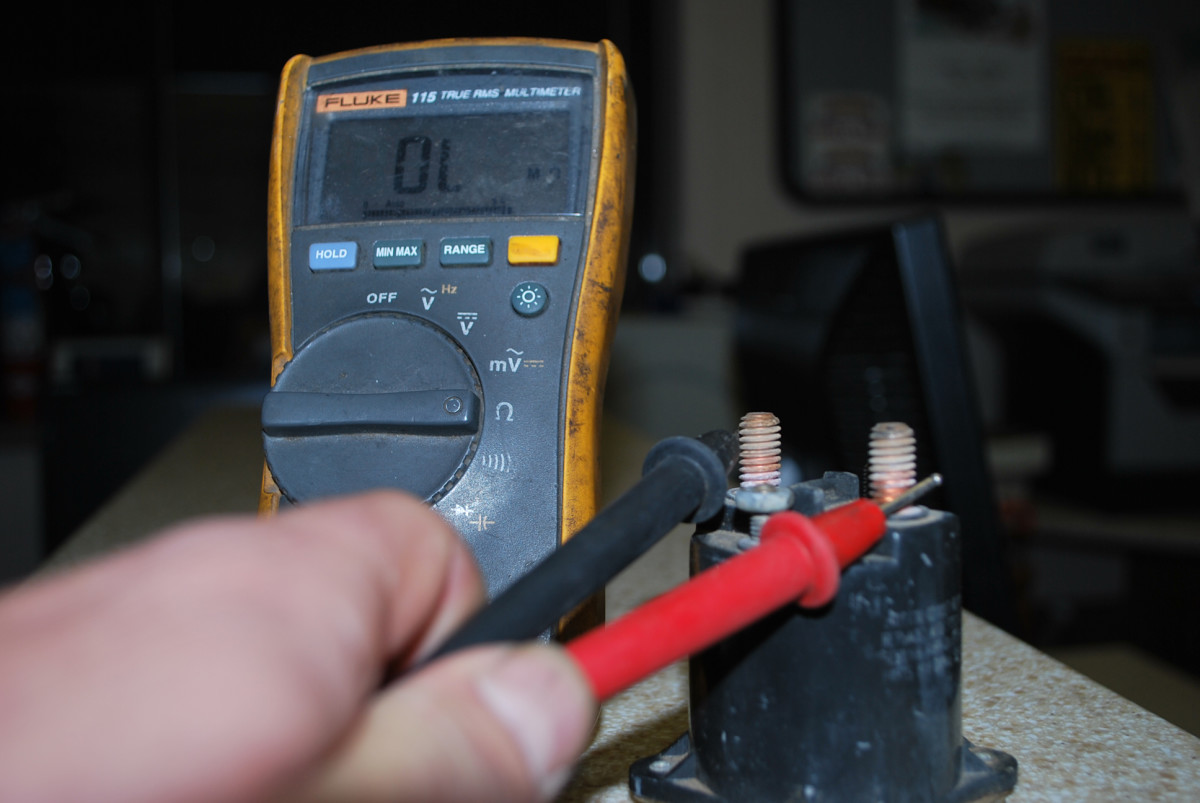
- Test Small Terminals: Place one multimeter probe on each of the small terminals of the solenoid.
- What to Look For:
- Good Solenoid: You should see a low resistance reading. This is usually between 2 and 10 ohms. The exact number can vary by cart model. If you get a reading in this range, the coil is likely good.
- Bad Solenoid (Open Coil): If the multimeter shows “OL” (Over Limit) or “1” (meaning infinite resistance), the coil is “open.” It means the coil wire is broken inside. The solenoid is bad.
- Bad Solenoid (Shorted Coil): If the multimeter shows “0” (zero resistance), the coil is “shorted.” This is also bad. It means the coil wires are touching where they should not. The solenoid is bad.
How to Bypass a Golf Cart Solenoid (For Testing Only)
LSI Keyword: how to bypass golf cart solenoid
Bypassing the solenoid is a risky test. It should only be done for a very quick check. Never use the cart with a bypassed solenoid. It bypasses safety features. It can damage your cart or hurt you.
Do NOT try this if you are not comfortable with electricity.
- Disconnect Battery: Turn off the cart. Disconnect the main negative battery cable first.
- Safety First: Ensure the cart is in neutral. The key is off.
- Get Jumper Cables: Get a short, sturdy pair of jumper cables.
- Connect Jumper Cables:
- Connect one end of the positive jumper cable to one large terminal of the solenoid.
- Connect the other end of the positive jumper cable to the other large terminal of the solenoid.
- Do not let the jumper cables touch anything else.
- Reconnect Battery: Reconnect the main negative battery cable.
- Quick Test: Briefly turn the key on. Press the pedal.
- If the cart moves (even a little): The solenoid is bad. The rest of your cart system (motor, controller, battery) is likely fine.
- If the cart does not move: The solenoid is probably not the problem. There is another issue. Disconnect the battery and remove the jumper cables right away.
Important: Remove the bypass immediately after the test. Do not drive the cart this way. It is dangerous.
Interpreting Your Test Results
Use this table to figure out what your tests mean.
| Test Result | Possible Cause | Action |
|---|---|---|
| No Click | Solenoid not getting power or coil is dead. | Check small terminal voltage; Coil test. |
| One Click, No Movement | Solenoid clicks but internal contacts are bad. | Main terminal voltage test (output). |
| Repeated Clicks | Low battery or weak solenoid coil. | Charge battery. Check small terminal voltage. |
| Main Terminals (Input) No Voltage | Battery cables, main fuse, or battery problem. | Check battery, cables, and fuses. |
| Main Terminals (Output) Low/No Voltage when activated | Solenoid contacts are bad. | Replace solenoid. |
| Solenoid Voltage Drop Test: Large Drop | Solenoid is weak, causing too much resistance. | Replace solenoid. |
| Small Terminals (Coil) Open (OL) | Solenoid coil is broken. | Replace solenoid. |
| Small Terminals (Coil) Shorted (0 Ohms) | Solenoid coil is shorted. | Replace solenoid. |
| Bypass Test: Cart Moves | Solenoid is faulty. | Replace solenoid. |
| Bypass Test: Cart Doesn’t Move | Solenoid is likely good. Problem is elsewhere. | Check motor, controller, wiring. |
Fixing a Bad Solenoid: Repair or Replace?
LSI Keyword: golf cart starter solenoid repair
Can you repair a golf cart solenoid? In most cases, no. Golf cart solenoids are sealed units. It is very hard to open them and fix the internal parts. Even if you could, the repair might not last. It is usually best to replace a bad solenoid.
How to Replace a Golf Cart Solenoid
Replacing the solenoid is often easier than trying to fix it.
- Buy the Right Solenoid: Make sure you get a solenoid that matches your cart’s voltage (e.g., 12V, 36V, 48V). Check your cart’s manual or look at the old solenoid for part numbers.
- Disconnect Battery: Always disconnect the main negative battery cable first.
- Label Wires: Before you take off wires, take a picture. Or use tape to mark which wire goes to which terminal (large vs. small, and specific small terminals if marked). This helps with the golf cart solenoid wiring diagram.
- Remove Old Solenoid: Use wrenches to loosen the nuts on the terminals. Remove all wires. Then, unbolt the solenoid from its mounting spot.
- Install New Solenoid: Put the new solenoid in place. Bolt it down.
- Connect Wires: Connect all wires to their correct terminals. Make sure they are tight. Do not overtighten and break the terminals.
- Reconnect Battery: Reconnect the main negative battery cable.
- Test the Cart: Turn the key on. Press the pedal. Your cart should now start!
Preventing Solenoid Problems
A little care can make your solenoid last longer.
- Keep Connections Clean: Rust and dirt on terminals stop power. Clean them often with a wire brush. Use a terminal protector spray.
- Check Battery Health: A weak battery makes the solenoid work harder. Keep your battery charged and in good shape.
- Avoid Overloading: Do not pull too much weight with your cart. This can put stress on the entire electrical system, including the solenoid.
- Regular Inspections: Look at your solenoid and wires once a year. Check for wear or damage.
Quick Troubleshooting Flow for Golf Cart No Power
Here is a fast way to troubleshoot golf cart no power issues and check your solenoid:
- Is the Battery Charged? Check battery voltage. If low, charge it.
- Are Battery Cables Clean and Tight? Check all ends. Clean if needed.
- Hear a Click?
- No Click: Check small terminals of solenoid with multimeter for voltage. If no voltage, check key switch or pedal switch. If voltage is present, check solenoid coil resistance.
- One Click/Repeated Clicks: Check large terminals of solenoid with multimeter for output voltage when activated. Also, consider battery strength.
- Did Multimeter Tests Pass?
- No (Solenoid is bad): Replace the solenoid.
- Yes (Solenoid is good): The problem is elsewhere. Check the motor, controller, or other parts of the main power circuit.
This process helps you narrow down the issue quickly. It uses golf cart solenoid troubleshooting steps in a clear order.
Frequently Asked Questions (FAQ)
How long does a golf cart solenoid usually last?
A golf cart solenoid can last many years. It often lasts 5 to 10 years or even longer. It depends on how much you use your cart. It also depends on the quality of the solenoid. Extreme heat or cold can also affect its life.
Can I drive my golf cart with a bad solenoid?
No. You cannot drive a golf cart with a bad solenoid. If the solenoid is bad, it will not let power go to the motor. So, your cart will not start or move. If it somehow works sometimes, it is still unsafe. It could stop working at any moment.
What is the difference between a starter solenoid and a regular solenoid?
For golf carts, they are often the same thing. The main solenoid in an electric golf cart acts as the “starter solenoid.” It sends power to the motor to make the cart go. In gas golf carts, there might be a separate starter solenoid just for the engine’s starter motor. But the main job is the same: to act as a heavy-duty electrical switch. For electric carts, you might just call it the “main solenoid.” For golf cart starter solenoid repair, you are usually replacing the main solenoid.
Why does my solenoid get hot?
A solenoid can get hot if it is working too hard. This might happen if:
* It is weak: A weak solenoid might not close fully. This causes resistance. Resistance creates heat.
* Low Battery: If your battery is low, the solenoid has to work harder to pull its contacts shut. This also creates heat.
* Too Small: The solenoid might be too small for the job. But this is rare for a factory part.
If your solenoid is getting very hot, it is a sign that it is failing or under too much stress. It might need to be replaced soon.
Is a clicking noise always a bad solenoid?
No, not always. A clicking noise means the solenoid is getting the signal to activate. If it clicks but does not engage, the solenoid’s internal contacts might be bad. But if it clicks rapidly, it is often a sign of a low battery. The battery might not have enough power to hold the solenoid’s contacts closed. Always check your battery first if you hear rapid clicking.
What does “continuity” mean for a solenoid?
For a solenoid’s coil, “continuity” means there is a complete path for electricity to flow through its wires. If the coil shows continuity (a low ohm reading), the wires are not broken. If it shows “open” or infinite resistance, the coil is broken. It has no continuity. A solenoid continuity test checks this.
Conclusion
Checking your golf cart solenoid does not have to be hard. By following these steps, you can quickly find out if it is the problem. Remember to always work safely. Use your multimeter to get clear answers. Most of the time, if your solenoid is bad, replacing it is the best and easiest fix. Get your cart running smoothly again with these simple checks!