
As an Amazon Associate I earn from qualifying purchases.
Choosing a Cpu And Gpu Combo For Computer Science can be confusing because processor, motherboard, memory, and graphics support all affect your build. These products are CPU-and-motherboard bundles, and most do not include a discrete GPU.
For programming, virtual machines, compiling, data work, and multitasking, focus on core and thread counts, platform age, memory type, PCIe support, and expansion options. If you want to use the computer without a separate graphics card, the Intel Core Ultra 5 250K bundle is the only listed option that specifically mentions integrated graphics.
These five picks were selected for distinct performance levels, platforms, form factors, and upgrade paths. The list starts with the strongest high-core-count option, then moves through modern Intel and AMD platforms to a more basic AM4 build.
Use the short reviews to match each combo to your workload, then check the buying guide for memory, storage, cooling, and graphics considerations before choosing.
Our Top 5 Cpu And Gpu Combo For Computer Science Picks At A Glance
| Product | ||
|---|---|---|
 |
Micro Center Intel Core i9-14900K + ASUS Z790 Heavy multitasking and professional workloads |
Check Price |
 |
Micro Center Intel Core Ultra 5 250K + ASUS Z890 Modern coding without a discrete GPU |
Check Price |
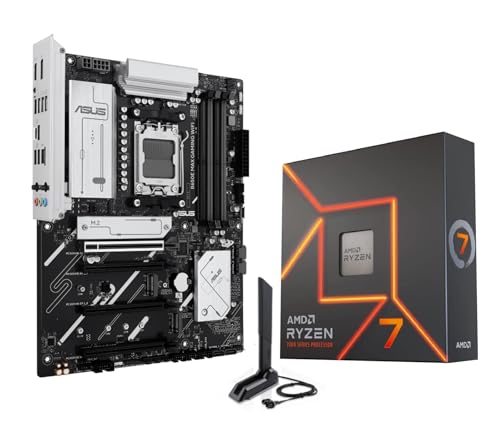 |
Micro Center Ryzen 7 7700X + ASUS B650E MAX Modern AMD builds and upgrades |
Check Price |
 |
Micro Center Ryzen 7 5800XT + ASUS B550 Strong DDR4-based development systems |
Check Price |
 |
INLAND Ryzen 5 5500 + GIGABYTE B550M Entry-level coding and compact builds |
Check Price |
Top 5 Cpu And Gpu Combo For Computer Science Picks: Detailed Reviews
1. Micro Center Intel Core i9-14900K + ASUS Z790
This Cpu And Gpu Combo For Computer Science pairs Intel’s 24-core, 32-thread Core i9-14900K with ASUS’s TUF Gaming Z790-Plus WiFi motherboard. Its 8 P-cores and 16 E-cores suit compiling, virtual machines, containers, and other heavily threaded work, while Intel UHD Graphics 770 handles basic display output without a listed discrete GPU. The board adds 16+1 DrMOS power delivery, reinforced sockets, VRM and M.2 heatsinks, four M.2/NVMe slots, and broad support for 14th- and 13th-generation Intel Core processors.
What We Like:
- The 24-core design gives you substantial headroom for parallel builds, virtual machines, and professional workloads.
- The 16+1 DrMOS design, ProCool sockets, and TUF components support a durable high-performance platform.
- Four M.2/NVMe slots make it easier to build a fast multi-drive development system.
- The integrated UHD Graphics 770 provides basic graphics output without requiring a listed discrete GPU.
- USB 3.2 Gen 2×2 Type-C and Thunderbolt 4 headers expand connectivity for modern peripherals and storage.
What Could Be Improved:
- The i9-14900K is likely excessive for basic programming, web development, and light coursework.
- Integrated UHD Graphics 770 is suited to display output, not workloads that depend on stronger dedicated graphics.
- This platform is built around Intel’s LGA 1700 generation, so processor upgrade flexibility is more limited than a newer socket platform.
Buy this combo if you compile large projects, run several development environments, use virtual machines, or want a powerful Intel workstation foundation with durable board features. Skip it if your coding is light, you need dedicated graphics performance, or you want the broadest long-term upgrade path from a newer platform.
2. Micro Center Intel Core Ultra 5 250K + ASUS Z890
The Micro Center Intel Core Ultra 5 250K Plus and ASUS Z890 AYW Gaming WiFi bundle is a capable Cpu And Gpu Combo For Computer Science, especially if you want modern coding hardware without a discrete graphics card. Its integrated graphics handle display output and everyday visual tasks, while 18 cores—6 Performance-cores and 12 Efficient-cores—support multitasking across editors, browsers, local services, and creator tools. Built-in AI features target productivity and content creation. The current Z890 platform adds DDR5, PCIe 5.0, Wi-Fi 6, fast USB connectivity, and Thunderbolt header support.
What We Like:
- 18 cores provide useful headroom for coding, virtualized services, and demanding multitasking.
- Integrated graphics let you build a working system without buying a separate graphics card.
- Built-in AI features support newer productivity and content-creation workflows.
- DDR5, PCIe 5.0, and the Z890 platform give you a current upgrade foundation.
- Wi-Fi 6, 20Gbps USB-C, and Thunderbolt header support offer flexible modern connectivity.
What Could Be Improved:
- The integrated graphics are less suitable for serious 3D work or GPU-intensive workloads than a system with a discrete graphics card.
- DDR5 memory and the Z890 platform can make the complete build more expensive than older-platform alternatives.
- The 18-core processor and robust motherboard power design call for sensible cooling and airflow planning.
Buy this bundle if you want a current Intel development system with integrated graphics, strong multitasking capacity, AI-focused features, and broad expansion options. It suits students, programmers, and PC builders planning several years of upgrades. Skip it if your coding needs are basic, your budget favors older platforms, or you need powerful discrete-GPU performance.
3. Micro Center Ryzen 7 7700X + ASUS B650E MAX
This Cpu And Gpu Combo For Computer Science pairs AMD’s eight-core, 16-thread Ryzen 7 7700X with an ASUS B650E MAX motherboard for modern AM5 systems. The processor reaches 5.4 GHz max boost, supports DDR5-5200, and has a 105W default TDP, giving you strong capacity for coding, containers, and multitasking. The board supports up to 256GB of DDR5, PCIe 5.0, and three M.2 slots, while AM5 compatibility supports newer Ryzen 7000, 8000, and 9000 processors. It also includes BIOS FlashBack and useful cooling hardware.
What We Like:
- Eight cores and 16 threads suit parallel builds, virtual machines, and demanding development tools.
- DDR5 support gives this platform a modern memory foundation.
- PCIe 5.0 and three M.2 slots leave room for fast storage expansion.
- AM5 compatibility makes future Ryzen upgrades more practical.
- BIOS FlashBack, Q-LED Core, and a pre-mounted I/O shield simplify setup.
What Could Be Improved:
- The Ryzen 7 7700X cooler and thermal solution are not included, so you must provide one.
- This is an ATX motherboard, which limits it to cases that support the larger form factor.
- You need to choose and install separate memory and storage components.
Buy this if you want a capable AMD development system with DDR5, fast expansion, and a clear upgrade path. It suits students, developers, and multitaskers building a new desktop. Skip it if you need a compact PC, already own DDR4 memory, or want a bundle that includes cooling.
4. Micro Center Ryzen 7 5800XT + ASUS B550
For a Cpu And Gpu Combo For Computer Science, this Micro Center bundle pairs AMD’s Ryzen 7 5800XT with an ASUS Prime B550-PLUS AC motherboard. The processor provides eight cores, 16 threads, and up to 4.8 GHz boost, giving you solid capacity for compiling, virtual machines, and multitasking. The AM4 platform supports DDR4 memory and PCIe 4.0, while two NVMe M.2 slots and six SATA ports leave room for storage upgrades. You also get Wi-Fi, Ethernet, USB-C, and useful cooling and protection features. A discrete graphics card is required.
What We Like:
- Eight cores and 16 threads suit parallel builds, containers, and demanding development tools.
- Two PCIe 4.0 M.2 slots make fast system and project storage straightforward.
- Six SATA 6Gb/s ports provide generous room for additional drives.
- DDR4 support can make an existing AM4-based upgrade more practical.
- The motherboard includes USB-C, Wi-Fi, Ethernet, and hybrid fan headers.
What Could Be Improved:
- The Ryzen 7 5800XT has no integrated graphics, so you must add a discrete graphics card for display output.
- This bundle uses DDR4 and the established AM4 platform, limiting access to newer memory and platform options.
- The 105W TDP and unlocked processor may require careful cooling and power planning, especially if you overclock.
Buy this bundle if you want a capable DDR4 development system with eight cores, strong storage expansion, and a practical AM4 upgrade path. It fits coding, compiling, and multitasking well, but skip it if you need integrated graphics, newer platform features, or a compact build based on a smaller motherboard.
5. INLAND Ryzen 5 5500 + GIGABYTE B550M
This Cpu And Gpu Combo For Computer Science pairs AMD’s Ryzen 5 5500 with a compact GIGABYTE B550M DS3H AC R2 motherboard. Its six cores and 12 threads provide a practical starting point for coding, multitasking, and development tools, while the 4.2 GHz max boost and 65W TDP suit a straightforward desktop build. You get DDR4 support up to 128GB, Wi-Fi 5, two M.2 connectors, four SATA ports, and an included Wraith Stealth cooler. The AM4 platform supports Ryzen 5000, 4000, and 3000 processors, but you need a discrete graphics card.
What We Like:
- Six cores and 12 threads give you a balanced entry-level development platform.
- Micro ATX makes the motherboard suitable for compact builds.
- DDR4 support up to 128GB leaves room for substantial memory expansion.
- Two M.2 connectors and four SATA ports provide flexible storage options.
- The included Wraith Stealth cooler simplifies the initial build.
What Could Be Improved:
- The Ryzen 5 5500 requires a discrete graphics card, so it cannot handle display output by itself.
- Wi-Fi 5 is functional but older than newer wireless standards.
- The platform uses PCIe 3.0 through the processor, limiting bandwidth compared with newer CPU platforms.
Buy it if you want an approachable, compact AM4 system for coding, coursework, and everyday development, especially if you already plan to use a discrete graphics card and DDR4 memory. Skip it if you want integrated graphics, newer platform features, or the strongest upgrade path.
How To Choose A Cpu And Gpu Combo For Computer Science
Choosing a Cpu And Gpu Combo For Computer Science starts with the software you expect to run, not with the most impressive component list. Coding workloads can range from lightweight editors and web tools to virtual machines, containers, data processing, 3D development, and local AI experiments. Match the system to your typical workload, then leave some room for projects that may become more demanding.
Start with your workload
For ordinary programming, a balanced processor and sufficient memory matter more than a powerful graphics setup. If you compile large projects, run several development environments, or use virtual machines at the same time, prioritize a stronger processor and a platform that can support your working habits. Students and developers who mostly write, test, and debug code may not benefit from paying for graphics performance they will rarely use.
Decide whether you need a discrete GPU
A system without a discrete GPU can suit modern coding, general development, and everyday display output while keeping the build simpler. You should consider a discrete graphics card if your coursework or projects involve GPU programming, game development, visualisation, machine learning, or other graphics-heavy tasks. Check the software you plan to use, since support for particular graphics features can influence the right choice more than raw component labels.
Choose the platform with upgrades in mind
The processor and motherboard should be considered as a pair. Confirm that the board matches the processor family and gives you the connectivity, expansion options, and memory support your build requires. An upgrade-friendly platform can make it easier to add storage, memory, or a different graphics solution later, while a compact or older platform may make more sense when you want a straightforward, focused system.
Balance cost, cooling, and daily comfort
A faster processor can increase cooling and power demands, so account for the rest of the build rather than judging the CPU alone. A quiet, stable computer is easier to use during long study sessions and extended development work. Set priorities before shopping: spend more on processing power if compilation and multitasking dominate, or keep the system modest if you mainly need an affordable machine for learning and routine coding.
Which Combo Fits Your Computer Science Build?
The Micro Center Intel Core i9-14900K + ASUS Z790 is the best overall pick here for heavy multitasking and professional workloads, giving demanding development work the clearest focus. The Micro Center Intel Core Ultra 5 250K + ASUS Z890 is the best alternative if you want a modern coding system without a discrete GPU. Your workload should decide between them: maximum multitasking capability or a simpler graphics setup.