
Imagine capturing crystal-clear sound for your next podcast, live music gig, or film project, no matter where inspiration strikes. That’s the power of a portable audio mixer. But with so many different models out there, choosing the perfect one can feel like trying to find a needle in a haystack. You want something that’s easy to use, sounds great, and doesn’t break the bank, but figuring out which mixer offers all that can be tricky.
This is where we come in. We’re going to dive deep into the world of portable audio mixers. By the end of this post, you’ll have a much clearer understanding of what to look for, what features really matter, and how to pick the mixer that will make your audio sound amazing. Get ready to say goodbye to confusing jargon and hello to pro-quality sound on the go.
Top Portable Audio Mixer Recommendations

- 4-IN-1 Line mixer for audio sources: this Compact 4-channel Line Mixer Supports Up To Multiple Audio Sources—Such As Electronic Drum , Electric Keyboards, Electric Guitar ,Computers, CD Players, or Gaming Consoles—and Mixes Them Into a Single Stereo or Mono Output. Ideal As a Mini Mixer for Expanding Your Audio Setup or Building a Basic Mixer System
- Ultra-low noise audio mixer: equipped MPS Power Management Chip to Eliminate Ground Noise, and 6 ROHM Low-Noise Op-Amps to Ensure Clean, Distortion-Free Output. Perfect for Anyone Seeking a Reliable Audio Mixer or Stereo Mixer with Professional-Grade Performance
- Mono/stereo switching – versatile mixer mode: easily Switch Between Mono Mixer and Stereo Line Mixer Modes to Suit Various Setups. Compatible with Both 3.5mm (1/8") and 6.35mm (1/4") TRS/TS Cables—no Need For Adapters. This Compact Mixer Is Perfect For Versatile Audio Routing
- DC 5V power supply: The audio mixer uses the latest DC 5V power supply mode, so it no longer restricts the application scenarios. NOTE: The power adapter is sold separately. For the best audio quality, we recommend using a CE- or UL-certified power supply and positioning the device away from other electronics to minimize interference
- Reliable 4 channel audio mixer with support: our 4-Channel Audio Mixer Comes with 24-hour Responsive Customer Service. If You Experience Issues—such as Adapter Compatibility—We'll Provide Fast and Effective Support for a Smooth User Experience
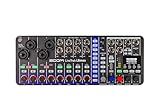
- TWELVE CHANNELS, FOURTEEN TRACKS, ONE MIXER – Features four combo inputs with Hi-Z and eight line inputs across 12 channels, capturing up to 14 tracks simultaneously to SD cards up to 2TB for any live or studio session.
- CLIP-FREE AUDIO WITH DUAL AD CONVERTERS – Records clip-free audio across extreme dynamics on channels 1-4, ensuring pristine sound quality no matter how loud or quiet your performance gets.
- BACKGROUND NOISE GONE WITH AI REDUCTION – Intelligently removes hum, hiss, and background noise in real time while preserving every detail of your voice and instruments for professional-sounding recordings every time.
- SOUND PADS THAT LOCK TO MIDI CLOCK – Trigger samples, jingles, and sound effects on demand with built-in sound pads that sync to a MIDI clock for seamless integration into live electronic performances.
- BATTERY, USB, OR MOBILE PACK — YOUR POWER – Runs on AA batteries, USB bus power, or a mobile battery pack, giving you the freedom to record and perform anywhere without being tied to a wall outlet.


- Stereo/Mono Simple Switching: Moukey mixer audio is divided into two channels. Stereo version-male connectors of 1 / 4-inch TRS stereo audio cable must be used for input and output connections (1 / 4-inch male-to-male stereo audio cable, TRS cable is Keypoint) then press the toggle key. Mono version-Mix 4 mono signal inputs into 1 mono signal output (1 / 4-inch TS male-to-male connector for input and output connection). NOTE: TRS / TS cables are not include in the packaging
- DC 5V Power Supply: The digital mixer uses the latest DC 5V power supply mode, so it no longer restricts the application scenarios. NOTE: Please use an external power supply with CE or UL certification, and stay away from the interference source, otherwise it will cause noise and other undesirable interference to the product
- Multi-function: It mixes multiple channels into one track, suitable for your keyboards, small stage setups, drum sets, or sub-mixes
- Low-noise: Mini audio mixer produces the highest sound quality at all output levels, has ultra-low noise operability, and provides excellent audio performance. Distortion-free and easy to set up, nice for quickly mixing 4 line-level signals without complexity. The 4-channel mixer produces the highest signal quality with the highest signal integrity, even at the highest levels. It is good for multi-keyboard devices and recording
- Simple Control: The audio mixer collects sound from many different sources (guitar, bass, and keyboard) into a monitoring position for monitoring or routing. Each channel on the linear mixer has an independent volume control, independent input plugs and volume control for each channel, and a single output from an amplifier

- 【Music Mixer Board】The 6-channel Bluetooth mixer, built-in wireless Bluetooth, DSP reverberation effect, 3-band equalization adjustment, comes with USB interface, support U disk playback function. Reminder: This kind of mixer is a traditional analog product, so there is no need to talk about whether the system is suitable or not. We are eager to know what function the customer wants to use. Any operation error may cause the device to have no sound. Welcome to email us.
- 【6 Channels Input】 DJ Mixing Console is great for multiple devices connectivity .4 XLR Lines input jack And 1/4 Inch (6.35mm) Jack. The XLR Jack Input Channel Supports 48v Condenser Microphone/Dynamic Microphone/Vocal And Other Instruments, Unbalanced 1/4 Inch Jack Input The Channel Supports Wireless Microphones/Electric Guitars/Di Boxes, Etc. And Musical Instruments. 5/6 Channel Is Stereo 1/4 Inch (6.35mm) Jack.
- 【48V Phantom Power】The sound mixer have 4 XLR inputs with phantom power.(If 1/2/3/4Channel Use 48v Condenser Microphone Need To Press +48v Button Phantom Power)you can feel free to switch 48V phantom power and ultra-low noise distortion enables the audio mixer to be used with condenser microphone.this compact DJ Mixer will provide total dynamic control mixer is great for high quality on stage performance, live gigs and Karaoke.
- 【USB Audio Interface / BT Function 】 *This bluetooth mixer enables users to wirelessly stream music from iPad/smartphone. *The USB interface can be connected to your USB stick/fast memory/MP3 to play music. flash drive or Bluetooth device to mix and record. After pressing the MENU button,Use the built-in controls to play/pause, skip tracks and switch between modes.
- 【3 Band EQ/16DSP Effects Processor】Easily adjust the high Mid and low frequencies of each channel with the onboard 3-band EQ and gain controls.Independent Adjustment Faders Include Single Audio Input Channel, Total Audio Output Volume Adjustment Fader And Effect Adjustment.USB Sound Mixer Has Built-In 16 Kinds Of Dsp Effects.You can even add delay or reverb effects in your mix.

- TEN TRACKS TO SD CARDS UP TO 1TB – Records 10 discrete tracks plus a full stereo mix to SD cards up to 1TB, giving bands, streamers, and solo performers a complete recording solution in a compact package.
- NO CLIPPING, NO GAIN SETTING EVER – Delivers clip-free audio every time without the need to set gain, ensuring perfect recordings whether you're capturing whisper-quiet acoustic instruments or loud live performances.
- RECORDS TO CARD AND COMPUTER SIMULTANEOUSLY – Functions as a 32-bit float audio interface for Mac, PC, iOS, and Android while simultaneously recording to SD card, and doubles as a DAW control surface for seamless studio integration.
- FULL CHANNEL STRIP ON EVERY SINGLE TRACK – Features 3-band mid-sweepable EQ, AUX sends, pan, and onboard effects including delay, echo, and reverb on every channel for complete mix control.
- MIDI, SOUND PADS, AND USB IN ONE BOX – Connect and sync outboard gear like drum machines and synths via 3.5mm MIDI I/O or USB, and trigger backing tracks or samples in real time with four assignable sound pads.

- Capture high-quality audio anywhere with an iPhone/iPad or a macOS (Only) Windows computer, as well as support for recording rates up to 24-bit/192 kHz
- Intuitive panel knobs and color display for easy operation, onboard EQ plus compressor and reverb modeled after popular studio processors
- Up to 12 total input channels, six outputs (three stereo pairs) and two XLR inputs for mics or line-level devices
- High-gain mic preamps and support for 48 V phantom power (requires 15 W power from a mobile device, computer, or USB adaptor/battery)
- Versatile audio outputs include ¼-inch stereo output jacks, a ¼-inch stereo headphones jack, and a mini headphones jack with headset mic support

- the power companion – K.O.–SIDEKICK fits everywhere. use it as a standalone DJ-style mixer to mix two stereo sources, connect it to a computer or phone to use it as an audio interface or external dj mixer. you can also use it in your home office as a sound card to connect headphones and speakers to your computer simultaneously.
- sidekick is the studio companion you always wanted. compact, customisable and instant fun. use it for its creative effects or to quickly capture the moment into your favorite daw
- combine sidekick with two EP-133, EP-1320 or EP-40 in a 'ones and twos' setup, performing your beats live
- plug sidekick straight into your computer and get dedicated controls for headphone vs. monitor out while easily mix in your favorite line-level sound source
- sidekick fits right in at home, use it as a pre-amp to plug in your turntable (line-level), or your phone, straight into your favourite speaker system
Your Guide to the Perfect Portable Audio Mixer
So, you need to mix sound on the go? A portable audio mixer is your best friend! It lets you control different sound sources, like microphones and instruments, and blend them together. This guide will help you pick the right one for your needs.
1. Key Features to Look For
- Number of Channels: This is how many different sound sources you can plug in at once. A small mixer might have 2 or 4 channels. Bigger ones have 8, 12, or even more. Think about how many microphones or instruments you’ll use at the same time.
- Inputs and Outputs: Check what kind of connections the mixer has.
- XLR Inputs: These are great for microphones. They help reduce noise.
- TRS/TS Inputs: These are good for instruments like guitars and keyboards.
- Outputs: You’ll need outputs to connect your mixer to speakers or recording devices.
- EQ (Equalization): This lets you adjust the bass, middle, and treble sounds. You can make things sound warmer or brighter.
- Phantom Power: Some microphones, especially condenser mics, need this extra power. Make sure your mixer has it if you plan to use those mics.
- Built-in Effects: Some mixers come with effects like reverb (makes sound echo) or delay (makes sound repeat). These can add a cool touch to your sound.
- Portability: Look for a mixer that is lightweight and compact. Some even run on batteries, which is super handy.
2. Important Materials
The material of your mixer affects how durable and how heavy it is.
- Metal Casing: Mixers with metal bodies are usually tougher. They can handle being moved around a lot without breaking. This is good for gigging musicians or people who travel.
- Plastic Casing: Plastic mixers are lighter. They are easier to carry. However, they might not be as strong as metal ones.
3. Factors That Improve or Reduce Quality
- Preamps: These are the circuits that boost your microphone’s signal. Good preamps give you clear, clean sound without extra hiss or noise. Cheaper mixers might have preamps that add unwanted noise.
- Build Quality: How well the mixer is put together matters. Are the knobs sturdy? Do the buttons feel solid? A well-built mixer will last longer and feel better to use.
- Noise Floor: This is the amount of unwanted background noise the mixer produces. A lower noise floor means cleaner sound.
- Power Supply: A stable power supply is important. If the mixer gets inconsistent power, your sound might cut out or have problems.
4. User Experience and Use Cases**
A portable audio mixer is great for many situations:
* **Live Gigs:** Small bands, solo artists, or DJs can use these mixers to control their sound at shows. You can plug in microphones for vocals, instruments, and playback devices.
* **Podcasting and Streaming:** If you want to record clear audio for a podcast or stream live, a mixer helps you manage multiple microphones and adjust levels.
* **Home Studios:** Even for a small home setup, a mixer can help you record different audio sources into your computer.
* **Events and Presentations:** For small conferences, weddings, or public speaking events, a mixer ensures everyone can be heard clearly.
Using a portable audio mixer is usually straightforward. Most have clear labels for each knob and button. You plug in your sound sources, adjust the volume and EQ for each one, and then send the mixed sound out to your speakers or recording gear. The easier the layout and the more intuitive the controls, the better your user experience will be.
—
Frequently Asked Questions (FAQ)
Q: What is the most important feature of a portable audio mixer?
A: The most important feature depends on what you need it for. For many, the number of channels is key, so they can plug in everything they need.
Q: Can I use a portable audio mixer for recording music?
A: Yes, absolutely! Many portable mixers have USB outputs, which let you send the mixed sound directly to your computer for recording.
Q: Do I need a mixer if I only have one microphone?
A: Probably not. If you only use one microphone, a simple audio interface might be enough. A mixer becomes useful when you have multiple sound sources to control.
Q: How do I connect my mixer to my speakers?
A: You connect the main outputs of your mixer to the inputs of your speakers using audio cables. The type of cable depends on the connectors your mixer and speakers have.
Q: What does “phantom power” do?
A: Phantom power sends a small amount of electrical power through the XLR cable to your microphone. This power is needed for some types of microphones, like condenser microphones, to work.
Q: Are more expensive mixers always better?
A: Not always, but often they offer better quality components. Higher-end mixers usually have cleaner preamps, more durable parts, and better sound quality. However, a budget mixer can still be great for beginners.
Q: How do I prevent feedback with my mixer?
A: Feedback is that loud, annoying squeal. You can prevent it by keeping microphones away from speakers and by using the EQ to lower the frequencies that cause the feedback.
Q: Can I use my mixer without plugging it into the wall?
A: Some portable mixers can run on batteries or a USB power source, making them truly portable. Others need to be plugged into an AC outlet.
Q: What is the difference between a channel and a bus on a mixer?
A: A channel is where you plug in a single sound source. A bus is a way to group or send signals to different places, like main outputs or effects.
Q: How do I choose the right size mixer for my band?
A: Count how many instruments and microphones you will use at once. Then, choose a mixer with at least that many channels, plus maybe one or two extra for future needs.