
Have you ever tried to cut clear, smooth shapes from plexiglass only to end up with jagged edges and frustrating cracks? It’s a common problem that can turn a simple DIY project into a major headache. Plexiglass, also known as acrylic, is a fantastic material, but it demands a specific approach when you use a jigsaw. Using the wrong blade is the number one reason for ruined sheets and wasted time.
Choosing the correct jigsaw blade for plexiglass feels like navigating a maze. Do you need fine teeth? Coarse teeth? Plastic-specific blades? The wrong choice leads to melting, chipping, and a finish that looks anything but professional. This guide cuts through the confusion. We will explain exactly what makes a blade perfect for this tricky material.
By the end of this post, you will know the exact specifications to look for, ensuring clean, precise cuts every single time you power up your jigsaw. Get ready to transform your plexiglass projects from frustrating to flawless as we dive into the best blades for the job.
Top Jigsaw Blade For Plexiglass Recommendations

- Boost Efficiency - With a Blade that stays cool, you can easily make smooth, melt - free cuts in plexiglass, giving you the precise results you are after.
- Ultra - Hardened Cutting Edge - Delivers up to 5X longer blade life compared to standard bi - metal blades, ideal for tough applications.
- Tooth Technology - Optimized tooth design ensures Effortless, Fast, providing a clean, professional finish on plexiglass applications.
- Universal Compatibility - Fits all combo and most U - shank cordless and corded jig saws, offering flexibility and convenience for all your cutting needs
- Superior Performance - Crafted specifically for cutting plexiglass, these blades provide precision, ensuring top - tier results in every project.


- Designed for cutting Plexiglas 5/64 In. to 3/4 In. thick
- Ideal for straight, clean cuts
- Ground and taper back tooth design
- Superior bi-metal longevity

- Engineered for precision cuts on Plexiglas 5/64 In. to 3/4 In. thick
- Ideal for fine and straight cuts
- High Speed Steel construction for long life
- 4 In. overall length, 2 3/4 In. working length
- 5 piece pack

- Engineered for precision cuts on plexiglas 5/64 In. to 3/4 In. thick
- Ideal for fine and straight cuts
- High Speed Steel construction for long life
- 4 In. overall length, 2 3/4 In. working length
- 5 piece pack
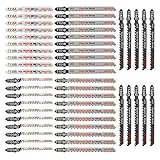

- 9-Type Blade Selection: This jig saw blades set includes T101AO ×4, T101B ×4, and T101BR ×4 for clean wood cutting, T144D ×4, T244D ×3, and T111C ×3 for fast wood cutting, T118A ×3 and T118B ×3 for basic metal cutting, plus T127D ×2 for aluminum
- T-Shank Compatibility: Standard T-shank blades fit the vast majority of modern jigsaws, providing a secure grip and stable cutting performance. These jigsaw blades are easy to install and remove for quick blade changes
- High-Quality and Durable: Made from premium HCS (high-carbon steel) and HSS (high-speed steel) for wear resistance, flexibility, and long service life. The wood blades resist breaking and metal blades stay sharp longer
- Controlled, Clean Cuts: Precision-ground teeth, fine-tooth profiles and reverse-cut designs support smooth results and help reduce splintering. Narrow scroll blades allow tight curves with improved control on plywood and laminate
- Easy Identification and Storage: Every jigsaw blade’s shank is clearly printed with the blade type for quick selection. Blades are supplied in a sturdy storage case to keep them organized, protected, and ready for use

- Comprehensive Set: Includes 20 jigsaw blades with 9 types, including T118AF, T118BF, T101AO, T119BO, T101B, T101BR, T111C, T244D (2 pieces each), and T144D (4 pieces); Ideal for various cutting tasks
- Superior Quality: Crafted from High Carbon Steel (HCS) and Bi-Metal (BiM) for excellent toughness, sharpness, and cutting performance; It maintains durability under high temperatures and pressures, ensuring a longer lifespan
- Clear Markings: Each jigsaw blade is clearly marked with its type, material, and intended use, allowing for easy identification and quick selection during projects
- Versatile Use: The set features blades suited for both wood and metal cutting; T118AF and T118BF are specifically designed for metal materials, offering precise and efficient performance
- Convenient Storage: Comes with a transparent storage box that keeps the Jigsaw blades organized and easily accessible; The compact design ensures the blades stay in place, making it simple to retrieve the right one when needed

- 【Material & Wear Resistance】 :Made of high-carbon steel with high hardness, these jigsaw blades stay sharp longer and resist wear when cutting metal, plastic, or jigsaw blades wood applications.
- 【TPI Variety for Speed or Finish】 :This jig saw blade set includes 6T (fast wood/plastic cut), 8T, 10T, plus 14T/18T/24T/32T for medium to extra-fine metal cutting—so you don’t use the wrong jig saw blades for wood on metal.
- 【U-Shank Grip & Breakage Reduction】:The U-shank design provides maximum grip and stability without needing a screw in the mounting hole, which reduces blade breakage on any jig saw brand.
- 【Compatibility with Major Brands】 :Works with over 90% of current jig saw models including Bosch, Makita, Milwaukee, Hitachi, Metabo, Porter Cable, and Craftsman—no adapter needed.
- 【Application Specifics】:Cuts clean through wood (furniture/kitchen installs), plastic, and non-ferrous metals (copper/aluminum) with polished teeth that remove chips fast—not just for rough demo work.
Choosing the Best Jigsaw Blade for Plexiglass: Your Buying Guide
Cutting plexiglass, also known as acrylic, takes a special touch. If you use the wrong blade, you might get cracks, melting, or a rough edge. This guide helps you pick the perfect jigsaw blade for smooth, clean cuts every time.
1. Key Features to Look For
When shopping for a blade, focus on these important features. They make the biggest difference in your cutting success.
- Tooth Count (TPI): This means “Teeth Per Inch.” For plexiglass, you need a high TPI, usually between 10 and 18 TPI. More teeth mean finer cuts and less chipping.
- Tooth Design: Look for blades with teeth pointing *down*. These are called “reverse-toothed” or “down-cutting” blades. They cut on the downstroke, which pulls the material toward the saw table. This stops the top surface of the plexiglass from chipping or splintering.
- Blade Thickness/Width: A thinner blade generally follows curves better. However, a blade that is too thin might wobble, causing rough cuts. Find a balance.
2. Important Materials Matter
The material the blade is made from affects how long it lasts and how smoothly it cuts.
Most good blades use High-Speed Steel (HSS). This material resists heat build-up. Heat is the enemy when cutting plastic because it causes melting. Carbide-tipped blades are very strong, but for thinner plexiglass, an HSS blade with very fine, sharp teeth often works better.
3. Factors That Improve or Reduce Quality
What makes a blade great or terrible for acrylic?
Factors That Improve Quality:
- Sharpness: Extremely sharp teeth shave the plastic instead of tearing it.
- Set: The “set” is how much the teeth bend side-to-side. A small set helps keep the cut narrow and clean.
- Finish: Smooth, polished blades reduce friction, which lowers heat.
Factors That Reduce Quality:
- Low TPI (Too few teeth): This rips the plastic, causing big chips and rough edges.
- Up-cutting Teeth: Teeth that point up pull the material upward, almost guaranteeing splintering on the top surface.
- Dull Blades: Old or used blades create friction, leading to melting and sticky residue on the blade.
4. User Experience and Use Cases
How you use the blade affects your experience.
If you are making straight cuts on thick plexiglass (over 1/4 inch), you can use a slightly slower speed. If you are cutting tight curves, you need a thinner blade and must move the jigsaw slowly. Always secure your material firmly to a workbench. Clamping prevents vibration, which causes bad cuts.
For general DIY projects, choose a down-cutting blade with at least 14 TPI. This combination gives you the best chance for a professional-looking finish right off the saw.
10 Frequently Asked Questions (FAQ) About Jigsaw Blades for Plexiglass
Q: Can I use a regular wood blade on plexiglass?
A: No. Regular wood blades have large, widely spaced teeth. These teeth tear the plastic, causing cracking and melting.
Q: What is the best TPI for cutting 1/8 inch thick plexiglass?
A: Aim for 14 to 18 TPI. More teeth give you a cleaner edge on thinner sheets.
Q: Should the jigsaw speed be fast or slow when cutting acrylic?
A: Use a slow to medium speed. High speed creates too much heat, which melts the plastic onto the blade.
Q: What is a “down-cutting” blade?
A: It is a blade where the teeth angle down toward the handle. It cuts on the downstroke, keeping the top surface of the plexiglass smooth.
Q: Why is my plexiglass melting while I cut it?
A: Melting happens because of too much friction and heat. Slow down your speed, use a sharp, high-TPI blade, and consider misting the cut line with water for cooling.
Q: Are metal-cutting blades good for plexiglass?
A: Sometimes. Metal-cutting blades often have a high TPI, which is good. However, check the tooth style; you still want a fine, smooth cut, not a rough grind.
Q: Do I need to score the line before cutting?
A: While not always necessary with the right blade, scoring the line with a sharp knife first can help prevent chipping on very thick or brittle acrylic.
Q: How can I prevent chipping on the bottom edge?
A: Use a down-cutting blade. Since the teeth cut on the way down, the pressure is applied toward the table, preventing the bottom edge from lifting and chipping.
Q: Which blades should I avoid completely?
A: Avoid coarse-toothed blades meant for wood or demolition. Also, avoid blades that are designed to cut on the upstroke unless they are specifically made for plastics.
Q: How often should I change the blade?
A: Change the blade as soon as you notice any melting or rough edges appearing. Dull blades ruin your project faster than anything else.