
Image Source: golfdigest.sports.sndimg.com
Unlock The Secret: How To Stop Hooking Golf
A golf hook is a golf shot that starts right of the target line and curves hard to the left for a right-handed golfer. It happens when the clubface is closed relative to the path the club is traveling on at impact. This shot often goes way left of where you wanted it to go.
Many golfers struggle with a hook. It can ruin a good score fast. But you can fix it. You need to know why it happens. Then you can make the right changes. It often comes from your swing path or how your clubface hits the ball. It could also be your grip. Or maybe your swing plane.
Let’s look at the main reasons for a hook. Then we will talk about how to stop it.
Deciphering the Causes of a Golf Hook
Why does the ball curve left so much? It’s based on simple rules. These are called the golf ball flight laws. The way the ball starts is mostly about the clubface direction at impact. The way the ball curves is mostly about the difference between the clubface direction and the swing path direction.
For a hook, the ball starts mostly where the clubface is pointing. Then it curves away from the swing path. If you hit a hook, your clubface is likely pointing a little right of the target line at impact (making the ball start right). Your swing path is going even more right of the target line (inside-out path). And your clubface is closed relative to that path. This makes the ball curve left.
Think of it this way:
– Clubface direction at impact points right. Ball starts right.
– Swing path direction at impact goes more right than the clubface points.
– Clubface is closed compared to the path. Ball curves left.
Sometimes, a hook can start left and curve more left. This often happens if your clubface is pointing left at impact, and your swing path is going even more left (outside-in path). But the classic hook is the one that starts right and curves left. We will focus on that one. It is usually caused by an inside-out swing path and a closed clubface relative to that path.
Let’s break down the two main parts: your swing path and your clubface position.
Grasping Your Golf Swing Path
Your golf swing path is the direction your clubhead moves just as it hits the ball. Does it move from inside to outside the target line? From outside to inside? Or right down the target line?
- Inside-out path: The club moves from inside the target line to outside the target line. This path, combined with a closed face, is a major hook cause.
- Outside-in path: The club moves from outside the target line to inside the target line. This path often causes a slice (with an open face) or a pull hook (with a closed face). If you want to fix golf slice, you usually need to fix this path.
- Neutral path: The club moves right down the target line. This is often the goal for straight shots.
A common cause of a hook is an inside-out swing path combined with a clubface that is closed relative to that path. Your body might turn too much or slide too much on the way down. This makes the club drop too far inside. Then you have to flip your hands or rotate hard to hit the ball, which closes the face quickly.
Deciphering Clubface Position Golf Swing
The clubface position golf swing happens at impact. Is the clubface square to the target? Open? Closed?
- Square face: Points down the target line.
- Open face: Points right of the target.
- Closed face: Points left of the target.
For a hook, the clubface is almost always closed relative to the swing path. Even if your swing path is inside-out, if your face is slightly open relative to that path, you’ll hit a push-slice. But if the face is closed relative to that inside-out path, you’ll get a hook.
Often, the face closes too much because of how your hands work through impact. If your lead wrist (left wrist for right-handed golfer) is cupped, the face is open. If it’s flat or bowed (bent inwards), the face is closed. Many hookers have a bowed lead wrist at impact.
Fixing the Hook: Step-by-Step Adjustments
Now that we know why hooks happen, let’s talk about how to stop them. You need to look at your grip, your setup, your swing path, and your clubface control.
Checking Your Golf Grip for Hook Issues
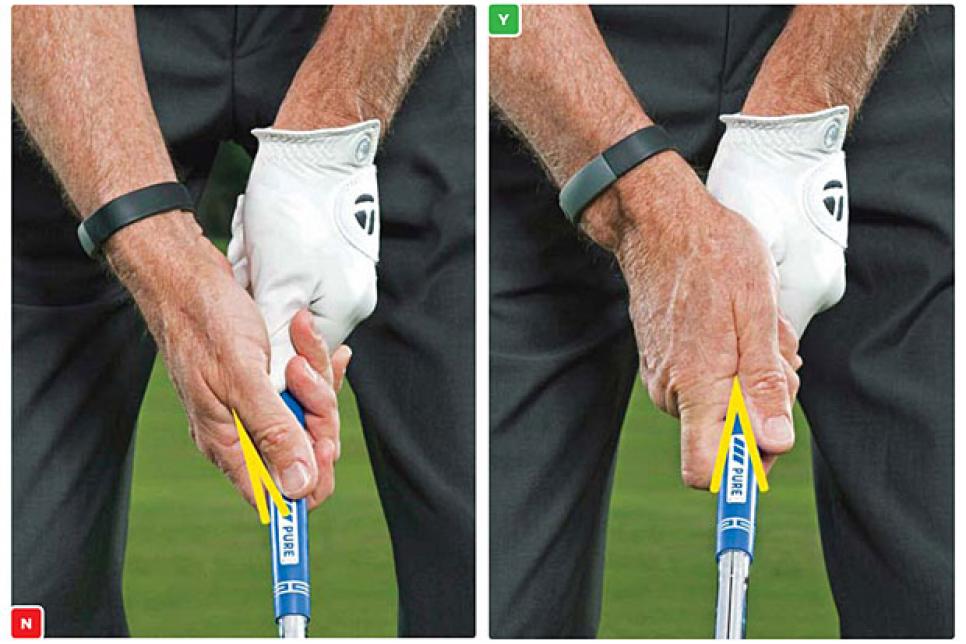
A strong grip is a common cause of a hook. A strong grip means your hands are turned too far to the right on the club for a right-handed golfer.
What a Strong Grip Looks Like:
– For a right-handed golfer, you can see three or more knuckles on your left hand at address.
– Your right hand is too far under the grip.
– Your V-shape between thumb and index finger on both hands points outside your right shoulder.
With a strong grip, it is very easy for the clubface to close too quickly during the swing. Your hands are already in a position that promotes face closure.
How to Weaken Your Grip:
1. Left Hand (for right-handed golfer): Turn your left hand more to the left on the grip. You should see only two knuckles (maybe 1.5) when you look down at address. The V-shape should point towards your chin or left shoulder.
2. Right Hand (for right-handed golfer): Place your right hand more on top of the grip. The V-shape should point towards your chin or slightly right of your chin.
3. Make sure your hands work together. They should be close, but not overlapping too much in a strange way. The grip should feel more in the fingers of your left hand and more in the pads of your right hand.
This might feel weak and strange at first. Practice hitting short shots with this new grip. It will help keep the clubface more square or even slightly open through impact. This is a critical golf grip for hook correction.
Adjusting Your Setup
Your setup before you swing matters. It sets the stage for your swing path and face control.
Check Your Ball Position:
– For irons, the ball should be slightly forward of center in your stance.
– For drivers, the ball should be off the heel of your lead foot.
– If the ball is too far back in your stance, you might hit it with an inside-out path and a quickly closing face. Try moving the ball slightly forward. This can help you hit the ball more on the upswing (for driver) or at the bottom of your arc (for irons).
Check Your Aim:
– Are your feet, hips, and shoulders aimed parallel left of your target? This is called being “aligned left”. If you swing down this line (outside-in path) you get a pull. If you then try to save it by swinging inside-out to hit the target, you can easily hook it with a closed face.
– Make sure your body lines are parallel to the target line. Use alignment sticks on the ground at the range to check.
Correcting Your Golf Swing Path
Stopping an overly inside-out swing path is key to golf swing path correction. You want a path that is more neutral or only slightly inside-out.
Why You Might Be Too Inside-Out:
– Taking the club back too far inside: The clubhead goes behind you quickly in the backswing.
– Dropping the club too far inside on the downswing: The club gets stuck behind your body.
– Over-rotating your body: You spin out your lower or upper body too fast on the downswing.
How to Work on a Better Path:
1. Takeaway: Focus on taking the club straight back for the first foot or two. Imagine the clubhead staying outside your hands.
2. Transition/Downswing: Feel like your arms drop more vertically at the start of the downswing, instead of swinging around you. This is part of shallowing the golf swing. It helps avoid getting stuck inside.
3. Impact: Feel like you are swinging down the target line for longer after hitting the ball, rather than swinging hard left and around your body.
Controlling the Clubface Position
This is often the most direct cause of the hook’s big curve. You need to learn to keep the clubface more square to the target line (or slightly open relative to your path) through impact.
Reasons for a Closed Face:
– Strong grip: As mentioned before.
– Too much hand/wrist flip: You are rotating your hands too actively to square the face, and you do it too early or too fast.
– Lack of body rotation: If your body stops turning, your hands and arms will take over and often flip the clubface closed.
– Casting or losing lag: Releasing the club too early in the downswing. This uses up your wrist hinge early, making it harder to control the face.
How to Keep the Face Square:
1. Weaken your grip: First step.
2. Less Hand Action: Feel like your hands are less active through impact. Let your body rotation pull the club through. Think of your lead wrist staying flat or even slightly bowed without flipping it over.
3. More Body Turn: Keep turning your chest and hips through impact. This helps prevent the hands from taking over and flipping the face closed.
4. Maintain Lag (Controlled Release): Practice keeping the angle between your lead arm and the club shaft for longer in the downswing. This helps release the club closer to the ball with speed, making face control easier.
Fathoming the Swing Plane
Your golf swing plane is the angle your club travels on during the swing. Think of it as a tilted circle around your body. Is it upright (more vertical) or flat (more horizontal)?
- Flat Swing Plane: A swing that is too flat can sometimes lead to getting stuck on the downswing. If you get stuck, you might make an inside-out path and flip your hands to hit the ball, causing a hook.
- Upright Swing Plane: A more upright swing can make it easier to swing down the target line or slightly outside-in. This path, when combined with a controlled face, is less likely to cause a hook (more likely to cause a slice if the face is open, which is the opposite problem).
Sometimes, trying to swing on a slightly more upright plane in the downswing can help fix a hook. This helps the club stay more in front of you, preventing the “stuck” inside position that leads to flipping and hooking.
Downswing Golf Hook Fix Strategies
The downswing is where the hook often happens. Getting the start of the downswing right is key.
Common Downswing Problems Leading to a Hook:
– Starting the downswing with the hands or upper body. This often leads to the club coming over the top (outside-in path) or getting stuck inside quickly.
– Getting the club stuck behind you (too far inside). This forces you to flip the face closed to hit the ball.
– Casting or releasing the club too early.
How to Improve the Downswing:
1. Start with the Lower Body: Feel like your lower body (hips, knees) starts the downswing rotation slightly before your upper body and arms. This creates lag and helps the club drop into the slot.
2. Shallow the Golf Swing (Correctly): This means making the swing plane flatter on the way down compared to the backswing. But you need to do it right. The club should drop behind you slightly, but stay in front of your body rotation. It should not get trapped behind you. Think of the club dropping down “into the slot” rather than looping way inside. This is a crucial downswing golf hook fix.
3. Keep the Club in Front: As your body rotates, your arms and the club should stay in front of your chest. If they get stuck behind you, you lose control and likely flip.
4. Maintain Wrist Hinge (Lag): Don’t release the club angle early. Keep that angle as your body turns. Release it powerfully at the ball by rotating your body through.
Shallowing is often misunderstood. It doesn’t mean making your entire swing flat. It means a specific movement at the start of the downswing where the club drops onto a slightly shallower plane than your backswing. This helps prevent the over-the-top move and the stuck-inside move if done correctly. For hookers who are stuck inside, less shallowing or even slightly steeper movement might be needed initially to keep the club in front. It depends on the exact fault.
Effective Golf Anti-Hook Drill Ideas
Practice is key. These drills can help you fix your hook.
-
Split Grip Drill:
- Hold the club with your hands separated by about 6-12 inches.
- Make swings like this.
- This drill makes it hard to flip your hands or close the face too early or too much.
- It helps you feel how body rotation moves the club, not just hand action.
- Start with half swings, then move to full swings. Focus on a square face at impact.
-
Gate Drill:
- Place two alignment sticks or headcovers on the ground, one just inside the ball and one just outside.
- Leave just enough room for your clubhead to pass through without hitting them.
- This helps with golf swing path correction. It trains you to swing through the gate, encouraging a neutral or slightly inside-out path, but more importantly, preventing an exaggerated inside-out path or an outside-in path.
- Hitting the inside stick means your path is too far inside-out. Hitting the outside stick means your path is outside-in.
- For hookers, you want to make sure you aren’t hitting the inside stick, meaning your path isn’t getting excessively inside.
-
Pump Drill:
- Swing to the top of your backswing.
- Stop.
- Pump your arms down a few times to waist height, feeling them drop vertically and keeping the club in front of your body.
- This helps you feel the correct start of the downswing and the feeling of shallowing the golf swing while keeping the club in front.
- After a few pumps, make your normal swing.
-
Towel Under Arm Drill:
- Place a small towel under your lead armpit (left armpit for right-handed golfer).
- Make swings keeping the towel in place.
- This helps connect your arm swing to your body turn. It prevents the lead arm from separating too much from the body, which can lead to getting stuck and flipping.
-
Aiming Drill (Exaggeration):
- Set up aiming slightly left of your target (for a right-handed hooker).
- Try to swing down your body line (which is left).
- This might feel like an outside-in swing relative to the target, but it can help break the habit of an extreme inside-out path.
- Be careful with this one; the goal is to feel a different motion, not necessarily swing outside-in permanently.
-
Slow Motion Swings:
- Make swings at 25%, 50%, and 75% speed.
- Focus on feeling the club drop correctly in the downswing, maintaining lag, and rotating your body through impact while controlling the clubface.
- Slow motion allows you to check positions and feel the proper sequence.
Contrasting Hook and Fix Golf Slice
Understanding the slice helps illuminate the hook. A slice is the opposite shot. It starts left and curves hard right for a right-handed golfer.
Slice Causes:
– Swing Path: Often outside-in (cutting across the ball).
– Clubface: Open relative to the swing path at impact. The face might even be square to the target, but if the path is outside-in, it’s open to the path.
– Grip: Often a weak grip.
– Swing Plane: Can be over the top (steep outside-in path).
Fix Golf Slice Strategies Often Include:
– Strengthening the grip.
– Working on an inside-out swing path.
– Learning to release the clubface more (square or close it relative to path).
– Shallowing the downswing to prevent coming over the top.
Notice how the fixes for a slice are often the opposite of the fixes for a hook:
| Problem | Common Swing Faults | Fix Strategies |
|---|---|---|
| Hook | Inside-out path, Closed face to path, Strong grip, Flat swing, Hand flip, Getting stuck | Weaker grip, Square/Open face to path, More neutral path, Slightly more upright plane, Body rotation, Shallowing the golf swing correctly, Reduce hand flip |
| Slice | Outside-in path, Open face to path, Weak grip, Steep swing, Lack of release | Stronger grip, Square/Close face to path, More inside-out path, Shallowing the swing, Release the clubface, Prevent coming over the top |
It’s important to know which issue you have. Sometimes golfers try to fix a hook with slice fixes, or vice versa, making the problem worse. If you are a hooker, do not try to strengthen your grip or force an inside-out path if that’s already your problem. You need the opposite.
Assembling Your New Swing Habits
Stopping a hook is not just about one quick fix. It’s about changing habits in your swing.
- Analyze: Watch videos of your swing or have a pro look at it. See if your path is inside-out, if your face is closed, if your grip is strong, or if you get stuck.
- Focus: Don’t try to fix everything at once. Pick one thing to work on first, like your grip or the start of your downswing (downswing golf hook fix).
- Drill: Use the golf anti-hook drill that targets your main issue. Repeat it many times.
- Practice: Hit balls on the range with your new focus. Start with half swings and build up speed. Don’t worry about where the ball goes at first. Focus on the movement.
- Play: Take your new swing thought or feeling to the course. Don’t try to be perfect. Just commit to the change you practiced.
It takes time and effort to change a swing. Be patient with yourself. You will hit some bad shots as you learn. That’s normal. Keep practicing the correct moves.
Keeping the Clubface Square Through Impact
Let’s spend a little more time on the clubface position golf swing at impact. This is the most sensitive part for controlling the curve.
Imagine the clubface is a door. At impact, you want that door to be facing the target. For a hooker, that door is slamming shut too early.
To stop the face from closing too much:
– Check your grip again: Is it still strong? Weakening it is the easiest first step.
– Lead Wrist Position: At impact, your lead wrist (left wrist for righties) should be flat or even slightly bowed. It should not be cupped. Practice making swings where you focus on keeping that wrist flat through the ball.
– Forearm Rotation: The closing of the clubface is caused by the rotation of your forearms. For a hooker, this rotation is too fast or happens too early. Feel less active forearm rotation. Let your body turn pull the club through and square the face naturally.
– Release: The release is when you unhinge your wrists and the clubhead overtakes your hands. For hookers, this often happens too early or too forcefully with the hands. Try to feel like the clubhead releases through the ball because of your body turning, not by actively flipping your hands.
Using a training aid that gives you feedback on clubface angle can be very helpful here. Or video recording your swing and looking at the clubface angle just before, at, and just after impact.
Considering Your Golf Swing Plane Again
The golf swing plane is linked to your path and how you control the clubface. A common path for a hooker is inside-out. This can happen if your swing plane is too flat, causing you to get stuck.
How to check your plane:
– Get a friend to film your swing from behind you, looking down the target line.
– Draw lines on the video: one up your club shaft at address, one up your lead arm at address. These show a good plane range.
– In the backswing, is the club head going too far inside or too high above the plane lines?
– In the downswing, does the club drop below the plane line significantly (getting stuck)? Or does it come over the top?
If you get stuck below the plane on the downswing, you often have to flip your hands to reach the ball, causing a hook. Working on a slightly more upright drop of the arms at the start of the downswing can help keep the club in front of you and on a better plane, making it easier to swing down the line without flipping. This goes back to the concept of shallowing the golf swing correctly – letting the club drop, but not getting trapped behind you.
Bringing It All Together: The Anti-Hook Checklist
Here’s a quick list of things to check and work on if you’re hooking the ball:
- Grip: Is it too strong? Weaken it.
- Setup: Is the ball position too far back? Are you aimed left? Adjust.
- Swing Path: Are you coming too far inside-out? Work on a more neutral path using drills (golf swing path correction, golf anti-hook drill, Gate Drill).
- Clubface: Is it closed relative to your path at impact? Work on keeping it squarer (clubface position golf swing, less hand flip, more body turn).
- Downswing: Are you getting stuck inside? Are you casting? Focus on starting the downswing with your lower body and shallowing the golf swing correctly, keeping the club in front (downswing golf hook fix).
- Swing Plane: Are you too flat and getting stuck? Consider working on a slightly more upright feel in the downswing to stay out in front.
Remember the golf ball flight laws. The curve (hook) comes from the face being closed compared to the path. Fixing either the path or the face control (or both) will fix the hook.
For many golfers, fixing a hook is mostly about correcting a strong grip and learning to control the clubface better through impact with less hand action and more body rotation. For others, it’s about fixing a swing path that is too inside-out, often caused by getting the club stuck on the downswing.
Experimentation and practice are key. Try one change at a time on the range. Hit 20-30 balls focusing only on that one thing. See what happens.
Getting help from a golf pro can speed things up greatly. They can see exactly what you’re doing and give you specific advice and drills.
FAQs About Stopping a Hook
Q: Can a strong grip really cause a hook?
A: Yes, absolutely. A strong grip makes it much easier for the clubface to close too quickly through impact. This leads to the clubface being closed relative to the swing path, causing the ball to curve left (a hook). Weakening your grip is often the first and simplest step to fixing a hook.
Q: How does my swing path affect a hook?
A: Your swing path is the direction the clubhead is moving at impact. If your path is too far from inside the target line to outside the target line (an inside-out path), and your clubface is closed relative to this path, you will hit a hook. The inside-out path makes the ball start right, and the closed face makes it curve hard left. Correcting an overly inside-out path is a key golf swing path correction for hookers.
Q: I heard shallowing the swing helps. How does that work for a hook?
A: Shallowing the golf swing means making the club path shallower (flatter) on the way down compared to the backswing plane. For some hookers who get the club stuck too far inside on the downswing, correctly shallowing helps the club drop into a better position in front of their body. This makes it easier to swing down the target line without getting stuck and having to flip the face closed. If you are already too flat and stuck, you might need a different type of “shallowing” feel or even think about staying slightly steeper to keep the club out in front. It depends on your specific swing fault.
Q: Are there specific drills to stop hooking?
A: Yes, many! Drills like the Split Grip Drill (to reduce hand flip), the Gate Drill (to correct swing path), the Pump Drill (to feel the correct downswing start), and the Towel Under Arm Drill (to connect arms and body) are good golf anti-hook drill options. Practice these on the range to train better habits.
Q: If I fix my hook, will I start slicing?
A: It’s possible to overcorrect. Fixing a hook often involves adjustments like weakening your grip or keeping the face more open relative to your path. If you weaken your grip too much or keep the face too open without also correcting your path, you might hit a push-slice (starts right, curves right). The goal is a neutral path and a square face to the target, or a slight inside-out path with a face that’s square or slightly open to that path. Don’t worry about a slice yet; focus on stopping the hook first with controlled changes. Once the hook is gone, you can fine-tune for straight shots. Remember the goal is not to fix golf slice, but to fix the hook.
Q: How important is the clubface position at impact compared to the swing path?
A: According to golf ball flight laws, the clubface direction at impact has the biggest effect on where the ball starts (about 80% for a driver). The difference between the clubface direction and the swing path direction creates the curve. For a hook, the clubface is closed relative to the path. So, both are very important. An inside-out path combined with a closed face relative to that path creates the classic hook. You usually need to address both face control and path control to truly stop the hook.
Q: What’s a common downswing fault that causes a hook?
A: A very common fault is getting the club “stuck” behind your body on the downswing. This often happens if you take the club back too far inside or start the downswing incorrectly. When the club is stuck inside, you lose the proper angle and have to flip your hands quickly to hit the ball. This flip closes the clubface dramatically, resulting in a hook. Correct sequencing in the downswing and ensuring the club stays in front of your body are key downswing golf hook fix elements.
Final Thoughts
Stopping a golf hook is a rewarding challenge. It requires you to understand your swing, especially your golf swing path, your clubface position golf swing, and how they relate based on golf ball flight laws. By working on key areas like your golf grip for hook issues, making golf swing path correction, practicing golf anti-hook drill methods, and mastering your downswing golf hook fix techniques like shallowing the golf swing correctly, you can gain control of your ball flight.
Be patient, practice smart, and consider getting help from a pro. Soon, you’ll be hitting straighter shots instead of wrestling with that frustrating left-turning ball. You can unlock the secret to stopping your hook.