
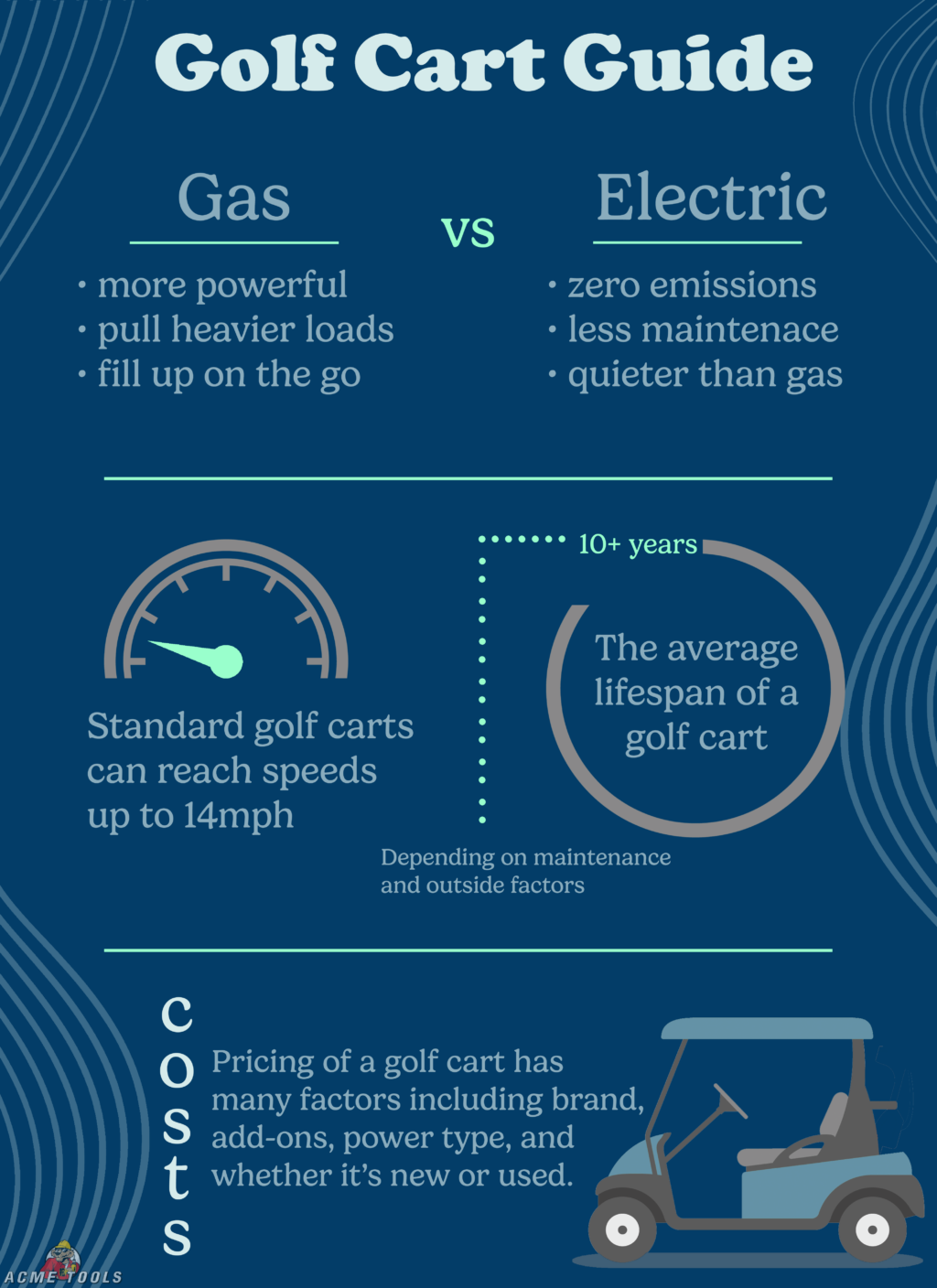
Image Source: blog.acmetools.com
See Precisely How Does A Gas Golf Cart Work Step By Step
Do you want to know how a gas golf cart works? Simply put, a gas golf cart uses a small engine that burns fuel to make power. This power then goes through a system of parts – like belts and gears – to turn the wheels and make the cart move. It’s like a tiny, simple car engine system. Let’s break down exactly how it all happens, step by step.
Grasping the Main Parts
To see how a gas golf cart works, we must first look at its main parts. Think of them as a team. Each part does a special job. Together, they make the cart go.
Here are the key players:
- Gas golf cart engine: This is the heart. It makes the power from burning fuel.
- Gas golf cart fuel system: This gets gas from the tank to the engine.
- Golf cart carburetor: This mixes the gas with air in the right amount for the engine.
- Golf cart ignition system: This creates the spark needed to light the gas mix.
- Golf cart starter motor: This spins the engine to get it started.
- Golf cart spark plug: This makes the actual spark inside the engine.
- Golf cart clutch: This part connects or disconnects the engine’s power from the wheels.
- Golf cart belt drive: Belts transfer power from one part to another.
- Golf cart transaxle: This part changes speed and power, and sends it to the wheels. It also lets the wheels turn corners easily.
- Golf cart governor: This part keeps the cart from going too fast.
Let’s look at each part more closely and see how they work together.
Interpreting the Gas Golf Cart Engine
The gas golf cart engine is where the magic of making power happens. Most golf cart engines are small, air-cooled, and use a process called the ‘four-stroke cycle’.
What an Engine Does
The engine burns a mix of gas and air. When this mix burns, it makes a small explosion. This explosion pushes a part called a piston. The piston moves up and down. This up-and-down motion is turned into a spinning motion by a shaft called a crankshaft. This spinning crankshaft is what gives power to move the cart.
The Simple Four-Stroke Plan
Think of the engine working in four simple steps or ‘strokes’ for each power push:
- Suck (Intake): A valve opens. The piston moves down. The engine sucks in the gas and air mix from the carburetor.
- Squeeze (Compression): The valve closes. The piston moves up. It squeezes the gas and air mix into a very small space. Squeezing makes it ready to burn hard.
- Bang (Power): The golf cart spark plug makes a spark. This spark lights the squeezed gas mix. It burns fast, making a little explosion. This explosion pushes the piston down hard. This is the stroke that makes power.
- Blow (Exhaust): Another valve opens. The piston moves up again. It pushes out the burned gas and air (smoke) through the exhaust pipe.
Then, the cycle starts again. The engine does this many times each second to keep running and making power.
Fathoming the Gas Golf Cart Fuel System
The gas golf cart fuel system is like the cart’s food delivery service. It makes sure the engine gets the right amount of gas.
Getting Gas to the Engine
The fuel system has a few main parts:
- Fuel Tank: This holds the gas. It’s usually under the seat or body.
- Fuel Lines: These are like hoses that carry the gas from the tank to the engine.
- Fuel Filter: This is a small part in the fuel line. It catches dirt or junk in the gas. This keeps the carburetor clean.
- Fuel Pump (Sometimes): On some carts, gas flows from the tank down to the carburetor by gravity. On others, a small pump is used to push the gas.
- Golf cart carburetor: This is the last stop for the gas before the engine.
The gas flows from the tank, through the filter (and maybe a pump), and ends up at the carburetor.
Interpreting the Golf Cart Carburetor
The golf cart carburetor is very important. The engine needs air as well as gas to burn properly. The carburetor mixes the gas and air together in the perfect ratio.
How Mixing Happens
Think of the carburetor like a special straw.
- Air is pulled into the carburetor as the engine sucks.
- Inside the carburetor, there’s a narrow spot called a ‘venturi’. When air rushes through this narrow spot, it moves faster.
- This fast-moving air creates lower pressure.
- This low pressure pulls gas up from a small bowl inside the carburetor (called the ‘float bowl’).
- The gas is pulled into the fast-moving air stream.
- The carburetor breaks the gas into tiny drops. This helps it mix well with the air.
- The carburetor also has parts (like jets and needles) that control how much gas mixes with the air at different engine speeds.
The right mix of gas and air goes into the engine for burning. If the mix is wrong (too much gas, too little gas, too much air), the engine won’t run well or maybe not at all.
Deciphering the Golf Cart Ignition System
The golf cart ignition system is what makes the spark that lights the fuel in the engine. No spark, no power.
Making the Spark
The ignition system does a few things:
- Makes high voltage: The engine needs a very hot spark. Normal battery voltage is not enough. The ignition system uses a part called an ignition coil to turn the low battery voltage into a very high voltage.
- Sends the spark at the right time: The spark must happen exactly when the piston is at the top of the squeeze stroke. A part of the ignition system (sometimes called an ignitor or CDI box) controls the timing.
- Delivers the spark: The high voltage travels through a wire to the golf cart spark plug.
So, the ignition system gets low power, makes it high power, times it just right, and sends it to the spark plug.
Examining the Golf Cart Starter Motor
The golf cart starter motor is what gets the engine turning in the first place. An engine can’t start by itself; it needs a spin to begin the suck, squeeze, bang, blow cycle.
Giving the Engine a Spin
When you turn the key (or push the pedal on some carts):
- Electric power from the battery goes to the golf cart starter motor.
- The starter motor is a small but strong electric motor.
- It has a gear on its end. This gear moves out and meets a large gear on the engine’s crankshaft.
- The starter motor spins the engine’s crankshaft.
- As the engine spins, it starts doing its four-stroke cycle (suck, squeeze…).
- Once the engine starts and runs on its own, the starter motor’s gear pulls back. The starter stops running.
The starter’s job is short but vital – just get the engine spinning enough to fire up.
Inspecting the Golf Cart Spark Plug
The golf cart spark plug is a simple but critical part. It’s like a tiny lightning maker inside the engine.
Creating the Little Bolt of Energy
- The spark plug sits in the top of the engine cylinder, where the gas and air are squeezed.
- It has a special tip with a small gap between two metal points.
- The high voltage from the golf cart ignition system comes down the wire to the spark plug.
- When the voltage is high enough, it jumps the small gap between the metal points.
- As it jumps, it creates a hot spark.
- This spark lights the gas and air mix that has been squeezed tight by the piston.
A clean, working spark plug with the right gap is needed for the engine to start and run smoothly. If it’s dirty or the gap is wrong, the spark is weak or doesn’t happen, and the engine won’t work right.
Comprehending the Golf Cart Clutch
Once the gas golf cart engine is running and making power (spinning the crankshaft), this power needs to get to the wheels. The golf cart clutch is the part that connects the engine’s spinning power to the rest of the drive system, but only when the engine is spinning fast enough.
Connecting the Power
Most gas golf carts use a type of clutch called a ‘centrifugal clutch’. Here’s the simple idea:
- The clutch is connected to the engine’s crankshaft.
- Inside the clutch are weights or parts that move outwards when the engine spins faster. This is like how you feel pushed back in your seat when a car speeds up.
- When the engine is idling (running slowly), the weights stay in, and the clutch is not connected. The engine spins, but the wheels don’t move.
- When you press the gas pedal, the engine speeds up. The weights in the clutch spin faster and move outwards.
- These moving weights grab onto another part of the clutch, or onto a belt pulley connected to the clutch.
- Now, the engine’s spinning power is connected to the rest of the system that turns the wheels.
The clutch lets the engine run without moving the cart, and then smoothly connects the power as you give it gas.
Interpreting the Golf Cart Belt Drive
The golf cart belt drive uses strong rubber belts and round wheels called pulleys to move power from the engine, through the clutch, and to the golf cart transaxle.
Moving Power with Belts
- There is usually a belt connecting the engine’s crankshaft (often through the clutch) to the transaxle.
- This belt sits in grooves on the pulleys.
- When the engine spins the pulley connected to it, the belt moves, and this makes the pulley connected to the transaxle spin.
- Golf carts often use a system with two clutches and a belt, sometimes called a Continuously Variable Transmission (CVT), but very simply. One clutch is on the engine (the drive clutch), and one is connected to the transaxle (the driven clutch). The belt runs between them.
- As the engine speeds up, the drive clutch closes, pushing the belt outwards. This makes the belt run on a larger circle on the drive clutch.
- At the same time, the driven clutch opens up, letting the belt move inwards on a smaller circle on the driven pulley.
- This change in where the belt rides on the pulleys changes the speed and power sent to the transaxle, like changing gears automatically in a car.
Belts are good because they are smooth and can slip a little if there is a sudden stop, which helps protect the engine and transaxle.
Deciphering the Golf Cart Transaxle
The golf cart transaxle is a single unit that does two main jobs: it acts like a gearbox (changing speed and power) and a differential (letting wheels turn at different speeds).
Changing Speed and Splitting Power
- The belt drive sends the spinning power from the engine (through the clutch system) to the transaxle.
- Inside the transaxle are gears. These gears take the spinning power from the belt and change its speed and strength before sending it to the axles that connect to the wheels. When you go slow, the gears give more power (torque). When you go fast, the gears give more speed.
- The transaxle also has a part called a differential. This is very clever. When you drive straight, both wheels spin at the same speed. But when you turn a corner, the wheel on the outside needs to travel a longer distance than the wheel on the inside. The differential lets the outer wheel spin faster than the inner wheel. This stops the wheels from dragging or skidding during turns.
- The axles for the rear wheels come out of the sides of the transaxle.
So, the transaxle takes the spinning power from the engine, changes it to the right speed and strength, and sends it to the wheels, letting them turn corners smoothly.
Grasping the Golf Cart Governor
The golf cart governor is a safety and control device. Its main job is to limit the top speed of the cart.
Keeping Speed in Check
Golf carts are usually designed to go a certain speed for safety and to keep the engine from being overworked. The governor makes sure the cart doesn’t go faster than that speed.
How it works (simply):
- Most governors work by sensing the engine speed or the speed of the transaxle.
- On many gas carts, the governor is linked to the transaxle or a turning shaft connected to the engine.
- As the cart (or engine) speeds up, a part inside the governor moves. This might be weights spinning outwards or a fan that pushes against something.
- When the speed reaches a certain point, the governor’s moving part pulls on a linkage (a small rod or cable).
- This linkage is connected to the golf cart carburetor, usually near the throttle.
- When the governor pulls the linkage, it partly closes the throttle.
- Closing the throttle reduces the amount of gas and air going into the engine.
- With less fuel and air, the engine can’t make as much power, and it slows down, keeping the cart below the set speed limit.
The governor acts like a speed cop for the golf cart.
Putting It All Together: The Steps to Motion
Now let’s see how all these parts work step by step when you want to drive the golf cart.
Step-by-Step Action
- You Sit Down: You get in the cart.
- You Turn the Key: You turn the key switch (part of the golf cart ignition system). This sends power from the battery.
- The Starter Spins the Engine: Power goes to the golf cart starter motor. The starter motor engages with the engine’s gear and starts spinning the gas golf cart engine.
- Engine Pulls in Air and Gas: As the engine spins, it starts the ‘suck’ stroke. It pulls air through the intake and gas from the gas golf cart fuel system into the golf cart carburetor.
- Carburetor Mixes Fuel and Air: The golf cart carburetor mixes the gas and air in the right amounts. This mix goes into the engine cylinder.
- Engine Squeezes the Mix: The piston moves up, squeezing the gas and air mix (the ‘squeeze’ stroke).
- Ignition Makes High Voltage: The golf cart ignition system takes battery power and makes it very high voltage. It times this high voltage to go to the golf cart spark plug just as the mix is fully squeezed.
- Spark Plug Fires: The high voltage jumps the gap on the golf cart spark plug, making a spark inside the engine cylinder.
- Engine Makes Power: The spark lights the gas/air mix. It burns fast and pushes the piston down (the ‘bang’ or power stroke). This turns the crankshaft on the gas golf cart engine.
- Engine Pushes Out Smoke: The piston moves up, pushing out the burned gas (the ‘blow’ or exhaust stroke).
- Engine Idles: The engine keeps running, repeating steps 4-10. If you are not pressing the gas pedal, it runs slowly (idles). At this slow speed, the golf cart clutch is not engaged. The engine spins, but power doesn’t go to the wheels.
- You Press the Gas Pedal: You push down the pedal. This opens the throttle on the golf cart carburetor, letting more gas and air into the engine.
- Engine Speeds Up: With more fuel and air, the gas golf cart engine spins faster.
- Clutch Engages: As the engine spins faster, the centrifugal golf cart clutch engages. It connects the engine’s spinning power to the drive system.
- Belt Drive Transfers Power: The power from the clutch is sent through the golf cart belt drive (using belts and pulleys).
- Transaxle Gets Power: The belt sends the power to the golf cart transaxle.
- Transaxle Changes Speed and Turns Wheels: The gears and differential in the golf cart transaxle prepare the power and send it to the rear wheels, making them spin.
- Cart Moves! The wheels turn, and the golf cart moves forward (or backward, if you selected reverse).
- Governor Limits Speed: If the cart goes too fast, the golf cart governor senses it. It pulls the throttle closed a bit on the golf cart carburetor. This slows the engine and keeps the cart below its top speed limit.
- You Let Go of the Pedal: When you take your foot off the gas pedal, the throttle on the carburetor closes. Less fuel and air go to the engine.
- Engine Slows Down: The gas golf cart engine spins slower.
- Clutch Disengages: As the engine slows down, the golf cart clutch disengages. It stops sending power to the belt drive and transaxle.
- Wheels Stop Spinning: Without power from the transaxle, the wheels stop spinning (unless you are rolling downhill).
And that’s how a gas golf cart takes fuel and air and turns it into movement!
Adding More Detail to the Fuel Path
Let’s look a little deeper at the gas golf cart fuel system.
The Path of Fuel
- Tank to Filter: Gas sits in the tank. A line comes out the bottom. This line goes to the fuel filter. The filter is a small plastic case, often see-through so you can see if it’s dirty. It stops rust, dirt, or water from going further.
- Filter to Pump (If Used): If there is a fuel pump, the line goes from the filter to the pump. A common type of pump uses pulses from the engine (engine vacuum or crankcase pressure) to pump the gas. It clicks or ticks quietly when working.
- Pump (or Filter) to Carburetor: The line then goes into the side of the golf cart carburetor.
- Inside the Carburetor: The gas enters a small bowl (the float bowl). There’s a float (like in a toilet tank) that rises with the fuel level. When the fuel reaches the right height, the float pushes a needle valve closed, stopping more gas from coming in. This keeps the fuel level steady.
- To the Engine: From the float bowl, the gas is pulled up into the air stream moving towards the engine’s intake port, as described before.
Keeping the fuel system clean, especially the filter and carburetor, is key for the engine to run well.
More About the Ignition Spark
The golf cart ignition system is more than just the spark plug. It’s an electrical dance to get that strong spark at the right time.
How the Spark Is Timed and Strengthened
- Power Source: The system gets 12-volt power from the battery when the key is on.
- Ignition Coil: This is a key part. It’s like a step-up transformer. It has two sets of wires wound around a metal core. Low voltage goes into one set. The ignition system control box (or points/condenser in older carts) rapidly turns this low voltage on and off. This rapid switching makes the voltage jump very high in the second set of wires – maybe 15,000 to 25,000 volts!
- Timing Control: A box (often called a CDI or ignitor) or mechanical points tells the coil exactly when to make that high voltage jump. This timing is linked to how the engine is spinning, usually by reading marks on the flywheel or crankshaft. It has to fire the spark at the top of the compression stroke.
- Spark Plug Wire: A thick, insulated wire carries this high voltage from the coil to the top of the golf cart spark plug.
- The Spark: The high voltage pushes electrons across the gap on the spark plug tip, making the spark.
A problem anywhere in this chain – battery, coil, timing unit, wire, or spark plug – means no spark and the engine won’t start or run right.
Taking a Closer Look at the Transaxle’s Work
The golf cart transaxle is a complex box of gears, but its job is simple to understand: make the wheels spin from the power given by the engine/belt drive.
Gears and Motion
- Input: The golf cart belt drive spins a pulley on the outside of the transaxle. This pulley is connected to shafts and gears inside.
- Gear Reduction: The main job of the gears is to slow down the fast spin from the engine/belt and make it stronger (more torque). Think of a bicycle: low gears (big gear on the back, small on the front) make it easy to pedal uphill but slow. High gears (small on the back, big on the front) are for speed on flat ground. The transaxle gears are like the low gears – they make the engine’s spin powerful enough to move a cart with people.
- Forward/Reverse: Inside, there are also gears that can be moved to change the direction. When you select forward or reverse, levers or cables move gears inside the transaxle to make the output shafts spin one way or the other.
- Differential: The differential part in the middle splits the power to the two rear wheels. As mentioned, it lets them turn at different speeds when needed, especially during turns. This is why a golf cart can turn smoothly without dragging a tire.
- Output: The power comes out on two shafts on the sides. The wheels bolt onto these shafts.
The transaxle needs oil inside to keep the gears moving smoothly and quietly.
Examining the Belt Drive System More
The golf cart belt drive isn’t just one belt. On many carts, it’s part of that automatic ‘CVT’ style system mentioned earlier, using two pulleys (sometimes called sheaves) and a special belt.
Automatic Speed Changing
- Drive Pulley (Primary Clutch): This pulley is connected to the engine crankshaft and is often the housing for the golf cart clutch. As engine speed increases, this pulley closes up, forcing the belt to ride higher up on the pulley, making it like a bigger gear.
- Driven Pulley (Secondary Clutch): This pulley is connected to the golf cart transaxle. It’s the opposite of the drive pulley. As the drive pulley closes and pushes the belt, the driven pulley opens up, letting the belt ride lower down on the pulley, making it like a smaller gear.
- The Belt: A strong, flexible V-belt connects the two pulleys. It has to grip well and handle the heat and strain.
This system works together automatically based on engine speed. When starting or going slow (engine speed low), the belt rides low on the drive pulley (like a small gear) and high on the driven pulley (like a big gear) for good power. As you speed up (engine speed high), the belt rides high on the drive pulley (like a big gear) and low on the driven pulley (like a small gear) for more speed. It smoothly changes this ‘gear ratio’ as you drive.
FAQ: Simple Answers
Here are some common questions people ask about gas golf carts.
How is a gas golf cart different from an electric one?
A gas cart uses an engine that burns gas to make power, like a car. An electric cart uses batteries to power an electric motor. Gas carts need fuel; electric carts need charging.
What if the cart won’t start?
It could be a few things related to the steps we looked at:
* Is there gas in the tank (gas golf cart fuel system)?
* Is the battery charged enough to spin the golf cart starter motor?
* Is the golf cart spark plug clean and making a spark (golf cart ignition system)?
* Is the golf cart carburetor getting fuel and mixing it right?
Why does the cart only go a certain speed?
That’s the golf cart governor doing its job! It’s set to limit the top speed for safety and to protect the engine.
Why does the engine run, but the cart won’t move?
This often points to the golf cart clutch or golf cart belt drive. If the clutch isn’t engaging when the engine speeds up, or if the belt is broken or slipping badly, power won’t get to the golf cart transaxle.
How often should I check the golf cart spark plug?
It’s good to check and maybe clean or replace the golf cart spark plug as part of regular service, like once a year or as the manual says. A fresh plug helps the engine run better.
Do gas golf carts have oil?
Yes, the gas golf cart engine needs oil, like a car engine, to keep parts moving smoothly and cool. The golf cart transaxle also needs oil for its gears.
Concluding Thoughts
A gas golf cart is a clever machine that uses a chain of simple actions to move you around. From turning a key that starts a small motor (golf cart starter motor), which spins the engine, to the gas golf cart fuel system and golf cart carburetor feeding it gas and air, the golf cart ignition system and golf cart spark plug lighting the fire, the engine making power, the golf cart clutch connecting that power, the golf cart belt drive sending it, and the golf cart transaxle getting it to the wheels – every part has a key role. The golf cart governor keeps it safe.
Knowing how these parts work together helps you understand your cart better and makes it easier to figure out if something isn’t quite right. It’s a system built on basic ideas of power, motion, and control.